Ghost Rockets of 1946: The Cold War UFO Mystery More Documented Than Roswell, Yet Forgotten
Ghost rockets baffled Scandinavia in 1946, backed by radar and debris—yet Roswell got the fame. Discover the Cold War mystery history forgot.
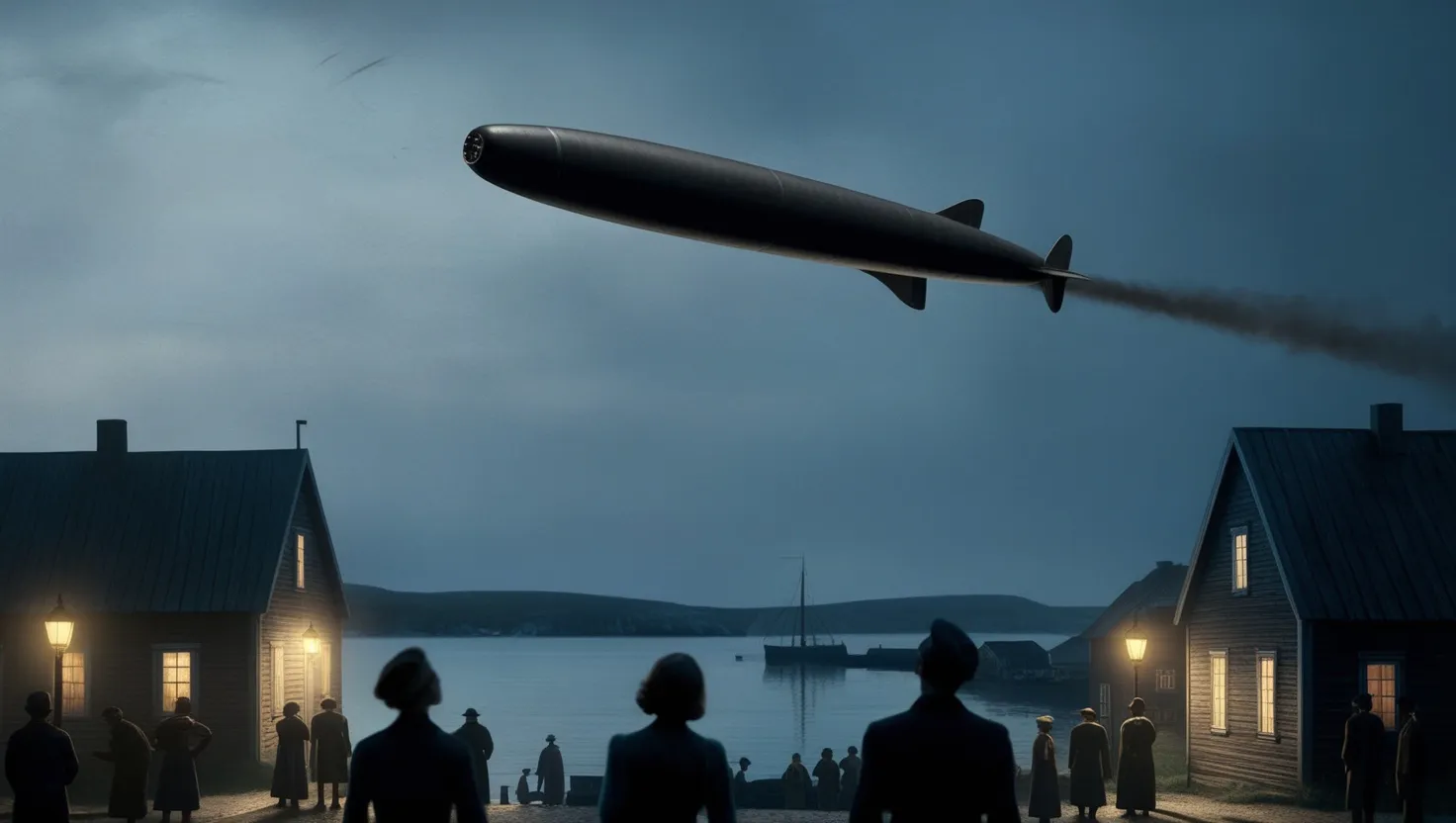
Picture this. It is the summer of 1946. You live in a small Swedish town near the Baltic coast. You step outside one evening and see something impossible. A dark, cigar-shaped object glides silently across the sky, or maybe it roars like a freight train. It has fins. It leaves a trail of smoke. Then it turns, changes direction, and vanishes. You are not alone. Hundreds of others across Sweden, Finland, and Norway see the same thing over the following months. Welcome to the ghost rocket summer, one of the strangest and least talked about mysteries of the early Cold War.
Ask yourself something. Why does almost nobody know about this today? Roswell gets movies, documentaries, and gift shop merchandise. The ghost rockets, which came a full year earlier and had far more physical evidence, barely get a mention. That gap between importance and fame is worth sitting with for a moment.
Let me walk you through what actually happened, because the details matter more than the label “UFO” ever could.
Throughout 1946, Swedish military radar operators tracked unidentified objects moving through their airspace. This was not one drunk farmer looking up at the wrong moment. This was trained personnel, using equipment built for tracking real aircraft, watching blips that moved like nothing they had trained for. Some objects flew straight and fast. Others made turns that no falling space rock could make. Meteors, as beautiful as they are, do not bank left.
The Swedish government took this seriously enough to launch a formal investigation. They collected physical debris from crash sites. They interviewed hundreds of witnesses. They used acoustic triangulation, a method of figuring out where a sound came from by comparing when it reached different listening posts, to map the paths of these objects. None of this is the behavior of a government that thinks its citizens are imagining things.
Here is a quote worth sitting with, from physicist and UFO researcher James E. McDonald: “The scientific community’s disinterest in this subject is not scientific.” Whether or not you buy into every UFO claim ever made, that line applies perfectly to the ghost rockets. This was not sloppy folklore. This was radar data and metal fragments.
So what was the official story? Meteors. Sweden was, at the time, experiencing a known meteor shower, and authorities leaned on that explanation hard. It is a tidy answer. It requires no diplomatic tension, no admission of a secret weapons program, and no uncomfortable questions about air defense failures. The problem is that meteors do not fly horizontally for extended periods. They do not slow down, speed up, or turn. They do not show up on radar as objects under apparent control. Yet the meteor explanation stuck around in public messaging, even as internal military reports told a messier story.
What is the more grounded explanation, if not little green men? Soviet rocket testing. In 1946, the Soviet Union had gotten its hands on captured German V-2 rocket technology after the fall of Berlin. Rocket scientists, blueprints, and hardware had been seized and shipped east. Testing new missile designs over your own territory is risky. Testing them over a neutral country’s skies, where you can deny everything and nobody can prove otherwise, is a different story. Sweden was neutral. Sweden was close. Sweden made a convenient runway in the sky.
Moscow never confirmed or denied anything. That silence speaks volumes if you know how governments behave. A country with nothing to hide usually says so, even briefly. A country testing secret weapons over foreign soil says nothing at all, because saying nothing preserves options. If it was working, keep quiet and keep testing. If it got exposed, deny everything and blame the weather, or the Americans, or hysteria.
Here is where it gets interesting for anyone who loves a good paper trail. British and American intelligence agencies requested copies of Sweden’s ghost rocket files almost immediately. This tells you two things. First, this was not treated as a local curiosity. Second, whatever was in those files mattered enough for two global superpowers to want a look. Many of those files remain classified or have simply gone missing over the decades. Ask a Swedish archivist about complete ghost rocket documentation today and you will mostly get a shrug.
The American response is its own rabbit hole. The U.S. Air Force later pointed to the ghost rocket wave as one of the reasons behind creating Project Sign, which became the first official government study into unidentified flying objects. Think about that sequence. Strange objects appear over Scandinavia. The public gets told it is probably meteors. Behind closed doors, the American military decides this is significant enough to build an entire investigative program around it. That is not the behavior of people who believed the meteor story themselves.
Winston Churchill, writing to his Air Ministry in 1952 about a separate but related UFO matter, asked plainly: “What does all this stuff about flying saucers amount to? What is the truth?” He never got the full picture, at least not one he shared publicly. If the most powerful man in Britain was asking that question with genuine confusion, you can guess how much clarity ordinary citizens ever got.
Why does the cover-up angle matter here? Because there are really only two options, and both are uncomfortable. Option one, the ghost rockets were Soviet missile tests. In that case, the cover-up protected military intelligence and avoided public panic about foreign weapons flying overhead undetected and unstoppable. Option two, the objects were something genuinely unexplained, not necessarily alien, but outside known technology of the era. In that case, the cover-up protected against something scarier than a foreign rival. It protected against admitting nobody understood what was happening in their own sky.
Either way, ordinary people were kept out of the loop. They saw something real. They reported it honestly. And then they were handed an explanation that quietly ignored half the evidence.
Does this sound familiar? It should, because the ghost rockets set the template for practically every UFO story that came after. A strange object appears. Multiple witnesses report it. Officials investigate, at least on paper. A vague or incomplete explanation gets issued to the public. Files vanish or stay sealed. The event fades into a mix of local folklore and internet forum trivia. Roswell followed this exact pattern one year later, and it got all the fame instead.
What makes the ghost rockets different, and honestly more interesting, is the sheer amount of hard data attached to them. Roswell has a debris field and decades of conflicting stories. The ghost rockets have radar tracking logs, acoustic triangulation data, physical fragments sent to laboratories, and multinational witness accounts spanning three countries and hundreds of individual sightings over months. This was not one event. It was a sustained wave, tracked by professionals, using real instruments, over an extended period.
Carl Sagan once said, “Extraordinary claims require extraordinary evidence.” Fair enough. But flip that statement around for a second. What do you call it when extraordinary evidence exists, and yet nobody wants to make the claim? The ghost rockets sit in that odd space. The evidence was collected. The radar returns were real. The debris was analyzed. Nobody needed to invoke aliens to find the whole situation unsettling. All it took was unidentified machines flying over sovereign airspace and a government response built on selective silence.
So where does that leave us? With more questions than answers, which honestly feels appropriate. Something flew over Scandinavia in 1946. Radar confirms it. Hundreds of witnesses confirm it. Physical debris confirms it. What remains unresolved is who built it, who sent it, and why decades of records connected to it are incomplete or locked away.
Maybe the real mystery is not the objects themselves. Maybe it is why an event this well documented, this widely witnessed, and this diplomatically significant got quietly filed away while flashier, less substantiated stories captured the public imagination instead. If you had to guess, would you bet on early Soviet missile tests, or something nobody has properly explained yet? Either answer should make you a little uneasy about how much of this story we are still missing.