Ice Valley's Unknown Woman: Inside Norway's Unsolved Cold War Spy Mystery That Still Baffles Investigators
Norway's Isdalen Woman: a 1970 Cold War mystery of coded identities and buried secrets. Uncover the unsolved case still baffling investigators today.
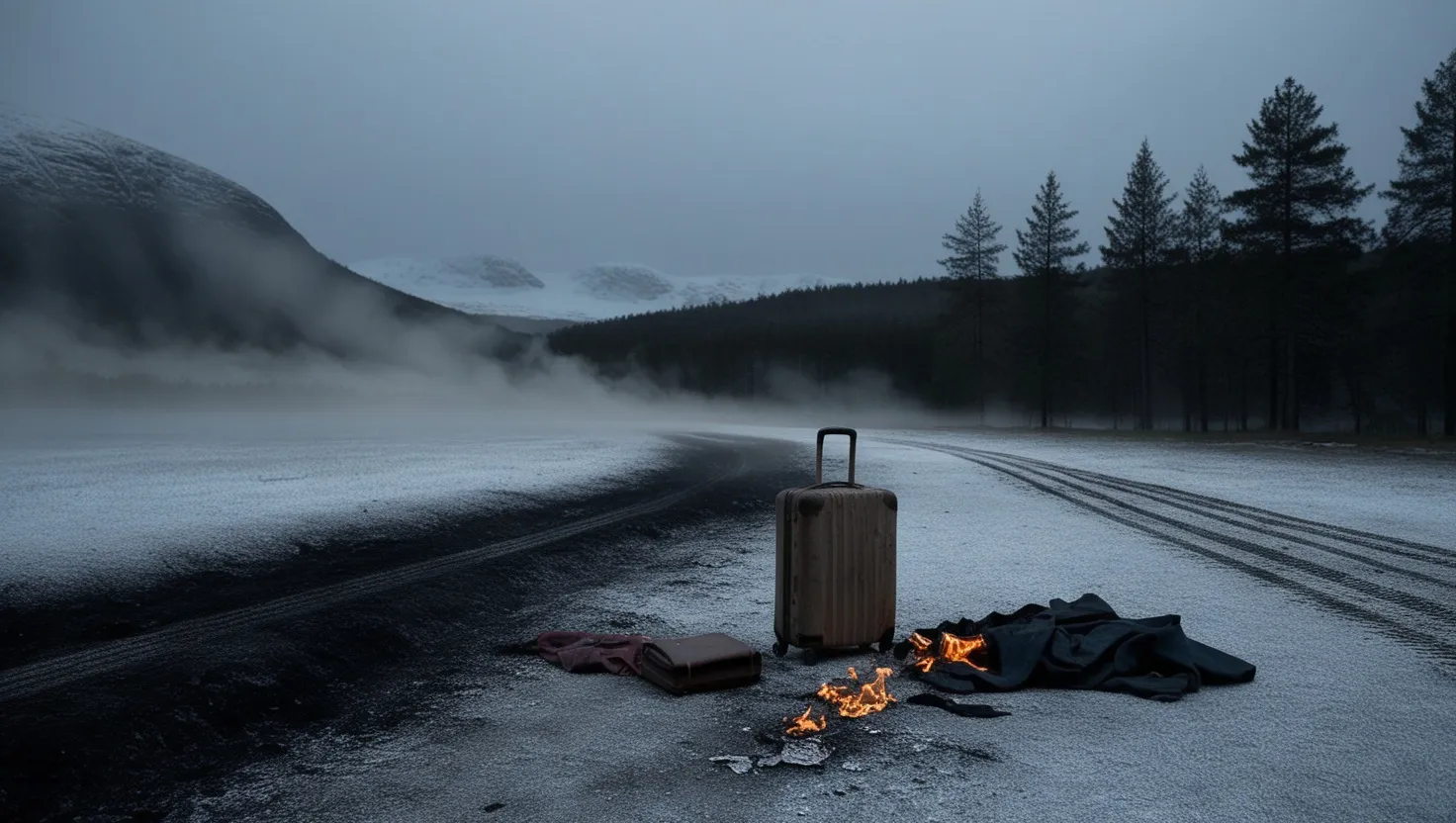
Let me take you to a cold Norwegian valley in November 1970, where a hiker stumbled upon something that would confuse investigators for over fifty years. A woman’s body, burned almost beyond recognition, lay in Isdalen, a place whose name literally translates to “Ice Valley.” She had no face left to identify. Her fingerprints were gone. And yet, everything around her screamed that this was no ordinary death.
Here’s the first strange detail. The labels on her clothes had been cut out. Every single one. Who does that before they die? You don’t accidentally lose your clothing tags. Someone removed them on purpose, and that someone wanted to make sure this woman could never be traced back to a store, a country, or a name.
Investigators found sunglasses melted onto her face, which tells you the fire was intense enough to fuse plastic to skin. Nearby, they discovered bottles that once held gasoline. This wasn’t a simple accident or a wandering tourist who lit a campfire that went wrong. This looked planned, deliberate, and disturbingly clean.
As the historian Barbara Tuchman once wrote, “Books are the carriers of civilization.” I’d argue that mysteries like this one are the carriers of our darkest questions about power and secrecy.
When police searched a train station locker in Bergen, they found her luggage. Inside were multiple wigs, a strange assortment of clothing from different countries, and cosmetics designed to alter her appearance. She also carried a notebook filled with coded entries. Numbers, letters, and symbols that made no sense to ordinary readers.
Do you know what’s genuinely bizarre? Some of those codes were later linked to hotel stays and travel dates across Europe. This woman had been moving constantly, using different names in different cities. Investigators eventually counted at least eight aliases she had used within a short span of time. Belgian, French, Italian, and British identities all belonged to the same woman.
Isotope analysis of her teeth, conducted decades later with modern technology, revealed she had grown up somewhere in Central Europe, possibly near the German-French border region. This wasn’t a woman with one home. Her body carried the chemical signature of someone who had lived in multiple places, eaten different diets, and traveled far more than an average person of her era.
I want you to picture Norway in 1970. This is the height of the Cold War. Spies moved through Scandinavian countries like shadows, using the region’s neutral reputation as cover. Oslo, Bergen, and Stockholm were meeting points for intelligence operatives from both sides of the Iron Curtain. Was this woman one of them?
John le Carré, who spent years working in intelligence before writing spy novels, once said, “A desk is a dangerous place from which to view the world.” Perhaps for this woman, no desk existed at all. Only trains, hotels, and borders.
Witnesses came forward describing a woman who matched her description, often seen in the company of well-dressed men. These weren’t casual acquaintances. Hotel staff remembered her paying in cash, always avoiding questions, always slightly evasive when asked for identification. One witness recalled her requesting a room away from other guests, insisting on privacy that seemed excessive for an ordinary traveler.
Here’s a question worth sitting with. Why would Norway, a country not typically associated with dramatic government cover-ups, seal an entire case file for decades? What information could possibly be so sensitive that a dead woman’s identity needed to remain hidden from the public for that long?
Some researchers believe she worked for Mossad, Israel’s intelligence agency, possibly involved in operations tracking former Nazi officials who had fled to Scandinavia after the war. Others suggest she may have been connected to NATO intelligence networks, given the strategic importance of Norway’s coastline during Cold War naval operations. Still others propose she was simply a smuggler or con artist who had made powerful enemies.
Le Carré also wrote, “A secret shared is a secret no more.” Norway seemed determined to prove him wrong.
The autopsy revealed she had taken sedatives before death, and traces suggested possible poisoning alongside the burns. This complicates the entire narrative. Was this suicide, murder, or an execution designed to look like an accident? Each theory has supporters, and each theory conveniently ignores certain facts that don’t fit.
Let me point out something most articles about this case skip entirely. The location where she died wasn’t randomly chosen. Isdalen sits near a route that intelligence operatives were known to use when moving between Bergen’s harbor and inland transportation networks. Locals had reported strange lights and vehicle activity in that valley on previous occasions, though these reports were dismissed at the time as nothing unusual.
Have you ever wondered how someone could live an entire life without anyone truly knowing her name? This woman managed to construct identities so convincing that even skilled document forgers of that era would have needed serious resources and connections. Creating one false passport was difficult enough in 1970. She had several, each crafted well enough to pass through European borders without raising alarms.
As spy novelist Ian Fleming observed, “History is moving pretty quickly these days, and rules that make sense in one decade seem foolish in the next.” This woman existed entirely outside conventional rules, moving faster than the systems built to track her.
Recent forensic work using facial reconstruction technology gave researchers an image of what she might have looked like in life. This image was shared publicly, hoping someone somewhere would recognize her from old photographs, family records, or personal memories. Despite international attention, no confirmed family member has ever come forward.
This absence itself tells a story. Somewhere, someone should remember a woman who vanished from her regular life sometime before 1970. Parents notice missing daughters. Siblings notice missing sisters. Yet nobody claimed her, which suggests either her real family believed she was already dead through some other cover story, or her connections to intelligence work meant her disappearance was expected and even planned by those who controlled her missions.
Let’s talk about the coded notebook more carefully, because this detail deserves more attention than it usually gets. Cryptographers who studied the pages found patterns consistent with simple substitution ciphers, the kind used by amateur agents rather than professionally trained operatives from major intelligence agencies. This raises an interesting possibility. What if she wasn’t a highly trained spy, but rather someone recruited informally, perhaps blackmailed or coerced into carrying information across borders?
George Orwell wrote, “Who controls the past controls the future. Who controls the present controls the past.” Norway controlled her past by sealing it away, and in doing so, controlled how future generations would understand Cold War secrecy itself.
I find it fascinating that despite fifty years of investigation, journalists, documentary makers, and amateur researchers have added more confusion than clarity to this case. Every new theory contradicts the last. Every piece of evidence that seems conclusive gets challenged by another expert with an equally reasonable counter-explanation.
What strikes me most is how ordinary the beginning of her story might have been. She was likely just a young woman once, with a name, a family, perhaps dreams that had nothing to do with espionage or coded messages. Something changed that trajectory, pulling her into a world where identity became fluid and dangerous.
Ask yourself this. If someone can erase their name so thoroughly that even death cannot restore it, what does that tell us about the systems built to protect national secrets? Governments claim these secrets protect citizens, yet cases like this suggest they often protect institutions from embarrassment rather than protecting anyone from genuine harm.
Norway finally exhumed her remains in 2016, hoping DNA testing might reveal answers that older technology couldn’t provide. Results confirmed she likely had Southern European or possibly Jewish ancestry, adding weight to theories connecting her to intelligence operations tracking war criminals. Yet even this breakthrough failed to produce a confirmed name.
As Winston Churchill once remarked, “It is a riddle wrapped in a mystery inside an enigma.” He was speaking about Russia, but he might as well have been describing this woman’s entire existence.
I think the real conspiracy isn’t about who killed her or why. The real conspiracy is about the deliberate choice to keep her nameless. Someone, somewhere, decided that this woman’s true identity was more dangerous alive in public memory than her death remaining unsolved. That decision speaks volumes about how governments handle uncomfortable truths, choosing silence over accountability.
Her grave in Bergen simply reads “Unknown Woman.” No name, no dates of birth, nothing to indicate the complicated life she must have lived before ending up burned in a remote valley. Visitors still leave flowers occasionally, strangers paying respect to someone whose story remains frustratingly incomplete.
Would you want to know the truth if you were in her position, forced to abandon every trace of who you once were? Or is there something almost merciful about disappearing so completely that no government file, no historian, no researcher can ever fully claim to understand you?
Her ashes rest in Norway, but her real story rests wherever intelligence agencies keep their oldest, most carefully guarded secrets.