Six Underwater Ruins That Challenge Human History: Sunken Cities, Ancient Mysteries, and Unexplained Ocean Anomalies
Explore six mysterious underwater ruins that challenge human history, from Yonaguni to Cuba's sunken pyramids. Could our past be hidden beneath the waves?
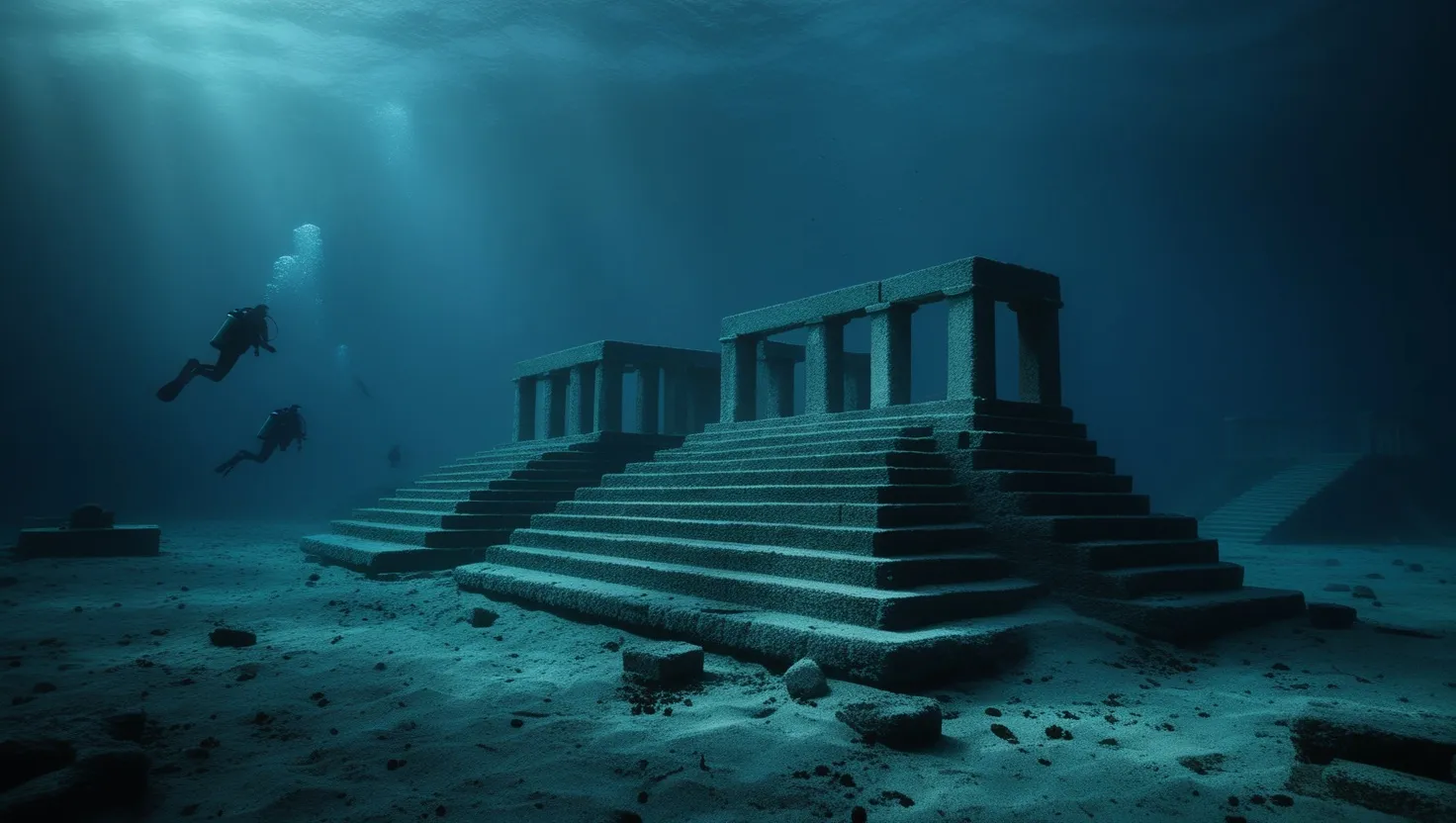
Let me take you somewhere strange. Somewhere the sun barely reaches, where the water sits heavy and cold, and where things exist that should not exist. I want to show you six places under the sea that make scientists uncomfortable and make the rest of us ask a very simple question: what if we have the story of human history wrong?
Before we start, sit with this thought from Arthur C. Clarke: “How inappropriate to call this planet Earth when it is quite clearly Ocean.” We forget that. We live on land, we write our history on land, but most of this planet is water, and water hides things very well.
Let’s begin with the most famous one.
Yonaguni is a monument, or maybe it’s just a rock
Off the coast of Japan, near a tiny island called Yonaguni, divers found something odd in 1986. Sitting under the water is a giant structure made of stone. It has straight edges. It has what look like steps. It has flat terraces that look like they were built for a purpose.
Geologists looked at it and said, calm down, this is natural. Sandstone breaks this way. It cracks along straight lines because of how the layers formed. This is called joint fracturing, and it does create shapes that fool our eyes.
But here’s what bugs me. Some of the site’s supporters, including a marine geologist named Masaaki Kimura who has studied it for decades, insist the site includes carved steps, drainage channels, and even what looks like a pathway carved by hand, not by nature. He believes it may be part of a sunken city over ten thousand years old.
Ten thousand years old would mean this was built before the last Ice Age fully ended, before we think complex societies existed. Does that sound impossible to you? It sounds impossible to most historians too, which is exactly why nobody wants to say it out loud.
Would you believe a rock formation over a lost civilization? I would want proof either way, and right now, nobody has enough of it.
Bimini Road looks too straight to be an accident
Near North Bimini in the Bahamas, divers found a long line of rectangular limestone blocks sitting in shallow water, arranged almost like a road or a wall. People call it the Bimini Road.
Geologists say this is beachrock, a natural formation where sand hardens and cracks in straight blocks over time. That is a real process. It happens in many places.
But something about the neatness bothers people who study it closely. The blocks are oddly consistent in size. They sit in a straight line for a long stretch. Some researchers have pointed out that the joints between blocks look too regular for random cracking.
Edgar Cayce, a psychic from the early 1900s, predicted decades before this was found that ruins from Atlantis would appear near Bimini around 1968 or 1969. The road was discovered in 1968.
Coincidence? Maybe. But that timing gives people chills, and it’s part of why Bimini Road never fully leaves the news.
A strange circle sits at the bottom of the Baltic Sea
In 2011, a Swedish diving team scanning the seabed with sonar found something enormous and completely round sitting on the ocean floor between Sweden and Finland. It looked almost like a giant disc, about 60 meters wide, with straight lines and sharp angles built into its surface.
People online called it a sunken UFO. Real scientists were more careful, but even they admitted the shape was strange. Some geologists suggested it could be a glacial deposit, something left behind when ice sheets moved across the region thousands of years ago.
But here’s the detail that keeps this story alive: the divers reported that their equipment stopped working properly when they got close to it. Cameras glitched. Communication devices failed. Was that a coincidence, faulty gear, or something about the object itself?
Nobody has fully explained it. The area is called the Baltic Sea Anomaly now, and it still sits down there, unexplained, waiting.
Carl Sagan once said, “Somewhere, something incredible is waiting to be known.” I think about that line every time I read about the Baltic circle.
Cuba’s underwater ruins sit deeper than they should
In 2001, a team exploring the ocean floor off the western coast of Cuba used sonar and underwater robots to survey the seabed. What they found was startling: symmetrical shapes resembling pyramids, and structures resembling roads, sitting nearly 2,000 feet below the surface.
Here is the part that makes this different from Bimini or Yonaguni. Land does not just sink 2,000 feet in a few thousand years. If these are man-made ruins, they would have to be extremely old, possibly 50,000 years old or more, sunk by shifts in the earth’s crust over a very long stretch of time.
That number breaks almost everything we teach in schools about when human civilization began building complex structures. Most experts believe organized building started around 10,000 to 12,000 years ago at the earliest.
So either the depth measurements are wrong, the shapes are natural formations, or something about human history needs a serious rewrite. Which one feels more likely to you?
Underwater cities are not just legend, some are proven real
Not every submerged mystery stays a mystery. Some sunken cities are fully confirmed and studied by archaeologists today. Take Pavlopetri, off the coast of Greece. It is over 3,000 years old and sits in shallow water, with visible streets, building foundations, and even tombs.
Or take Dwarka, off the coast of India, which some archaeologists link to ancient Hindu texts describing a city swallowed by the sea. Divers found stone structures and anchors that suggest old maritime activity, though the exact age is debated.
These confirmed sites matter because they prove something simple: cities really do sink. Coastlines really do change. Sea levels really do rise enough to swallow entire towns. So when someone says a underwater ruin “should not exist,” the ocean has already proven that it can, and it does.
So why does this all matter to you?
Here is my honest opinion. I think humans like clean stories. We like saying civilization started here, spread there, and moved forward in a straight line. But oceans do not care about our timelines. They rise, they fall, they swallow land, and they carry pieces of the past somewhere we cannot easily reach.
Jacques Cousteau, the famous ocean explorer, once said, “The sea, once it casts its spell, holds one in its net of wonder forever.” I think that spell is exactly why these ruins matter so much to us. They are proof that the ocean keeps secrets better than any vault or archive ever could.
Ask yourself this: how much of human history is sitting under water right now, waiting for someone with the right equipment, or the right courage, to find it?
We have only mapped a small percentage of the ocean floor in real detail. Space gets more attention, more funding, more excitement. But our own planet’s floor remains mostly a blank space on the map.
Maybe Yonaguni is just rock. Maybe Bimini is just beach stone. Maybe the Baltic circle is just a boring glacial leftover. But maybe, just maybe, one of these places is the answer to a question we have not even learned to ask yet.
I don’t know about you, but that thought keeps me up at night, staring at pictures of stone steps under fifty feet of blue water, wondering who walked on them first, and why the sea decided to take them back.