Lake Vostok's Hidden Secret: What Russia Found 4km Under Antarctic Ice
Beneath 4km of Antarctic ice lies Lake Vostok — and the unexplained magnetic anomalies, classified data, and eerie heartbeat signals may hint at something extraordinary. Read the full story.
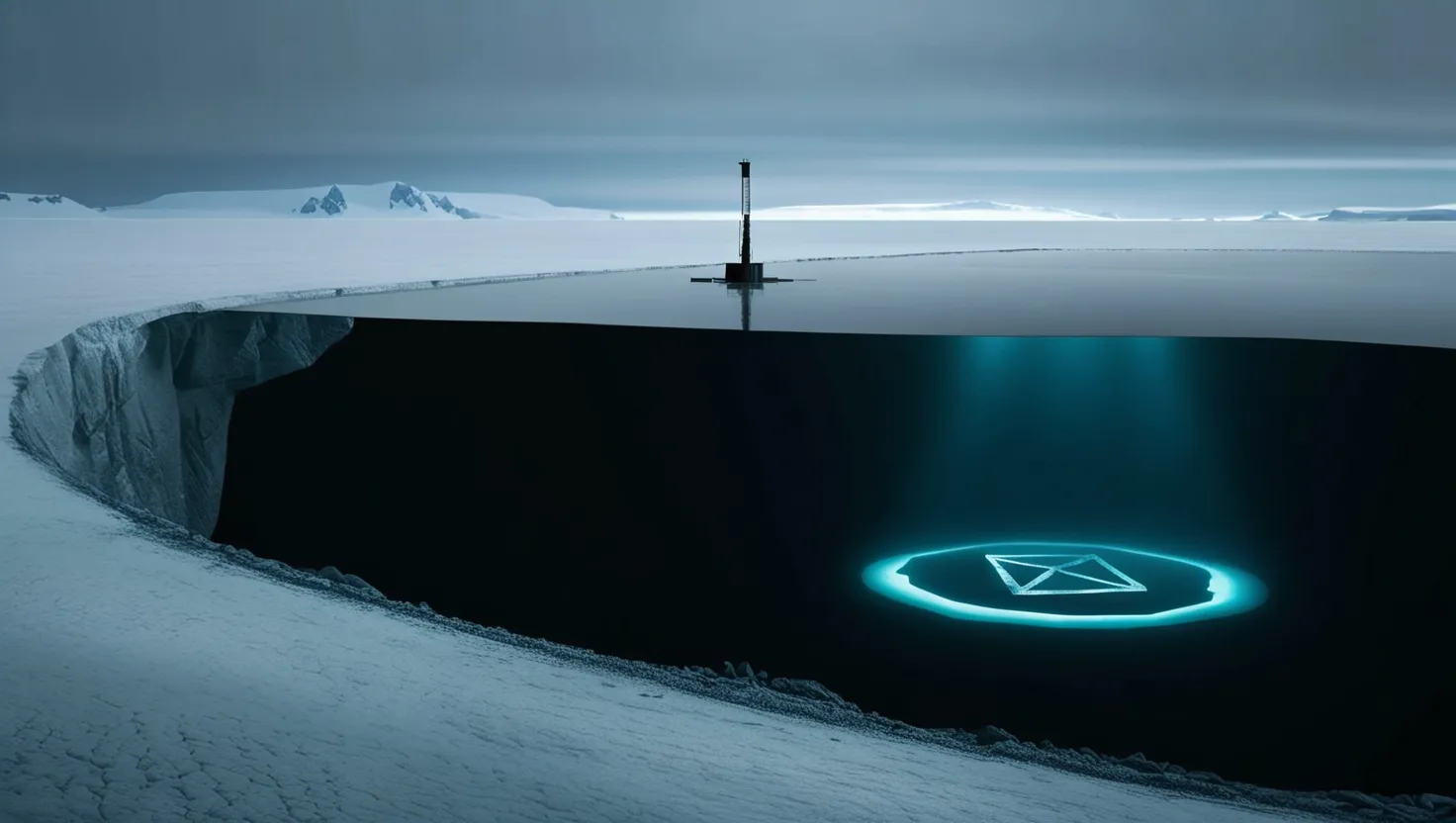
Four kilometers straight down, underneath ice that has been building up for millions of years, there is a lake. Not a small puddle — a body of water the size of Lake Ontario. Completely dark. Cut off from sunlight, from air, from everything we associate with normal life. This is Lake Vostok, and it sits beneath one of the most remote places on Earth: Antarctica.
Russian scientists spent over two decades drilling through that ice. Think about that for a second. Twenty years of drilling, in temperatures that regularly hit minus 80 degrees Celsius, to reach a lake that nobody alive has ever seen. When they finally broke through in February 2012, the world expected headlines about ancient microbes and primordial life. What came back instead was a series of questions that have never been properly answered.
So let me walk you through what we actually know, what was reported, and why the silence around this story is almost as strange as the story itself.
The first strange thing happened when instruments were lowered into the borehole. Sound-recording equipment captured a low-frequency hum from inside the lake. It was rhythmic. Regular. It did not match anything the scientists had heard from geological activity. No thermal vent, no ice shift, no water current produces a consistent, almost pulse-like sound. The Russian team nicknamed it the “heartbeat” of the lake. Their official explanation was vague — water movement, perhaps. Or shifting ice. The audio files were never released in full to the international scientific community.
Now, maybe you’re thinking: sounds are weird underground, who cares? Fair enough. But then add the second finding.
Magnetic surveys flown above the lake revealed a large circular anomaly at the southern end. A circular magnetic signature. Not a smear, not an irregular blob — a circle. The signal was consistent with a large metallic object buried beneath the lake floor. Ice-penetrating radar then picked up something else: a geometric formation beneath the sediment, with sharp angular lines that didn’t match any natural rock formation.
“The most beautiful thing we can experience is the mysterious. It is the source of all true art and science.” — Albert Einstein
Rock doesn’t form right angles. Rock doesn’t make circles. These are shapes we associate with things that were designed.
Here’s where the story gets genuinely interesting from a geological standpoint, because the easy explanation was tried first. Some scientists suggested the anomaly was a massive iron meteorite buried in the bedrock. Iron meteorites do create magnetic signatures. That makes sense on paper.
The problem is scale. For a meteorite to generate the kind of magnetic field that was measured, it would need to be roughly the size of a large skyscraper. A rock that size hitting Earth doesn’t just land quietly — it causes a catastrophic, planet-altering impact. It leaves a crater you can see from space. There is no such crater near Lake Vostok.
So the meteorite theory quietly collapsed. What replaced it officially? Nothing. The data was classified by Russian authorities as “sensitive.” That is a word governments use for military secrets, not lake water.
Ask yourself this: when was the last time a lake was classified?
The Antarctic Treaty of 1959 is worth understanding here. It designates the continent for peaceful, scientific purposes. Most people know that much. What fewer people know is that it contains a clause permitting certain military-adjacent activities as long as they are framed under scientific investigation. That’s a loophole wide enough to park a secret program inside.
Multiple nations have research stations near Lake Vostok. The United States, the UK, France, and Russia all operate nearby. Officially, they collaborate. Unofficially, the final phase of the Vostok drilling project excluded Western teams entirely. The last meters before breakthrough were drilled without international observation.
“The truth is rarely pure and never simple.” — Oscar Wilde
The drilling project itself has a timeline that raises questions. It started in the 1990s. It should not have taken twenty years. At specific depths, the drill was pulled back on direct orders from Moscow. Work was paused. Restarted. Paused again. These weren’t weather delays or equipment failures — the stops corresponded to specific depth milestones, as if decisions were being made about what to do before going further.
When the lake was finally breached and water samples were collected, the microbial life everyone had predicted wasn’t there. No ancient bacteria. Nothing. Then, months later, a previously unknown strain of bacteria was reported — but the samples had been contaminated during the drilling process, making the results scientifically useless, or at least unpublishable in any clean form. Some researchers believe the uncontaminated samples were simply never shared.
Think about what Antarctica actually is as a location. There are no independent journalists there. There is no civilian oversight. The research stations are isolated outposts with tightly controlled communications. If you wanted to study something extraordinary without the public ever finding out, Antarctica is possibly the single best place on Earth to do it.
The continent has its own mythology, too. Ancient maps — specifically the Piri Reis map from 1513 — show an Antarctic coastline that shouldn’t have been known to 16th century cartographers, and show it without the ice cap. This gets dismissed quickly in mainstream history, but the dismissal is always quick. Too quick. The map predates confirmed European discovery of Antarctica by over three hundred years.
“History is a set of lies agreed upon.” — Napoleon Bonaparte
Here’s the part I find most telling. After all the anomalies, after the magnetic signatures and the geometric structures and the unexplained hum — no follow-up mission has been funded to return to Lake Vostok with better instruments. No robotic submarine has been sent in. No international team has gone back to do a proper survey of the southern end where the anomaly sits.
Normally, when science finds something strange, it sends more scientists. That’s how science works. You find an anomaly, you investigate it harder, you publish results, you argue about it in journals, and eventually you figure it out. None of that happened here. The anomaly was noted, the data was filed, and the funding dried up.
The world’s space agencies, which regularly propose missions to Europa and Enceladus specifically because they might contain liquid water and ancient life, have shown no public interest in going back to a lake that actually exists, that we’ve already drilled into, and that is already producing unexplained signals. That gap in logic is hard to ignore.
What would it mean if the structure under Lake Vostok is artificial? It would mean something built it before humans existed in anything resembling their current form. It would mean our understanding of intelligent life, of history, of time itself, is fundamentally incomplete. It would be the single most important discovery ever made.
And here is a simple, uncomfortable thought: that might be exactly why we’re not being told about it.
Governments have suppressed smaller discoveries for smaller reasons. The institutional resistance to paradigm-shifting information is well documented. Scientists who challenge foundational assumptions lose funding. Journals reject papers that don’t fit accepted timelines. The machinery for keeping inconvenient knowledge quiet doesn’t require a grand conspiracy — it just requires bureaucracy and the human preference for comfortable certainty over disturbing truth.
“In a time of deceit, telling the truth is a revolutionary act.” — George Orwell
Whether you think the heartbeat of Lake Vostok is a strange natural phenomenon in an extreme environment, or something far older and stranger than we’ve been told, the story presents a genuine problem. We don’t have the data. The people who do have it aren’t talking. And nobody is going back to look.
A lake sealed for millions of years. A circular magnetic anomaly with no natural explanation. Classified radar data. A two-decade drilling project with unexplained stops. No follow-up missions. No published resolution.
The question isn’t really whether something extraordinary is buried under the ice. The question is much simpler than that.
If it were already found — would we know?