The story of the Philadelphia Experiment sounds like something out of a cheap sci‑fi movie: a warship that disappears, teleports, and then comes back with sailors stuck inside the metal. But why has this story stayed alive for so long, when almost every fact around it falls apart under simple checking?
Let me walk you through it step by step, in plain language, as if we are sitting together and you keep asking, “Wait, but does that make sense?” Because that is exactly the right question to ask here.
“Extraordinary claims require extraordinary evidence.”
— Carl Sagan
First, what was really happening in 1943?
The U.S. Navy was fighting German submarines. One real threat in the water was magnetic mines. These mines exploded when they sensed the magnetic field of a ship passing above them. A steel ship is like a huge magnet to these mines.
So engineers came up with a practical trick called degaussing. It sounds fancy, but the idea is simple. You run electrical cables around the hull, send current through them, and partially cancel the ship’s magnetic field. To an underwater mine, the ship looks “less magnetic,” so it is less likely to explode under it.
Now imagine you are a sailor or a civilian who does not understand any of this. You see big cables wrapped around a ship. You hear about electricity. You hear rumors of new “secret” devices to protect ships. You see sparks or strange lights in certain weather, maybe St. Elmo’s fire glowing on the ship’s structures during a storm. Would it be hard to believe that some people thought, “They are trying to make the whole ship invisible”?
So the seed of the story came from something completely real, but boring: protection from magnetic mines. It did involve electromagnetism. It did look strange. It was secret enough not to be explained to everyone.
But the crazy part of the story did not show up in 1943 at all. It appeared almost ten years later.
In the mid‑1950s, a man named Carl Allen, who also called himself Carlos Allende, sent letters to a writer named Morris Jessup. Jessup had written about UFOs, so he already attracted people who liked wild ideas. Allen claimed he had been a merchant seaman during the war and had personally seen a U.S. Navy ship disappear and reappear.
Think about that delay for a moment.
If a whole ship had really vanished in a busy wartime harbor, with multiple ships nearby, dock workers, officers, and foreign crews around, do you think the first detailed story would appear ten years later from one man, in private letters, after the war was long over?
That should already bother you.
“Where all think alike, no one thinks very much.”
— Walter Lippmann
Allen’s letters were not calm reports. They were messy, dramatic, and full of big scientific words used in strange ways. He talked about “Unified Field Theory,” claimed Einstein had secret work never published, and said a scientist named Franklin Reno used it to run the experiment. There is no reliable record of this scientist in that role. It is like a movie script where someone adds a mysterious expert to make the story sound smarter.
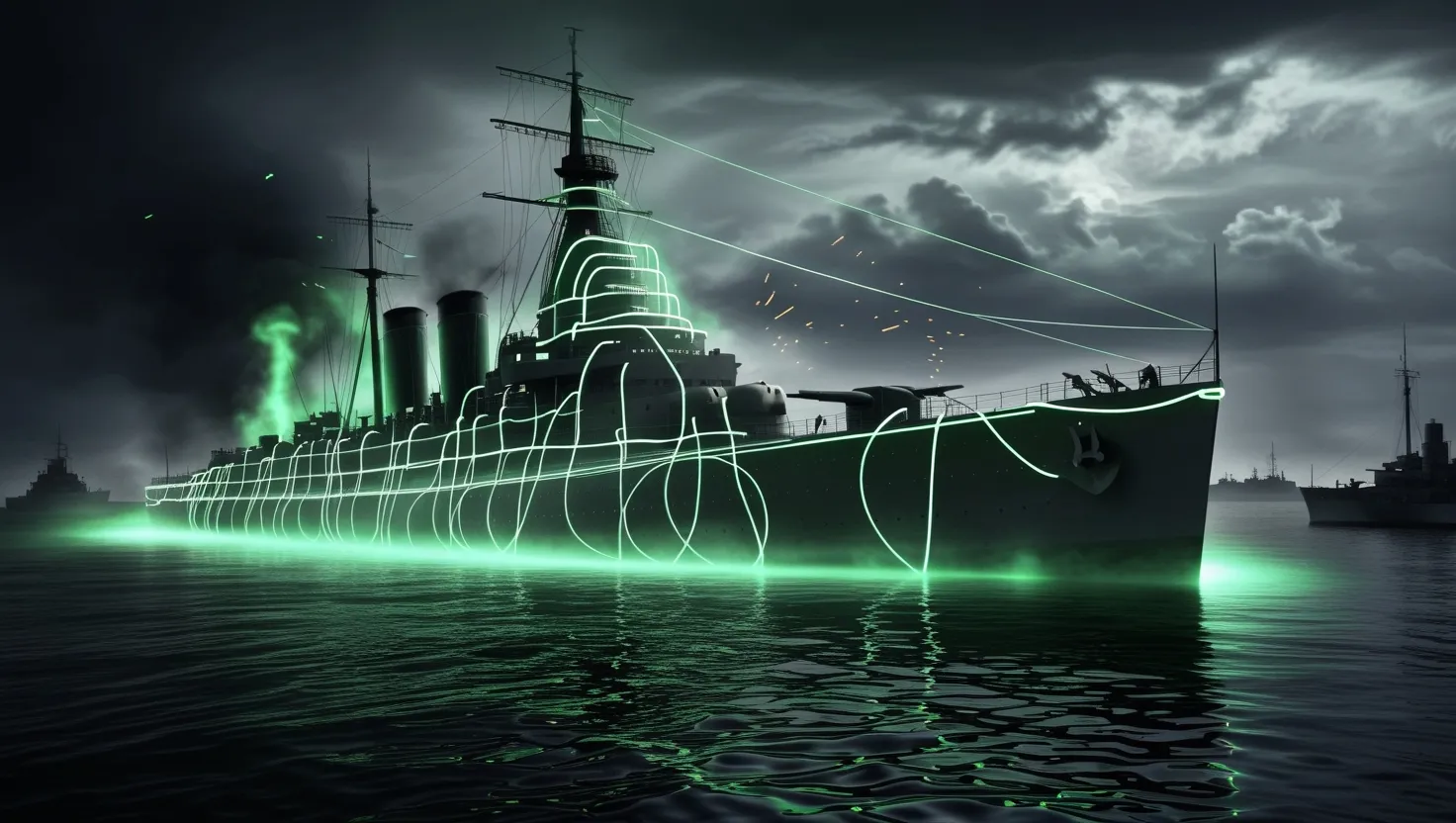
The ship in the legend is the USS Eldridge. According to the story, it was fitted with huge generators in Philadelphia to create a powerful electromagnetic field. When turned on, a greenish fog surrounded the ship, then the ship disappeared from sight. Some versions say it was still faintly visible. Others say it vanished completely and showed up hundreds of kilometers away in Norfolk, Virginia, before snapping back.
Now pause and ask yourself a simple question: if military radar systems in the 1940s were not even that precise or powerful compared to today, would the Navy really jump all the way to “let’s bend light and teleport a ship?” That is like going from learning to ride a bicycle straight to flying a jet without any steps in between.
After this supposed test, the story gets darker. Sailors are said to have been embedded in the ship’s metal, arms or torsos sticking out of bulkheads. Others allegedly went insane or became “unstuck” in time, fading in and out of reality. Sometimes the story adds brainwashing sessions to erase memories.
This part of the tale feels very emotional. It has horror, tragedy, and a sense that humans “went too far” with science and paid a price. This perfect mixture makes the story memorable and easy to repeat.
But strong emotions do not equal strong evidence.
So what evidence do we actually have?
We have:
A small number of letters from one man whose claims changed over time.
A few people repeating parts of his story, many years after the war.
A ship that really existed, but whose official logs show it was somewhere else at the time of the supposed teleportation.
We do not have:
Original wartime logs or diaries from crew members describing these events.
Photographs, technical documents, or orders mentioning invisibility experiments.
Consistent testimonies from multiple independent witnesses written close to the time of the war.
If you and I were building a case in court, this would be incredibly weak. You would probably say, “Is that all?”
“The greatest enemy of knowledge is not ignorance, it is the illusion of knowledge.”
— Stephen Hawking
So why do people still talk about the Philadelphia Experiment?
One reason is timing. The story grew during the early Cold War. People had seen the atomic bomb. They knew governments could build secret projects that changed the world and were kept hidden for years. So the idea that the Navy might have run some extremely dangerous experiment did not feel impossible anymore.
There was also a general fear of invisible dangers. Radiation, fallout, and new types of energy were in the news, but most people did not understand them. A story about a ship surrounded by invisible fields that scrambled bodies and minds fit perfectly with those fears.
In this way, the legend acts like a mirror of our fears about science. It says, “If you push technology too far, reality itself might break and people might suffer in terrible ways.”
You can see similar patterns in other stories from that era: UFO crash sites, secret mind‑control experiments, hidden bases. All of them express the same worry: “What are they doing behind closed doors, and what are they not telling us?”
Do you notice something subtle? The details change from one legend to another, but the structure stays the same:
Secret project.
Extraordinary claim.
Small number of sensational witnesses.
Official denial, which believers treat as proof of a cover‑up.
No solid physical evidence that survives careful checking.
Now let us talk a bit about the science, but in simple terms.
Could a strong electromagnetic field make a ship invisible to radar? Possibly, in limited ways similar to jamming or scattering signals, but that would be more like making the radar “confused,” not making the ship vanish like in a magic trick.
Could you bend light around a ship in 1943 using electromagnetism? Not with the tools or theories they had then. Even today, when scientists talk about “cloaking” in labs, they are working with tiny objects and very specific frequencies, often using complex materials. And it still does not look like a Hollywood invisibility shield.
Now, what about teleportation? That would require changing spacetime itself or moving an enormous object instantly without passing through the space in between. The energy needed, based on what we know today, would be beyond anything a destroyer escort could hold. You would not just see a little fog. You would see destruction on a ridiculous scale.
So from a science point of view, the claims are not just unlikely. They clash with basic physics in a way that would require rewriting huge parts of our understanding. When big claims like this are made, we look for big evidence. Here, there is none.
“It is wrong always, everywhere, and for anyone, to believe anything upon insufficient evidence.”
— William K. Clifford
There is another curious angle some writers raise: maybe the story itself was used as a distraction.
Imagine, for a moment, that the Navy and its allies were working on real but less dramatic secret projects in radar, sonar, and electronic warfare. Some of those things did happen. Now imagine that rumors about strange equipment and glowing effects started to leak out from shipyards.
How could you make those rumors harmless? One way would be to drown them under a much crazier story. If someone reports “odd electromagnetic experiments,” and the public only knows the “teleporting ship horror story,” then serious complaints start to sound like science fiction ranting.
Is there solid proof that intelligence agencies planted or boosted the Philadelphia Experiment myth on purpose? No, not in a clear way. But does the legend serve as a convenient smokescreen, mixing real secret work with absurd claims so everything can be mocked together? It certainly functions that way.
Do you see the trap here? If an official denies the event, believers say, “Of course, they would deny it.” If records show the ship was elsewhere, believers say, “The logs are fake.” If scientists explain why the physics does not work, believers say, “This is based on secret theories you don’t know about.” The claim is built so that no amount of ordinary evidence can ever touch it.
At that point, we are not in the world of history or science anymore. We are in the world of myth.
And myth is powerful.
The Philadelphia Experiment survives today not because it is supported by strong facts, but because it satisfies deep emotional needs. It gives people:
A dramatic story where hidden knowledge exists and only a few “insiders” see the truth.
A way to express distrust of governments without needing detailed proof.
A chilling warning about what might happen when scientists “go too far.”
In that sense, it is less a story about a ship and more a story about us.
It shows how easily we can mix a real technology (degaussing and radar research), a mysterious atmosphere (war, secrecy, new physics), and a dramatic imagination into something that feels real even when it is not.
It also shows how a single persistent person with a colorful story can change public memory. Without Carl Allen’s letters, there is no Philadelphia Experiment legend as we know it. Just think about that: one person, writing to one author, at the right time, helped start a tale that people still repeat 80 years later.
So where do I land on the central question: electromagnetic cloaking or mass hysteria?
If we mean “cloaking” in the sense of real radar reduction and magnetic protection, then yes, the war did see serious electromagnetic work on ships, and the USS Eldridge almost certainly had degaussing equipment like many other vessels.
If we mean “cloaking” in the dramatic sense of making a ship vanish from sight, teleport across states, and merge human bodies with steel, then no, there is no reliable evidence for that at all. The story fits myth, rumor, and later embellishment much better than it fits physics or wartime documentation.
Mass hysteria may not be the perfect phrase, because the legend did not start with crowds seeing something at once. It started with delayed, second‑hand stories and then grew socially. But there is a kind of shared fascination and shared anxiety here that behaves like a psychological wave. People want the story to be true because it is exciting, frightening, and gives them a sense of being “in” on something secret.
“Men willingly believe what they wish.”
— Julius Caesar
So the Philadelphia Experiment stands today as a modern ghost story wrapped around real war technology. It tells us less about what ships were doing in a harbor in 1943, and more about what people fear and imagine when science gets complicated and governments get quiet.
If you take away everything that cannot be supported, you are left with this very human picture:
A real war with real secret work.
A complex technology most people did not fully understand.
A few dramatic personalities spinning tales.
A public eager for mysteries about power, physics, and hidden experiments.
Let me leave you with a simple question to think about:
When you hear a story that is both very strange and very satisfying, do you feel a small rush of pleasure? And if you do, does that make you lower your guard before asking, “But how do we actually know this happened?”
The Philadelphia Experiment survives because most people never seriously ask that second question.