The Hessdalen Lights: Norway's Unexplained Sky Phenomenon Scientists Still Can't Fully Solve
Explore the mystery of Norway's Hessdalen Lights — decades of unexplained glowing orbs studied by scientists. Natural phenomenon or Cold War secret? Read the full story.
There is a valley in Norway where the sky does strange things. Not occasionally. Not once in a while on a foggy night when someone has had too much to drink. Regularly. Predictably. For decades.
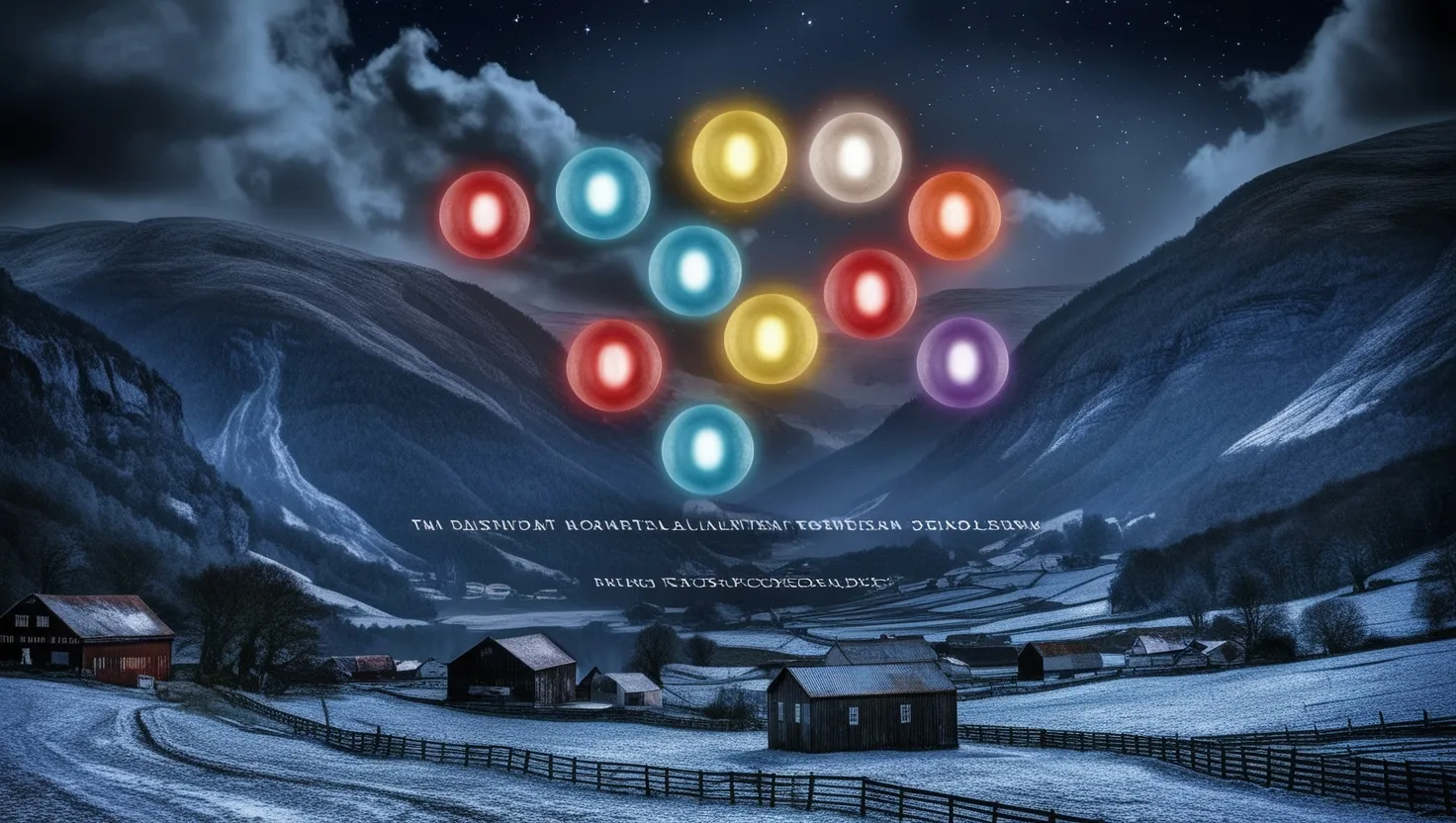
The village is called Hessdalen, and it sits in central Norway like a forgotten postcard — a few hundred people, some farmland, and mountains that press in from both sides. Starting in the early 1980s, the people who lived there began reporting something unusual. Lights in the sky. Not the northern lights, which Norwegians know well. These were different. Orbs. Floating, hovering, pulsing things that came in white, yellow, red, and blue. They would hang in the air for hours, then suddenly accelerate faster than any known aircraft. Sometimes they split into multiple objects. Sometimes they blinked in patterns. And they kept coming back.
By 1984, people were seeing them multiple times a night.
So here is the first question worth sitting with: if something strange happens once, it is an anomaly. If it happens every night for years, what exactly is it?
Scientists showed up in 1984. The University of Oslo and the Norwegian Institute for Air Research launched something called Project Hessdalen, which was a serious, equipment-heavy investigation. They brought cameras, radar, spectrometers, and magnetometers. They set up systems and watched the valley for extended periods. What they found was genuinely puzzling. Some of the lights turned out to be aircraft or astronomical objects seen through unusual atmospheric conditions. That part was explainable. But a significant portion of the sightings left the scientists without a clear answer. Some lights showed up visually but returned nothing on radar. Others appeared on radar with no visible counterpart. And the most persistent detail — the lights most often appeared near a specific ridge, at roughly the same elevation, as if something in the ground itself was producing them.
“The most beautiful thing we can experience is the mysterious. It is the source of all true art and science.” — Albert Einstein
The scientific community eventually converged on a theory that is genuinely interesting, even if it does not fully satisfy. The idea is that the Hessdalen valley acts like a natural battery. Beneath the ground is a layer of shale rich in metals. On either side are quartzite ridges. Quartzite, when compressed, generates an electrical charge — a process called the piezoelectric effect. The valley also has an unusually high concentration of radon gas, which ionizes the air. Put compressed quartz electricity together with ionized air and the right atmospheric conditions, and you might get glowing balls of plasma.
It is a plausible explanation. But it has a problem. Plasma balls generated by geology do not accelerate rapidly. They do not hover intelligently. They do not interfere with car electronics, which some witnesses reported. And geologically similar valleys elsewhere in the world do not produce the same phenomenon. If the recipe is just shale, quartzite, and radon, why is Hessdalen the only restaurant serving this dish?
That question is where the military theory walks in through the back door.
Norway during the Cold War was not a sleepy Scandinavian corner. It shared a border with the Soviet Union. It sat above the Norwegian Sea, where Soviet submarines regularly operated. As a NATO ally, Norway was strategically significant in ways that most people never thought about. The fjords, the mountains, the sparse population — all of that made the Norwegian interior a reasonable place to hide things you did not want anyone to see.
One theory proposes that what people in Hessdalen were watching was not geology at all, but the side effect of a Very Low Frequency antenna system buried in the valley. VLF systems are used to communicate with submarines deep underwater — radio waves at extremely low frequencies can penetrate seawater in ways that normal signals cannot. A buried VLF transmitter powerful enough to reach submarines in the Norwegian Sea would produce enormous electromagnetic fields. Under the right atmospheric conditions, those fields could generate exactly what was described — glowing plasma orbs that float, accelerate, and behave in ways that look almost intentional.
“We do not see things as they are. We see them as we are.” — Anaïs Nin
A more dramatic version of the theory suggests directed energy weapons testing. The 1980s were the height of Reagan’s Strategic Defense Initiative — the so-called Star Wars program — and research into high-energy lasers and particle beams was happening at significant scale on both sides of the Cold War divide. A remote Norwegian valley, surrounded by mountains, accessible only by a single road, with a tiny local population that could easily be told that what they were seeing was a natural phenomenon — that would be a reasonable place to test things you were not ready to announce publicly.
Ask yourself this: if a government wanted to test a directed energy system in secret, where would they do it? Somewhere populated and visible? Or somewhere like Hessdalen?
The timing of the sightings adds an uncomfortable layer. Reports of the lights increased sharply in the early 1980s, right when the SDI program was announced and military research budgets in NATO countries expanded dramatically. The frequency of sightings began to decline in the late 1980s, around the time the Cold War started winding down. That correlation proves nothing. But it also does not disappear just because it is inconvenient.
There are also specific claims made by people who worked on or around Project Hessdalen that have never been fully addressed. A former engineer involved in the project reportedly stated in a private letter that he was instructed to delete data files containing what he described as signatures typical of modulated transmissions — patterns that matched known military waveforms. Whether that claim is true is impossible to verify. But it is the kind of detail that stays with you, because it is also the kind of detail that would never appear in a peer-reviewed paper.
“Condemnation without investigation is the height of ignorance.” — Albert Einstein
What makes Hessdalen genuinely different from most unexplained phenomena is that it has been studied honestly and openly by scientists who are not trying to prove anything paranormal. Project Hessdalen has published data, maintained observation stations, and continued research into the twenty-first century. The scientists involved have been transparent about what they do not know. That intellectual honesty is actually what makes the gaps more visible, not less.
Because the honest answer is: the natural geology explanation does not fully work. The military explanation does not have enough evidence to confirm. And the lights keep appearing regardless of which theory is currently fashionable.
One thing that rarely gets mentioned is the psychological impact on the people who live there. Hessdalen’s permanent residents have watched researchers come and go for forty years. They have seen television crews, academics, amateur investigators, and conspiracy enthusiasts all pass through the valley looking for an answer and leaving with a different version of the question. For the locals, the lights are not a mystery to be solved. They are simply part of where they live — the same way a coastal town accepts fog, or a desert town accepts heat shimmer.
There is something worth thinking about in that. We tend to treat unexplained phenomena as problems that need solutions. The people closest to the phenomenon often just learn to live alongside it.
“Not everything that is faced can be changed, but nothing can be changed until it is faced.” — James Baldwin
The Hessdalen Lights remain one of the few persistent, repeatedly documented, scientifically measured phenomena that has not been explained away. That is a rare thing. Most mysteries collapse under sustained investigation. This one has only become more structured and more stubborn with time.
Whether the cause is geological electricity, military infrastructure, or something that does not fit neatly into either category, the valley continues to produce its light. Scientists continue to measure it. The Norwegian government continues to say very little about it. And the ridge above Hessdalen continues to glow on nights when the conditions are right — which, if the military theory is correct, might mean whenever someone, somewhere, decides to switch something on.