Imagine I sit you down and say: “Let’s talk about one giant explosion in the middle of nowhere, and why smart people still argue about it more than a century later.” That is the Tunguska event. I’ll keep this simple, step by step, and I’ll question both the space rock story and the “secret weapon” idea with you as we go.
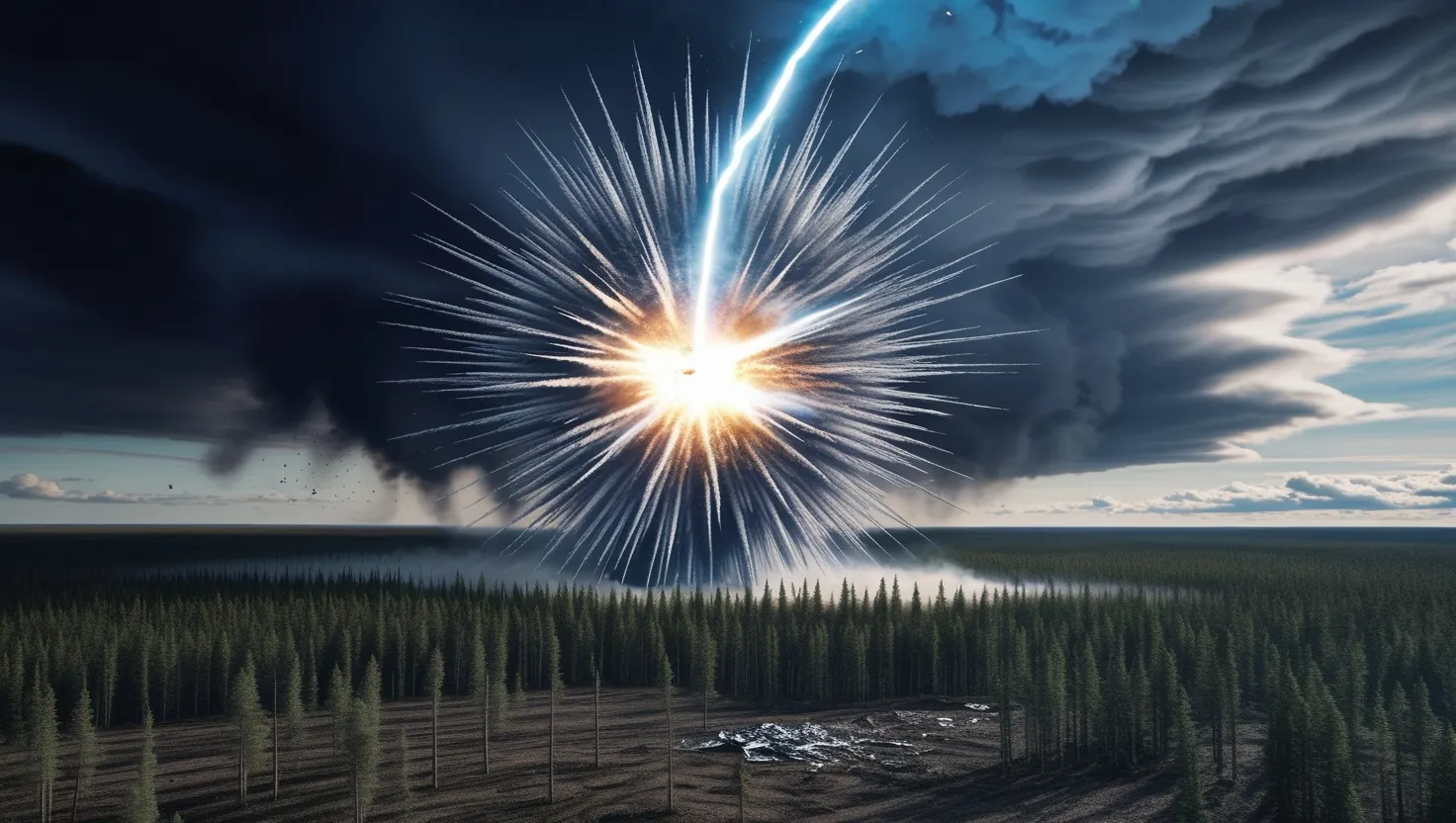
On the morning of June 30, 1908, over a lonely part of Siberia, something in the sky exploded with the power of a big thermonuclear bomb. Forest over an area the size of a small country went flat. Trees were snapped like matchsticks. People hundreds of kilometers away felt the shock. Some thought the world was ending. Yet today, if you stand at ground zero, there is no big crater, no obvious “hole from the sky.” That’s where the confusion begins.
The standard story is simple: a space rock, roughly the size of a building, came in fast, hit thick air, and exploded high above the ground. The air itself became the hammer. No crater, because the object never hit the soil in one piece. The blast wave did the damage. Easy, right?
But when we look closer, it stops being so tidy. And that is where the fun starts.
First, there is the pattern of the trees. When scientists finally got to the site almost twenty years later, they saw something strange. Around the center, trees were stripped of branches but still standing, like bare poles. Further out, they were blown down in a huge radial pattern, all pointing away from a central spot. From above, it looked almost like a giant “butterfly” or a flattened starburst. That kind of pattern suggests more than just one shock wave and more than just a simple “boom, then silence.” It hints at complex waves in the air, possibly several bursts or an odd breakup in the sky.
Now think about this: how do you get an almost perfect radial pattern in a messy atmosphere, from a lump of rock hitting air at many kilometers per second? We know airbursts happen, and we have more recent examples, like the Chelyabinsk event in 2013. But Tunguska’s pattern was unusually neat. Some later studies even suggested there might have been more than one center of shock. If it was just one chunk of rock, why does the ground look like several punches instead of one?
Second, we have witnesses. Accounts collected years later describe “a column of blue light” or a bluish-white pillar moving across the sky, growing brighter over several minutes, followed by the flash and the thunder-like boom. Some reported the object seemed to change direction. Others said it looked like the sky “split in two.”
Here I want you to pause and ask yourself: if you saw a bright object in the sky for almost ten minutes, would you expect it to be a space rock moving at tens of kilometers per second? That kind of rock crosses the visible sky in seconds, not ten full minutes. So, what’s going on?
There are a few options. Maybe memories stretched the time. People remember fear more than numbers. A few seconds can feel like minutes when the sky is glowing. Or maybe the object came in on a shallow path, skimming the atmosphere and dumping energy over a longer track before exploding. That’s rare, but not impossible.
Still, that “it turned” or “it aimed” flavor in some stories sounds odd. It is one reason people started saying: “What if this wasn’t just a rock?”
Here is where the directed energy idea enters the story, and it does so riding on one famous name: Nikola Tesla.
Tesla was, at that time, playing with big ideas. He worked on wireless power, huge coils, and talked about sending energy across the planet through the air or the ground. He also hinted at a “teleforce” device—what people like to call his “death ray,” though he himself used more careful terms. The timing is interesting: by 1908 he had the Wardenclyffe Tower built, struggling for funds, and making bold claims to attract attention.
So some people ask: what if Tunguska was a test? What if someone, Tesla or another group, tried sending a narrow beam of energy to a remote point on Earth? No one around, nothing important—just forest. If it worked, you get a huge blast, no crater, and a strange atmospheric footprint. That would look, from the ground, a lot like what we see at Tunguska.
Let me be clear: there is no solid document that says “we did it” or “Tesla targeted Siberia.” There is no letter in a drawer where a government official writes, “Great beam test yesterday, the trees in Siberia are gone.” But the idea survives because it explains some little details that the rock story struggles with.
For example, early surveys reported odd magnetic behavior in the soil and local magnetic anomalies. Not everybody agrees on how strong or how unusual these were, but they were reported. High-energy experiments, strong currents, and some types of directed energy could, in theory, twist local magnetic conditions and leave subtle footprints. So people who love the Tesla angle grab that and say: “See? It fits.”
At the same time, other teams digging in the soil and swamps around the blast site found tiny metallic spheres with lots of nickel and elements we often see in meteorites. These little grains look like the ashes of a space rock burned in the sky. They strongly support a natural impact. In other words, if this was a directed energy test, it just happened to fake the chemical signature of a cosmic object very well.
Is it possible both are true in some way? Maybe an object from space and something else interacting with it? That feels a bit like bending too far just to keep both stories alive, but you can see how the puzzle invites such ideas.
Then we have another weird piece: radiation and growth.
Some trees that survived near the center later showed strange growth. Their rings got wider in the years after the explosion. It looks as if the forest, after almost being wiped out, started growing faster than before. That could be because the blast cleared competition, added nutrients, and gave the remaining trees more sun and space. But some researchers connected it to unusual radiation exposure, almost like the low-level effects we might see around nuclear tests or cosmic-ray bursts.
Tunguska happened long before nuclear bombs, yet later scientists studying nuclear explosions used Tunguska as a comparison. The similarity between the flattened, scorched forest and photos from Hiroshima and test sites makes people’s minds jump: “Was that a bomb? Or a prototype energy weapon?” The atmosphere effects—strange glows and night skies bright enough to read newspapers in Europe—also remind some of high-altitude tests carried out decades later.
Let me stop and ask you: when several different events share similar signs, do we always need the same cause? Or can different processes create similar results?
Here, the simple answer is: a huge energy release in air behaves in certain universal ways. Whether you use a bomb, a rock from space, or a powerful beam, you still get shock waves, light, heat, and sky effects. So similarity alone does not prove anything. But it keeps the weapon question alive in the background.
Another small but stubborn puzzle is debris. For an object big enough to release ten to fifteen megatons of energy, some models say we should find more leftovers: larger fragments, or a traceable crater from pieces that survived the breakup. Instead, we mostly find micro-fragments, tiny grains in peat and soil, and nothing like a large chunk. That makes the comet idea attractive: a mostly icy, fragile body that turns to vapor and dust, leaving very little behind. But even then, you’d expect a bit more material in some models.
So we have a funny situation: chemical hints of a space object, but fewer big pieces than some simulations expect. Does that mean the models are wrong, or the object was unusual, or something else was at work?
On top of all this sits the political and historical context. The Russian Empire, at the time, did not rush to investigate. It took almost two decades for a proper scientific team led by Leonid Kulik to get to the site. Roads were bad, the area was remote, money was tight, and the explosion did not happen over a city. That sounds like simple neglect. But some people read more into it. They say: “If this tied into secret research, maybe someone wanted time for the evidence to fade.”
Later, during the Cold War, Soviet and American analysts both looked at Tunguska’s data while studying nuclear effects and missile defenses. If you want to plan how to spot or survive blast waves from above, Tunguska is a natural case study. You do not need a conspiracy for that. It is simply useful data. But in people’s minds, “Cold War interest” often smells like “secret weapon work,” even when it is just physics.
Here is where I want to challenge you directly: when you hear “they studied it during the Cold War,” do you immediately think “proof of a cover-up”? Or can you accept that scientists and military planners use any big natural event as a free laboratory?
Now, consider Tesla again. He liked saying he could send energy around the world. He spoke of transmitting power through Earth and atmosphere, focusing it, even bringing down aircraft. It sounds like science fiction today, but remember, this was a time when radio itself felt like magic. If he convinced himself and a few others that such experiments were possible, could someone have funded a secret test? And if it went wrong, would they admit it?
There are problems with this picture. The energy needed to deliver a 10-megaton blast at a distant target is immense. The hardware at Wardenclyffe, as far as records show, was nowhere near that scale in practical operation. Tesla excelled at ideas, but building a fully working energy weapon is another level. No reliable document shows a system capable of directing that kind of power all the way to Siberia in 1908. The engineering alone would have been a nightmare.
Yet the story survives, partly because it feels dramatic, and partly because our information about secret military research from that era is thin. Where there is a gap, stories grow.
Let’s ask another simple question: if someone had such a weapon in 1908, why did it vanish? Why did it not shape World War I or later conflicts? Superweapons do not usually appear once over a forest and then never show up again.
On the other hand, we know space objects hit Earth all the time. The planet’s surface is full of craters from them. Smaller airbursts happen more often than most people realize; they just usually pop over oceans or empty land. Tunguska fits very comfortably into that pattern: a rare but natural impact in a remote region. In this sense, the natural explanation has a strong advantage: it does not need extra assumptions.
But I do not want you to walk away thinking the natural story is perfectly neat. It is not. There are still questions about the precise type of object, its entry angle, how many bursts there were, why certain eyewitness reports look so odd, and what role local geology and atmosphere played in shaping the blast. Modern computer models try to match all this, and they get close, but not perfectly. Science often lives in that “almost, but not quite” space.
So where does this leave us?
We stand between two broad pictures. One says: a weird but natural visitor from space, breaking apart in the air, leaving behind a scarred forest, tiny metallic grains, and a lesson about how vulnerable we are to the sky. The other says: perhaps a human-made energy experiment or early weapons test, launched at a quiet patch of Siberia during a time of fast-growing but secretive research.
Ask yourself: which one needs fewer extra stories to be true? Which one fits best with what we know about technology in 1908? And which one best explains the details that still feel strange?
I cannot hand you a final, absolute answer. No one can, at least not yet. Some pieces of the puzzle may sit at the bottom of Siberian swamps that are hard to reach. Some might sit in lost papers, misfiled reports, or archives that no one has fully examined. Some might simply be gone with the people who saw the fireball and then died before anyone asked the right questions.
What I can do is show you how to think about it in a clear way.
When you hear “meteoroid,” do not picture a simple rock falling straight down like a stone in water. Picture a fragile object hitting air at extreme speed, heating up, breaking apart, dumping its energy into the atmosphere. Understand that such an event can flatten forests and light up skies far away without ever digging a crater.
When you hear “directed energy test,” do not picture pure fantasy either. Early 20th century scientists did play with huge voltages, big coils, radio waves, and wireless power. Ambitious men like Tesla talked beyond what they could fully build. It is fair to ask whether some experiments crossed lines we still do not fully know.
And each time you meet a new detail—strange lights, odd tree rings, magnetic quirks—try this: first, ask “how would a natural impact explain this?” Then ask “how would a human weapon explain this?” Then ask “which one needs the fewest extra miracles?”
In the end, the Tunguska event is more than a mystery about one morning in 1908. It is a test of how we handle the unknown. Do we rush to the neat official story and stop? Do we jump straight to hidden weapons and secret towers? Or do we keep both on the table, weigh them carefully, and accept that sometimes the world keeps a few quiet scars whose full stories are not yet clear?
You do not have to be a genius to think about this well. You only need patience, simple questions, and a willingness to say “I don’t know yet” instead of grabbing the first answer that feels exciting. That, more than any “death ray” or space rock, is the real power this strange blast in Siberia gives us today.