The Wow! Signal: The 72-Second Transmission From Space That Was Never Explained
Discover the Wow! Signal — a mysterious 72-second transmission from 1977 that baffled scientists and was never explained. Could it be proof of alien life? Read the full story.
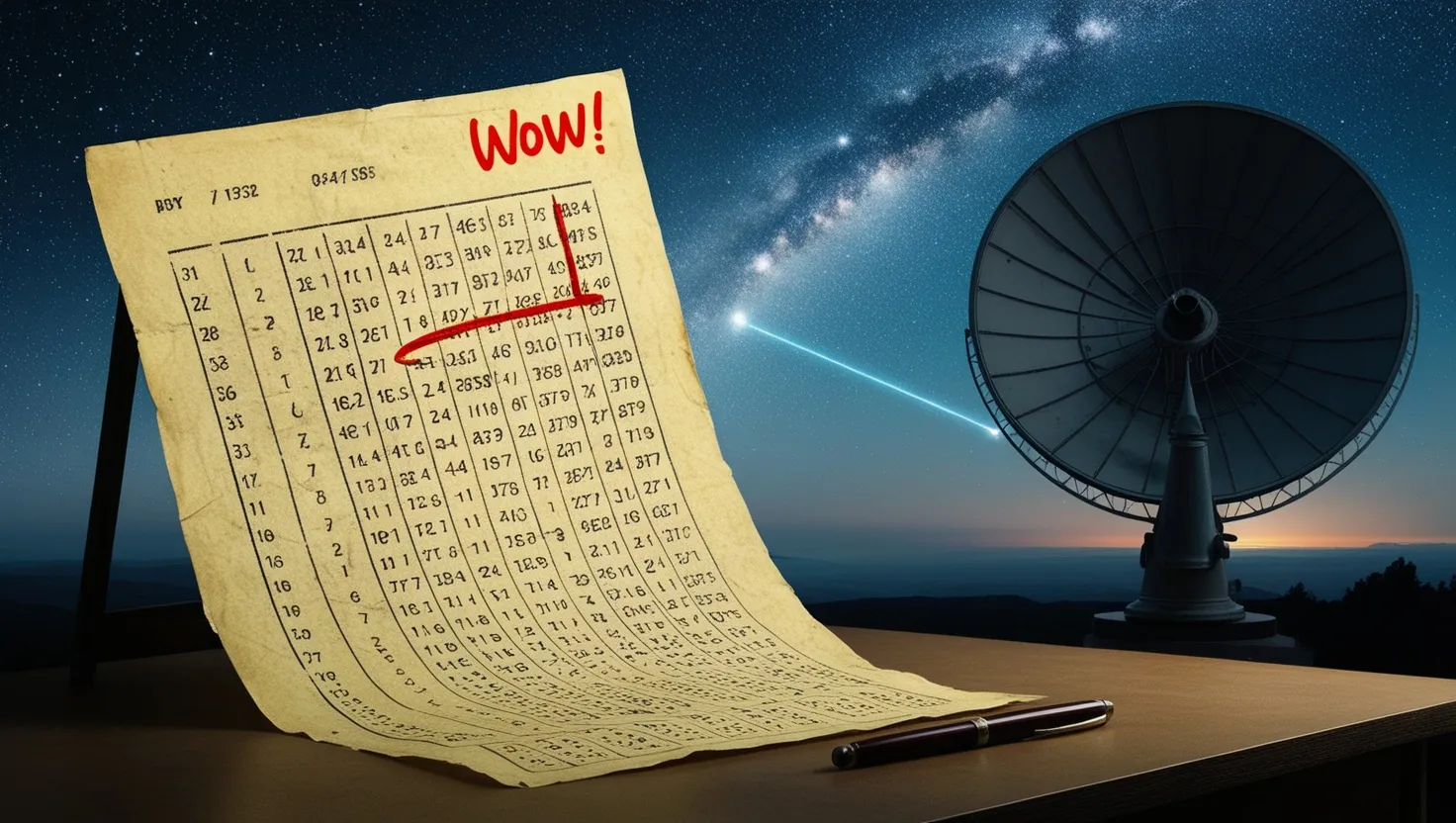
There is a yellowed sheet of computer paper sitting in a museum in Ohio. On it, a series of numbers and letters printed by a machine in 1977. And in the margin, circled in red pen, one word written by a tired volunteer astronomer who could not believe what he was looking at: Wow!
That word became one of the most famous annotations in scientific history. And the story behind it is stranger, more frustrating, and more fascinating than most people realize.
Let me take you back to August 15, 1977.
Jerry Ehman was working at the Big Ear Radio Observatory, a giant radio telescope at Ohio State University. His job was simple — go through printouts of radio signals captured from space and look for anything unusual. The machine printed letters and numbers. The higher the number or the further along the alphabet, the stronger the signal. Most printouts looked like background noise. Flat, random, boring.
Then he saw it. A sequence that read 6EQUJ5.
That sequence meant the signal had risen in strength, peaked, and then fallen back down — in a perfect, clean curve. Like a bell. Like something passing through the telescope’s view. Ehman circled it and wrote “Wow!” He had no idea he had just marked the most debated moment in the entire history of the search for alien life.
“Two possibilities exist: either we are alone in the universe or we are not. Both are equally terrifying.” — Arthur C. Clarke
So why was this signal so special? Most radio signals from space are wide — they spread across many frequencies, like how a radio station might bleed into nearby channels. Natural things like stars, gas clouds, and galaxies do this. But the Wow! signal was narrowband. It occupied a single, razor-thin frequency. That almost never happens in nature. It happened to land right on 1420 megahertz — the hydrogen line — a frequency that scientists had long predicted any intelligent civilization would use to send messages across the galaxy, because hydrogen is the most common element in the universe and any smart species would know to listen there.
The signal lasted exactly 72 seconds. That was not because it stopped transmitting. That was simply how long it took for the telescope’s beam to sweep past that fixed point in the sky. The signal rose and fell in perfect symmetry, exactly the way a signal from a single compact source in deep space should behave. It was coming from the direction of the constellation Sagittarius.
Here is the part that should bother you: they never heard it again.
The team pointed the telescope back at the same coordinates the very next day. And the day after that. For weeks, then months. Nothing. The signal had appeared once, perfectly, and then simply stopped existing. No repeat. No variation. No follow-up burst. Just silence.
Have you ever tried to convince someone of something you only saw once and can never prove again? That is exactly the position every scientist who studied the Wow! signal found themselves in.
The official scientific community has never settled on a single explanation. One theory says it was a reflection of Earth’s own radio transmissions bouncing off a piece of orbiting space debris. Another suggests it was a brief burst from a magnetar — an extremely dense, magnetic star that occasionally releases massive energy pulses. A more recent theory from 2022 proposed that a passing hydrogen cloud briefly amplified a distant background source, creating a fake but convincing signal. Each of these explanations works on paper. None of them perfectly fits the clean, artificial shape of what was recorded.
Here is something most people do not know: the Big Ear telescope actually had two receiver horns, not one. When something real passes through the sky, it should trigger both, about three minutes apart. The Wow! signal only appeared in one horn. That is either deeply suspicious or deeply interesting, depending on your perspective.
“The universe is not only stranger than we suppose, but stranger than we can suppose.” — J.B.S. Haldane
Now, let us talk about the parts of this story that tend to get left out of the textbooks.
The Big Ear Observatory was demolished in 1998. Not for scientific reasons. To build a golf course. The original data tapes from the night of August 15, 1977 have either been lost or destroyed — no one is entirely sure which. The printout that Ehman marked exists. The raw data that would allow modern computers to re-analyze the signal in greater detail does not.
Does that bother you? It should.
The coordinates of the Wow! signal overlap with a region of sky that sits near known military satellite positions. Some researchers — not conspiracy bloggers, actual researchers — have raised the possibility that the signal was a reflected or accidentally generated pulse from a classified military communication system. The U.S. Navy operated extremely low-frequency systems during the Cold War. Some of those systems were capable of producing narrowband radio bursts. The timing, 1977, places it squarely in the height of Cold War signals intelligence activity.
Nobody has ever officially investigated this angle. Nobody has ever officially ruled it out.
Think about that for a moment. The most promising candidate for an alien transmission ever recorded — and no government, no intelligence agency, no international body ever formally investigated where it came from. Not once.
The Allen Telescope Array in California was built specifically to search for signals like the Wow! signal. It has the sensitivity and the bandwidth to monitor the relevant coordinates continuously. It has never been systematically tasked to do so. Funding problems, they say. Priority conflicts. The Array spent years offline due to budget shortfalls before partial restoration.
The Arecibo Observatory in Puerto Rico, one of the most powerful radio telescopes ever built, collapsed in December 2020. Its archives — decades of recorded sky data — were partially lost. Whether those archives contained any relevant observations of the Wow! coordinates is something we will now never fully know.
“Somewhere, something incredible is waiting to be known.” — Sharon Begley
What makes the Wow! signal genuinely haunting is not the possibility that it was alien. It is the possibility that it was real — whatever it was — and the system that should have pursued it simply moved on.
Science requires repeatability. You must see something more than once before you can call it confirmed. That is a good rule. But it also means that a single, unrepeatable event — even a perfect one — falls into a kind of institutional limbo. It becomes a footnote. A curiosity. Something to mention in lectures and then file away.
The signal was not a hoax. The equipment was working correctly. Ehman was a careful, experienced observer. What he recorded was real. And it was never explained, never repeated, and never seriously chased by the resources that could have chased it.
Some people read that as bureaucratic failure. Some read it as deliberate suppression. The honest answer is probably simpler and sadder: nobody wanted to spend the money and the political capital on something they could not prove.
Here is a question worth sitting with: if a signal arrived tomorrow, perfect and clean and coming from deep space, do you trust that the institutions and governments of the world would tell you?
Jerry Ehman himself was cautious his entire life about what the signal meant. He never claimed it was alien. He said it was unexplained. He circled it and wrote one word, and then spent decades carefully not overclaiming. That kind of restraint deserves respect. But it also means the loudest voice connected to the Wow! signal was always a whisper.
The universe is roughly 13.8 billion years old. The Milky Way alone contains somewhere between 100 and 400 billion stars. The mathematical probability that Earth holds the only intelligent life is, by most reasonable calculations, extraordinarily small. And yet, in all our listening, the most compelling thing we ever heard was a 72-second whisper from the direction of Sagittarius on a summer night in 1977, scrawled on a printout that now sits in a museum, the data that created it gone forever.
The sky is not silent. We just stopped listening carefully enough.