Ancient Astronomical Computers: How Lost Greek Gears Predicted Eclipses 2000 Years Ago
Discover ancient computers like the Antikythera Mechanism - bronze gear systems that predicted eclipses and planetary movements 2,000 years ago. Learn how these lost technologies shaped modern astronomy.
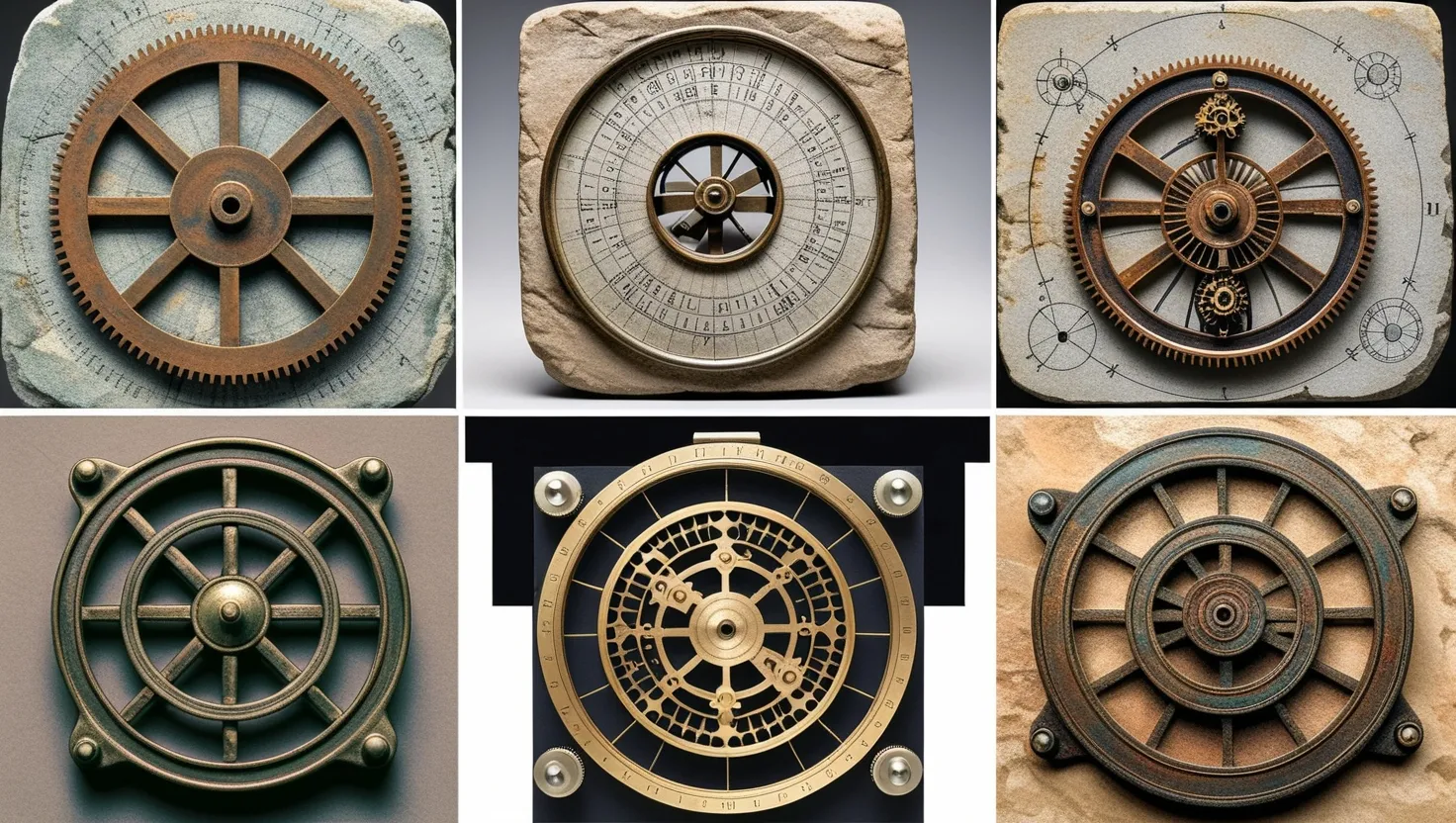
When I think about the oldest computers, what comes to mind isn’t a humming box of silicon chips but bronze gears, mysterious disks, and carved stone. These were not simply artifacts but remarkable machines with a purpose: tracking the movements of the heavens. Their story stretches across continents, from the Mediterranean to the sands of Egypt, and still leaves us with questions that challenge how we understand history itself.
The first time I encountered the Antikythera Mechanism, it felt like reading a detective story. Imagine: a battered ship sunk off a Greek island more than two thousand years ago, its cargo rediscovered in 1901. Divers expect statues and valuables; what they find is far stranger—a calcified lump, later revealed to be packed with precision-cut gears. For decades, scientists wondered what it was for. Today, we know it could predict the positions of the Moon and Sun, model eclipses, and possibly even forecast planetary alignments, all using a network of gears so sophisticated that similar technology would disappear for centuries.
“Equipped with his five senses, man explores the universe around him and calls the adventure Science.” – Edwin Powell Hubble
Why would anyone in the ancient world build such a machine? Would it have been for astronomers charting eclipses, or priests timing rituals and festivals according to the sky? Reconstructions have shown that the Antikythera Mechanism encoded cycles like the Metonic cycle, the Saros cycle, and even accounted for the Moon’s sudden changes in speed. If you’ve ever tried to predict the phases of the Moon without modern software, you’ll understand how astonishing this is. What’s more, these mechanisms required not only scientific knowledge but also expert craftsmanship. What sort of workshops made these gears? Who understood enough mathematics to say how many teeth each should have?
Modern technology let researchers image inside the crust-encased device and read faint Greek inscriptions—some referring to Olympiad calendars, others to planetary synods. Yet, for all this detail, no record remains of how knowledge so advanced spread, nor why it vanished almost as abruptly as it appeared. I often wonder whether the answers lay in texts lost to time, or in oral traditions passed quietly between generations.
So many ancient cultures built instruments to follow the stars. The Egyptians inscribed the Dendera Zodiac and constructed massive calendars carved in temple stone. The Babylonians recorded planetary positions and eclipses on clay tablets with mathematical accuracy. Eratosthenes, who measured the Earth’s circumference with sticks and shadows, also described the armillary sphere—a globe-shaped framework demonstrating how stars appeared to move around the Earth. Sometimes, I reflect on just how interconnected these cultures were. Did travelers, merchants, scholars exchange ideas not only about trade and war but about the inner workings of the cosmos itself?
“If you wish to make an apple pie from scratch, you must first invent the universe.” – Carl Sagan
The really fascinating part is how unconventional many of these mechanisms are. The Nebra Sky Disk, discovered in Germany, depicted the sun, stars, and phases of the moon in a pattern that some say is the earliest known map of the cosmos. Chankillo, in the Peruvian desert, with its thirteen towers aligned for solar tracking, implies a culture just as obsessed with precision as the Greeks or Egyptians. In China, water clocks and armillary spheres advanced the concept of continuous measurement of time—a vital skill if you want to know exactly when the solstice will occur.
Have you ever considered why these ancient people cared so much about modeling the sky? Was it simply curiosity, or something deeper—perhaps the desire to harmonize lives with celestial cycles? In some societies, eclipses were omens; in others, they were milestones for planting and harvest. There’s something poetic about people thousands of years ago peering upward with the same questions we have now: Is the universe predictable? Are its motions knowable?
“Not only is the Universe stranger than we think, it is stranger than we can think.” – Werner Heisenberg
Many of these artifacts are oddly silent about their creators. The Antikythera Mechanism’s origin story is lost, though clues hint at connections to the workshops of Syracuse—Archimedes’ home—and perhaps Rhodes, where astronomical knowledge flourished. No workshop inventories, no instruction manuals have surfaced. Imagine designing a system so intricate, with gears meshing precisely to model a moon whose orbit isn’t even exactly circular! Every piece would require careful calculation, each gear ratio mapping to a known celestial period.
There’s even evidence these devices encoded sacred calendars. The names of months visible on the Mechanism match those in far-flung Greek colonies. This suggests it wasn’t just the work of one genius, but of a culture in love with numbers, geometry, and the order behind apparent chaos.
What do you think: Did these inventors sense they were living in a golden age of science, or were they simply continuing traditions handed down across centuries? Why do ideas sometimes rise, catch fire in the minds of a few, then fade almost without a trace?
“Men must turn square corners when they deal with each other and when they deal with nature.” – Archimedes
Even the arithmetic used in these machines was ahead of its time. The Babylonians, for instance, worked with a base-60 place-value system, perfect for dividing circles and time, which appears again in our modern methods for degrees and minutes. Their tablets show that they solved quadratic equations and knew how to predict planetary conjunctions. It’s surprising—as though the seeds for modern science were planted in ground that no one expected.
As I look across the range of ancient astronomical computers, I see clues pointing to lost books, workshops with specialized tools, and the movement of knowledge through trade routes or centers like Alexandria. Some devices, like volvelles—rotating paper disks from medieval Europe—echo ancient methods, using simple geometry to simulate motion. Why such knowledge didn’t continue consistently is a mystery that still draws debate.
Perhaps you’re wondering: were these inventions isolated strokes of genius, or part of a more widespread technological web? Archaeological finds suggest the latter. From the astrolabes of the Islamic Golden Age to the sundials and star charts of Mayan astronomers, many societies seemed to hit upon similar solutions, often separated by hundreds or thousands of miles.
“It does not matter how slowly you go as long as you do not stop.” – Confucius
Some speculate that political upheavals, wars, or the destruction of libraries led to the disappearance of these technologies. Others believe transmission of specialized knowledge relied on tiny circles of scholars, easily interrupted by social change. I’m intrigued by the idea that some secrets were intentionally guarded—handed down as private wisdom among priesthoods or scientific guilds.
There’s a lesson here: advanced knowledge is both fragile and tenacious. It can disappear but also reappear in new forms when the world is ready. Think of how mechanical clocks—and later, modern calculators—arrived many centuries after the ideas embodied in the Antikythera Mechanism.
Is it possible we’ve lost other complex devices, waiting to be rediscovered on a future shipwreck or in some neglected tomb? Could the artifacts we already possess yield new secrets if our tools improve? When researchers used x-ray tomography and imaging to re-examine the Antikythera fragments, they revealed details previously invisible, sparking fresh theories about its celestial reach.
“The greatest enemy of knowledge is not ignorance; it is the illusion of knowledge.” – Stephen Hawking
Today’s automated telescopes and astronomical software owe a silent debt to these ancient computers. Whenever I set up a digital tracker to follow the planets, I wonder if a craftsman two thousand years ago felt the same satisfaction as a gear slipped into place and a dial spun, predicting the next lunar eclipse. The enduring lesson is that curiosity, creativity, and precision are timeless tools—just as meaningful in a bronze gear as in silicon chips.
How would you have felt if handed such a device—perhaps tasked with predicting the heavens for your community or priesthood? Would it seem magical, or a practical expression of mathematical skill? And what did those who built them feel as their inventions grew in complexity—pride, anxiety, a sense of wonder?
In examining ancient computers, I am reminded that history is a dialogue rather than a fixed story. Artefacts do not merely record knowledge; they inspire questions that have no easy answers. Our task, I believe, is not simply to admire their workmanship but to look for the forgotten insights they hold.
And perhaps, in reflecting on the lost brilliance of these machines, we glimpse how humanity’s quest to chart the stars is never about answers alone. It is about asking the next, and sometimes unexpected, question.