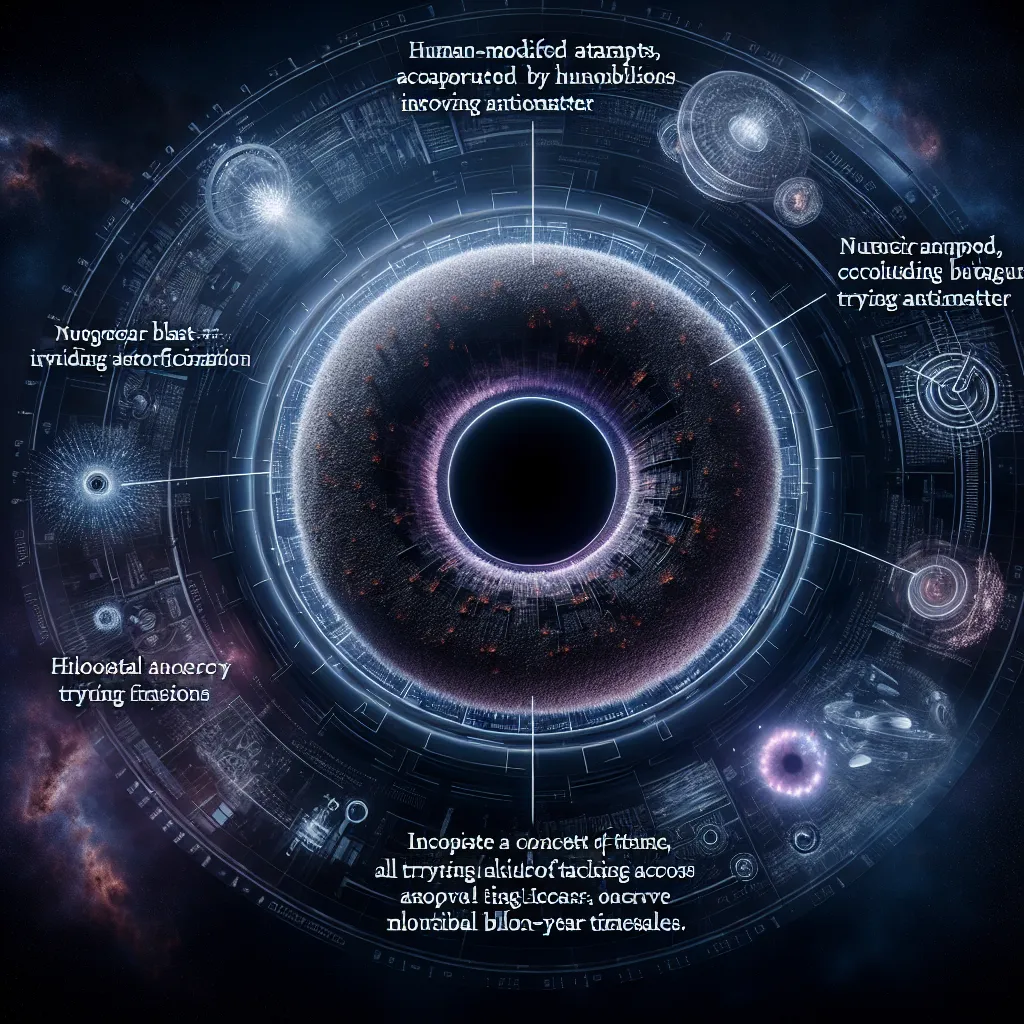
Can black holes be destroyed? That’s the epic question we explored by pushing the limits of physics. Imagine creating a tiny black hole, about the size of our moon, in a hypothetical Lab and trying various crazy methods to rip it apart.
First, we thought about blasting it with the world’s entire nuclear arsenal. Spoiler: the black hole just gets bigger. Adding all that energy and mass only makes it more massive, thanks to the principle of E=mc². Next, we tried antimatter. Unfortunately, whether you throw matter or antimatter at a black hole, it ends up with the same mass increment. So, no luck there either.
But what if we collide a black hole with its hypothetical antimatter counterpart, an anti-black hole? Sorry to burst the bubble, but that only results in a bigger black hole with a neutral charge. The anti-black hole idea was a bust too.
Next on our list: manipulating the black hole’s spin and charge. If you overcharge or over-spin the black hole, it might lose its event horizon. The event horizon is the boundary beyond which nothing, not even light, can escape. Destroying the event horizon would technically “destroy” the black hole, letting you get close and even come back. But even this is complicated. Theories suggest that pushing a black hole to these limits might not be feasible due to extreme repulsion effects.
Here’s a catch: removing the event horizon could release a “naked singularity,” a point of infinite gravity without the protective shell. This would break down the laws of physics as we know them, creating unpredictable chaos. So, experimentally breaking down a black hole isn’t just tough—it’s potentially universe-threatening.
The safest method to destroy a black hole is to wait for it to evaporate via Hawking radiation, a process taking billions of times longer than the age of the universe. While intriguing, this isn’t practical.
So, can black holes be destroyed? Yes, but you’d need an eternal patience. Meanwhile, there are simpler, fascinating things to explore right here on Earth. So let’s stick to those!