Cosmic Mystery Unveiled: Why Haven't We Found Aliens Yet?
The Fermi Paradox questions why we haven't encountered aliens despite the vast number of stars and planets. Possible explanations include the Great Filter theory, the Zoo Hypothesis, and the Dark Forest Hypothesis. Despite ongoing searches, we've found no conclusive evidence of intelligent extraterrestrial life. The paradox challenges our understanding of the universe and our place in it.
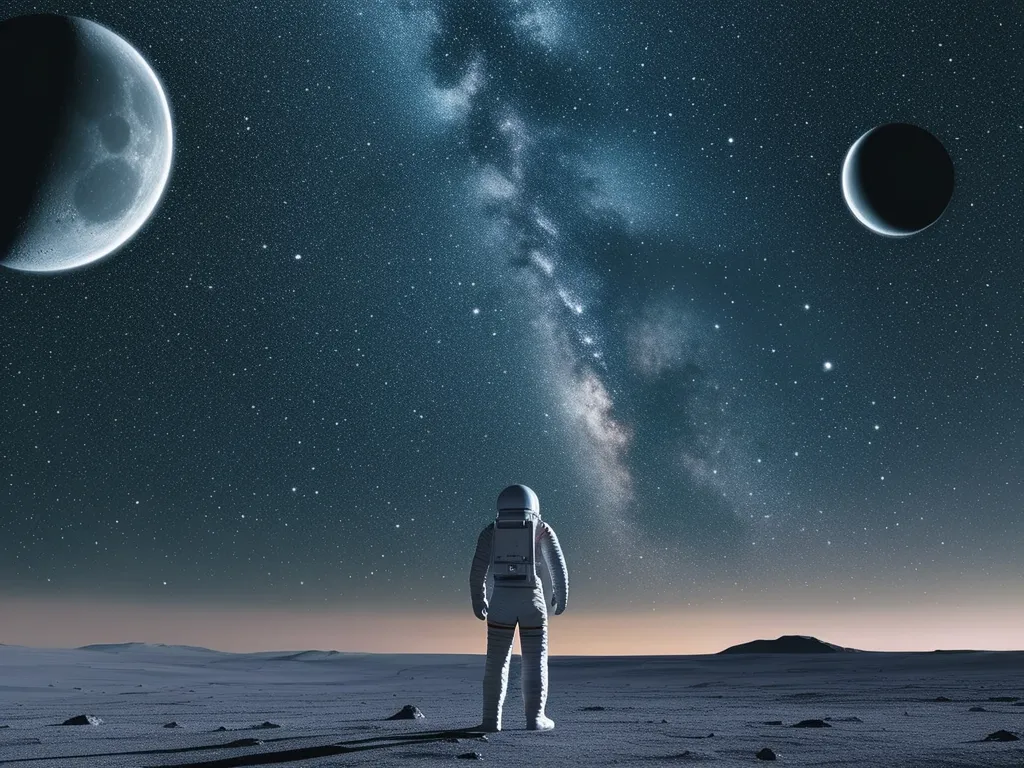
As I gaze up at the night sky, the stars twinkling like diamonds against the dark canvas, a question echoes in my mind: “Where is everybody?” This is the essence of the Fermi Paradox, a puzzle that has intrigued scientists and the general public alike for decades. The paradox, named after the Italian-American physicist Enrico Fermi, poses a simple yet profound question: given the vast number of stars and potentially habitable planets in the universe, why have we not encountered any signs of extraterrestrial life?
The story begins in the summer of 1950, when Fermi, along with fellow physicists Edward Teller, Emil Konopinski, and Herbert York, engaged in a casual conversation about flying saucers and the possibility of faster-than-light interstellar travel. As they walked to lunch, Fermi suddenly asked, “But where is everybody?” This question was not just a passing remark; it was a profound inquiry into the nature of the universe and our place within it.
To understand the paradox, let’s delve into the numbers. The Milky Way galaxy alone contains between 200 and 400 billion stars, and the observable universe is home to an estimated 70 sextillion stars. Even if intelligent life arises on only a tiny fraction of these planets, the sheer scale suggests that there should be a significant number of extant civilizations. Assuming that some of these civilizations could achieve speeds of even a fraction of the speed of light, they could have explored or colonized the entire galaxy in a relatively short period, certainly within the 4.5 billion-year history of Earth.
So, why the silence? One of the earliest and most enduring explanations is the “Great Filter” hypothesis. This suggests that there is a significant barrier or filter that prevents civilizations from becoming interstellar, and that we might have not yet passed this filter. Perhaps the emergence of intelligent life is far more improbable than we think, or maybe technological civilizations inevitably self-destruct before they can expand into space. This idea is haunting, as it implies that our own civilization might be heading towards a similar fate.
Another intriguing explanation is the “Zoo Hypothesis.” This theory proposes that advanced extraterrestrial civilizations might be aware of our existence but are deliberately avoiding contact with us, much like zookeepers observing animals without interfering. This idea was discussed in depth during a workshop by the Messaging Extraterrestrial Intelligence (METI) group in Paris, where scientists and philosophers debated the possibility that we are being watched but not contacted. The question then becomes, how can we signal to these hypothetical zookeepers that we are ready for communication?
The “Dark Forest Hypothesis” offers a darker perspective. This theory, inspired by science fiction, suggests that the universe is filled with silent and paranoid civilizations that destroy any life form that makes itself known, to avoid potential future threats. In this scenario, the silence is not due to a lack of life but rather a survival strategy where civilizations remain quiet to avoid being targeted.
A more sinister angle is the idea that Earth is deliberately being isolated or that the universe is a simulated reality. The “Planetarium Hypothesis” posits that advanced beings might have created a simulation of the universe, making it appear empty of other life. While this sounds like the stuff of science fiction, it highlights the complexity and depth of the Fermi Paradox.
The search for extraterrestrial intelligence (SETI) has been ongoing since the 1960s, but so far, it has yielded nothing conclusive. This has led to what is known as the “Great Silence.” Despite the vast number of stars and planets searched, we have found no definitive evidence of intelligent life. This silence is puzzling, especially when considering the Drake Equation, which estimates the number of intelligent civilizations in the Milky Way galaxy that might be able to communicate with us. However, the variables in this equation are highly uncertain, making it more of a speculative tool than a precise predictor.
One of the lesser-known aspects of the Fermi Paradox is the role of sociology and psychology. An alien civilization might feel that communication with other civilizations is too dangerous, either for themselves or for the other side. Historical examples on Earth show that when different civilizations meet, the outcomes are often disastrous. This fear could lead advanced civilizations to hide not only from Earth but from everyone, out of a cautious avoidance of potential threats.
The interplay between astronomy, sociology, and even conspiracy theories makes the Fermi Paradox a rich and multifaceted puzzle. While some argue that the lack of evidence means we are alone in the universe, others propose that we are simply not looking in the right places or using the right methods. For instance, life could be thriving in environments that are inhospitable to us, such as the buried oceans of moons like Enceladus and Europa. These organisms might not even be aware of the existence of other worlds, let alone have the capability to communicate with them.
As we continue to explore the cosmos and search for signs of life, the Fermi Paradox remains a constant reminder of how little we know about the universe and our place in it. It challenges us to think beyond our current understanding and to consider the myriad possibilities that could explain the silence. Whether the answer lies in the vast expanse of space, in the depths of our own planet, or in the complexities of interstellar communication, the Fermi Paradox is a riddle that continues to captivate and intrigue us.
In the end, the silence could mean many things: it could be a sign of our solitude in the universe, a result of advanced civilizations avoiding us, or even a hint at a much larger cosmic reality that we have yet to comprehend. As we ponder this question, we are not just searching for extraterrestrial life; we are also reflecting on our own existence and the mysteries that lie beyond the reaches of our current knowledge. The Fermi Paradox is more than just a scientific inquiry; it is a journey into the heart of what it means to be human in an vast and often mysterious universe.