Could We Be Banished from Our Solar System by a Wandering Star?
Dancing with Stars: When Galaxies and Gravities Juggle Our Fate
The night sky can seem calm and peaceful, but stars are actually zooming around the galaxy at mind-blowing speeds. Stars are not stuck in one spot but are constantly moving and changing their cosmic neighborhoods. Luckily, space is vast, so stars in the Milky Way are unlikely to crash into us. Unfortunately, stars don’t need to collide with Earth to cause big problems. Even nearby stars can shake things up significantly.
To grasp how stars pose a threat, we need to talk about gravity. Gravity pulls every piece of matter towards every other piece. This force weakens over distance and depends on how big the object is—bigger and closer objects have a stronger pull. The Sun, for example, is the heavyweight champ of our solar system, containing 99.75% of its mass, and it dictates the orbits of everything else.
Billions of years ago, the solar system was chaotic, with planets forming from countless dust and rocks colliding. Over time, a stable balance formed, creating the orderly orbits we see today. However, this balance is fragile. Another star passing close by could disturb everything, much like a spoiled child messing up all the toy trains arranged perfectly.
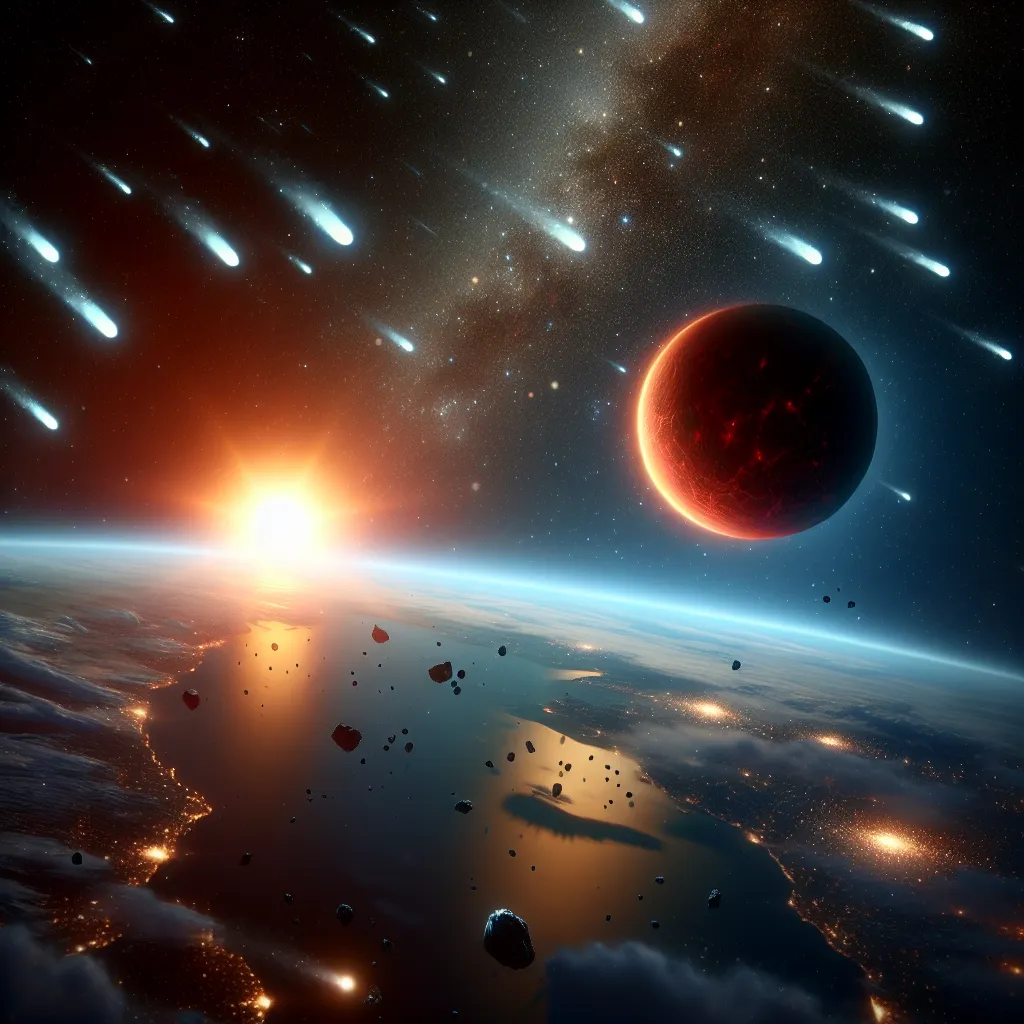
This isn’t just theoretical. Seventy thousand years ago, a red dwarf and brown dwarf binary system passed through our Oort Cloud, potentially sending a slew of comets our way. Although it might take another 2 million years for these comets to enter the inner solar system, the real concern is Gleise 710. This red dwarf is on a path towards our solar system and will become alarmingly close in about a million years. Its flyby could stir up the Oort Cloud, turning our night sky into a chaotic shower of comets and asteroids, some of which could bring about mass extinctions similar to the one that wiped out the dinosaurs.
The galaxy is full of stars constantly drawing near to one another. This raises a scarier possibility: a star could pass so close that it ejects Earth from the solar system. Though the odds of this happening in the next 5 billion years are about 1 in 100,000, it’s not impossible. If it were to happen, Earth would face a fatal freeze.
Imagine a small orange dot appearing in the sky, growing brighter over months until it’s more luminous than the moon. As the Sun shrinks, warmth and light fade, leading to a catastrophic drop in temperatures. Earth would become an icy wasteland, with polar ice caps spreading and living conditions becoming unbearable. Eventually, as Earth drifted farther away, temperatures would plunge to -150°C, and our planet would look like a frozen moon. The atmosphere would collapse into snow, turning Earth into a rogue planet, drifting in the dark and cold—lifeless.
But there’s a glimmer of hope. Humanity wouldn’t be caught off-guard; we’d have thousands of years to prepare. Though billions might perish, millions could survive in artificial complexes powered by geothermal, nuclear, or even fusion energy. Over generations, survivors might adapt, watching documentaries in disbelief about Earth’s once warm, sunlit surface.
In the distant future, driven by necessity, humanity might seek out a new home. The lack of an atmosphere would make space flight easier, enabling the last survivors to leave Earth and start anew on another planet around a new star. Wouldn’t it be something if, thousands of years later, our descendants told tales of a distant, icy planet floating alone in space—our lost home, Earth?