Did a Time-Traveling USS Eldridge Vanish into Thin Air?
When Reality Blurs with the Shadows of Time - The Enduring Myth of the Philadelphia Experiment
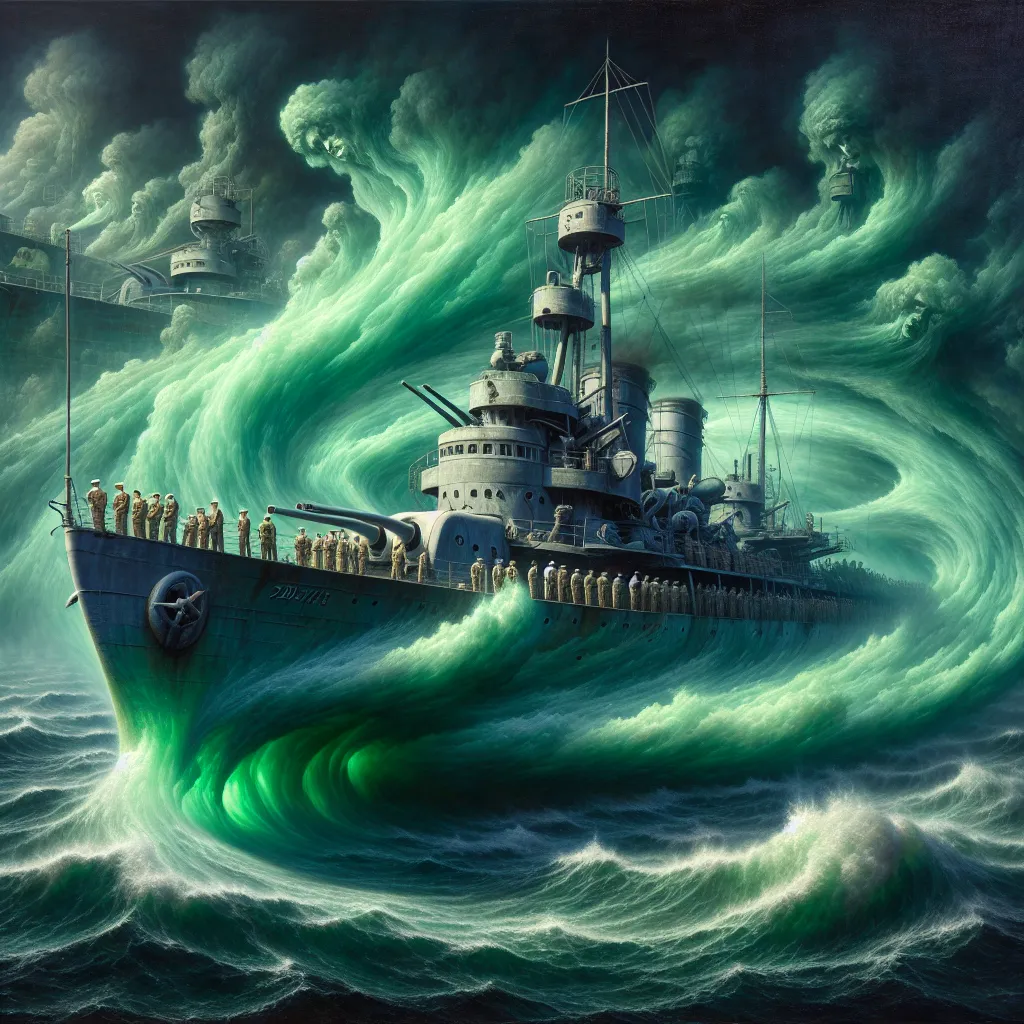
On October 28, 1943, a bizarre event known as the Philadelphia Experiment thrust the US Navy into the realm of time travel and teleportation—at least according to some wild conspiracy theories. Back in the thick of World War II, the Navy faced severe challenges, with German submarines and mines becoming a massive threat. Determined to counter this, something strange supposedly happened with the USS Eldridge, a newly commissioned destroyer.
Rumor had it that the Navy had set up large generators on the ship to create a magnetic field that could make it invisible to enemy radar and mines. During the test, a weird green fog engulfed the ship, and then it vanished, only to reappear in Norfolk, Virginia—250 miles away and ten minutes earlier in time. When it returned to Philadelphia minutes later, things had gone terribly wrong. Crew members suffered burns, others went mad, and some were gruesomely fused into the ship’s metal. The story is both creepy and tantalizing, propelling decades of conspiracy theories.
While the USS Eldridge was real, records show it wasn’t in Philadelphia that day but actually in New York. However, the Navy did carry out experiments aimed at invisibility—specifically making ships invisible to underwater mines, not to the naked eye. This process, called “degaussing,” involved using electromagnetic coils to mute a ship’s magnetic field, a method initially expensive and hard to install, which led to alternative techniques.
The legend gained traction in 1955 when a man named Maurice Jessup, an astronomer and author, received a letter from someone named Carlos Allende (later revealed as Carl Allen). Allen claimed to have witnessed the incredible event and went on about Einstein’s Unified Field Theory, trying to stitch together electromagnetism and gravity into one field. His rambling letters, filled with ridicule yet compelling details, fueled the fire of the Philadelphia Experiment lore.
Despite Jessup trying to validate Allen’s claims, the story stayed in the realm of science fiction rather than fact. Jessup later faced personal hardships, leading to his mysterious death in 1959 by carbon monoxide poisoning—officially ruled as suicide, though theories persisted about his demise being linked to his research.
The Philadelphia Experiment, despite its lack of concrete proof, highlights our innate desire for mystery and the unexplained. It taps into a timeless fascination with the unknown, making us wonder if there are truths the government might be hiding. This legendary tale continues to capture imaginations, proving our collective intrigue in exploring the boundaries between what’s real and what’s sensational fantasy.
So, was the USS Eldridge really a time-traveling, teleporting ghost ship? Probably not. But the idea that such stories can exist and persist speaks volumes about our need for mystery and the allure of the unknown.