Did We Miss the Real Year Zero? Discover How a New Calendar Could Rewrite History
Epochs of Stone and Stars: A Human Tale from Temples to Space
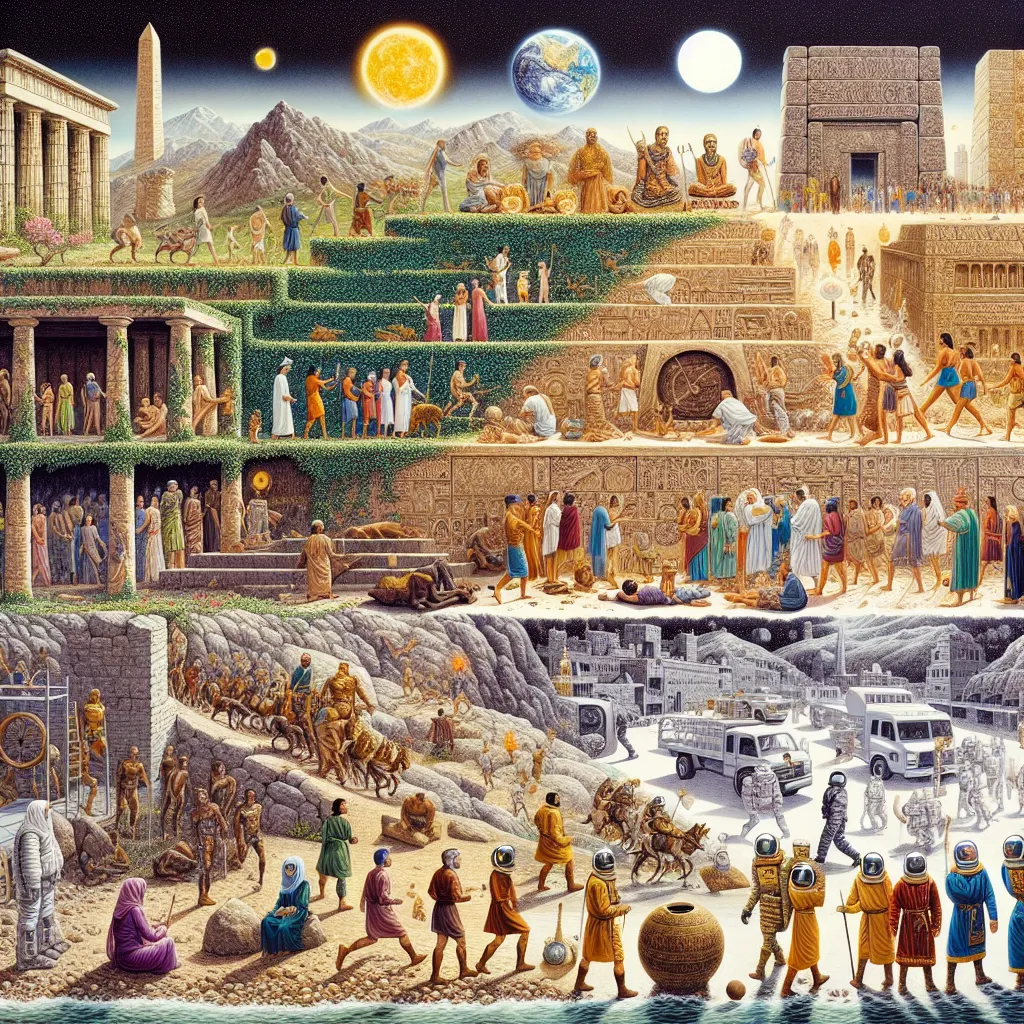
Humans have roamed this planet for millions of years, blending seamlessly with nature. Then, in a blink of an eye, everything changed. We began to shape the world to fit our needs. We’ve terraformed Earth, designed cities, and altered landscapes. This rapid evolution makes us the only species we know to have completely taken over a planet. The leap from hunting and gathering to farming and building happened so quickly that many of our old-world views don’t hold up today.
One outdated concept is our current calendar. The Gregorian calendar claims it’s the year 2016, which distorts our understanding of human history. This could be the right moment to choose a Year 0 that truly reflects our journey as a species and acknowledges all cultures. A new Year 0 could mark when we began constructing our own world on top of the natural one.
Take, for example, the first temple built 12,000 years ago in southern Anatolia. Back then, humans were hunters and gatherers with only stone and wood tools. Yet, they came together to create massive stone pillars up to six meters high and 40 tons in weight, decorated with art and carvings. This was a major construction project that hinted at an organization level we didn’t know early humans possessed. The most popular theory is that this structure was a temple dedicated to long-forgotten gods.
This first-of-its-kind construction marks the beginning of a new era. Around this time, humans started building their new world. Cesare Emiliani proposed that we should switch to the Holocene calendar, adding 10,000 years to our current Gregorian calendar. We wouldn’t need to change the days and months, nor would it interfere with religious calendars. But officially, this year would be the year 12,016 of the human era.
This shift could drastically change our perception of history. Moving through our revised history, 12,000 years ago, we see the beginning of humanity’s first major construction project. By the year 1000 of the human era, Jericho, probably the world’s first city, was founded. Progress was incredibly slow. Permanent settlements started appearing, agriculture spread, and humans began domesticating plants and animals.
By the year 4000, humans started using metal, heralding the Bronze Age around the year 5000. Early writing systems and the wheel were invented, and cultures began emerging, including the Indus Valley Civilization and Ancient Egypt. By the year 7000, high cultures appeared worldwide. Stonehenge was built, and China’s first dynasty began.
Near the year 9500, what we now consider Western culture began. The Greek city-states fought off the Persian invasion, triggering their golden era. Rome rose to power, and Caesar was assassinated around the year 9956, with the world population reaching about 300,000,000.
By the year 10,000, the Gregorian calendar marks the starting point of our current historical timeline. In a mere 2,000 years from then, humans would set foot on the moon. Adding 10,000 years to our calendar could make our 10,000 years of human progress more impressive and show how quickly progress can become exponential, incorporating all human cultures into our shared history.
A new Year 0 could reframe how we view ourselves, from ancient builders of the first temple to explorers of the cosmos, uniting our past and future in one inclusive timeline.