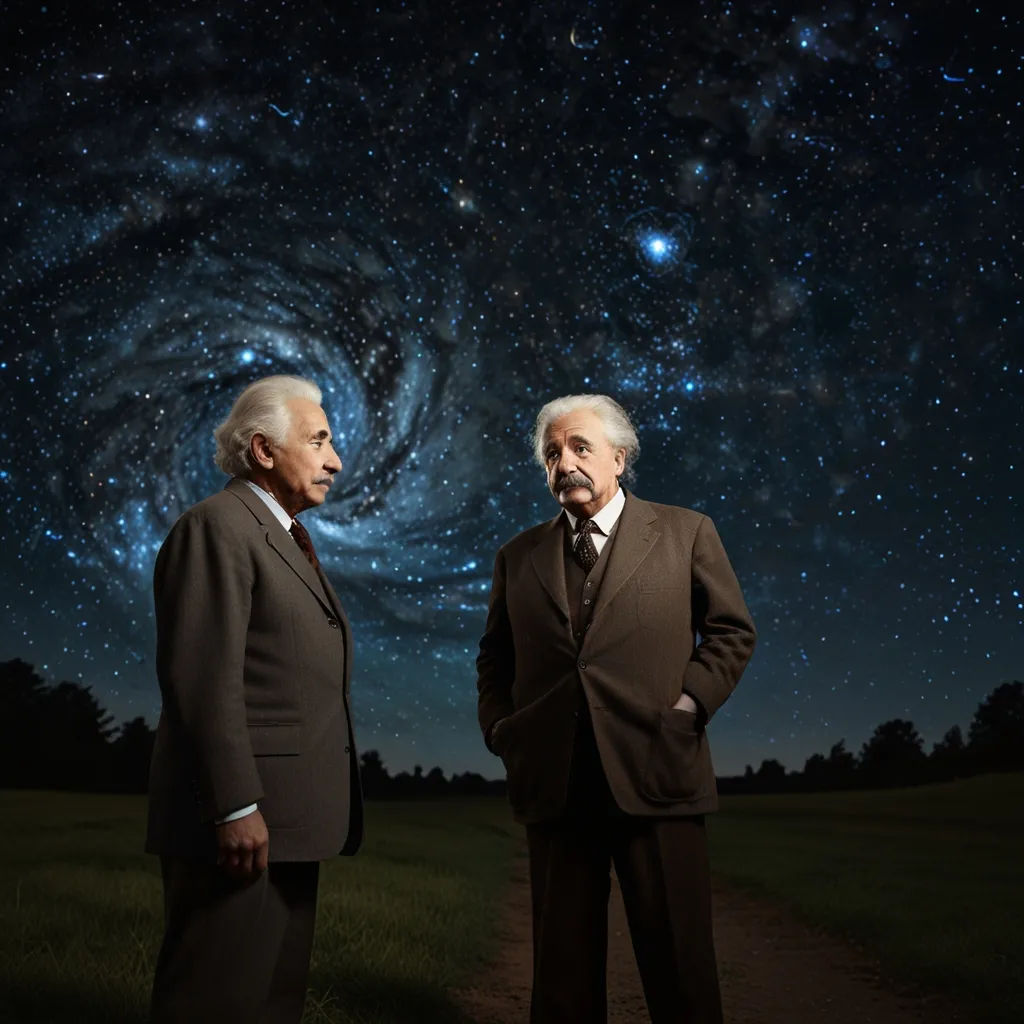
Imagine a world where everything you see, touch, and experience is not what it seems. A world where the three-dimensional reality we inhabit could be nothing more than a holographic projection from a higher-dimensional space. This mind-bending concept, known as the holographic principle, has been fascinating physicists and theorists for decades, and it challenges our very understanding of space, time, and consciousness.
At its core, the holographic principle suggests that the information contained in a three-dimensional space can be encoded on a two-dimensional surface. This idea is not as far-fetched as it sounds; after all, we are familiar with holograms in our everyday lives. A hologram is a flat surface that, when illuminated, projects a three-dimensional image. Similarly, the holographic principle proposes that our entire universe, with all its galaxies, stars, planets, and even us, could be a hologram projected from a lower-dimensional reality.
This theory emerged as a potential solution to one of the biggest puzzles in modern physics: the integration of quantum mechanics and general relativity. Quantum mechanics explains the behavior of particles at the smallest scales, while general relativity describes the universe on its largest scales. However, these two theories are fundamentally incompatible within our current understanding. The holographic principle offers a way to bridge this gap by suggesting that the information in our three-dimensional world is actually encoded on a two-dimensional surface, much like the information on a compact disc encodes music.
One of the key figures in developing this idea is Leonard Susskind, who described the three-dimensional world we experience as a hologram coded on a distant two-dimensional surface. This concept is supported by the AdS/CFT correspondence, a theoretical framework proposed by Juan Maldacena, which shows that the physics of a three-dimensional space can be described by a two-dimensional theory living on its boundary. This correspondence has been incredibly successful in explaining phenomena such as black hole entropy and has provided strong evidence for the holographic principle.
Black holes are particularly interesting in this context. The holographic principle helps resolve the black hole information paradox, which questions what happens to the information contained in matter that falls into a black hole. According to the principle, this information is not lost but is instead encoded on the surface of the event horizon, the boundary beyond which nothing can escape the black hole’s gravity. This idea aligns with the Bekenstein bound, which states that the maximum entropy in any region scales with the radius squared, rather than cubed, as one might expect.
But the implications of the holographic principle go far beyond just explaining black holes. It challenges our understanding of space and time themselves. If our reality is a hologram, then the third dimension we experience might be an illusion. This raises profound questions about the nature of reality and our place within it. Are we living in a cosmic holodeck, with the true nature of existence hiding just beyond our perception?
The holographic principle also touches on the mysteries of consciousness. Some theories, such as the Quantum Hologram Theory of Consciousness, suggest that consciousness itself might be holographic in nature. According to this theory, the brain processes information in a way similar to a hologram, creating our three-dimensional world from interference patterns. This idea is supported by researchers like Roger Penrose and Stuart Hameroff, who propose that quantum activity inside neurons could be responsible for conscious events.
Moreover, the concept of a holographic universe opens up possibilities that seem almost science fiction. If reality is encoded on a two-dimensional surface, could we manipulate this surface to alter our reality? Could we access hidden dimensions or communicate with entities existing in these higher-dimensional spaces? These questions, while speculative, highlight the revolutionary potential of the holographic principle.
The idea that we might be living in a simulation created by a higher-dimensional reality is another intriguing aspect of this theory. This concept, often referred to as the “Simulation Hypothesis,” suggests that our universe could be a complex simulation run by advanced beings. While this is highly speculative, it aligns with the holographic principle’s notion that our reality could be a projection from a more fundamental level.
In exploring these ideas, scientists are not just delving into abstract theories; they are also conducting concrete research. For instance, projects funded by organizations like the Simons Foundation are working to use the holographic principle to reconcile quantum mechanics and general relativity. These efforts involve collaboration among physicists worldwide and aim to develop a unified theory that encompasses both the small-scale world of quantum mechanics and the large-scale world of general relativity.
As we continue to explore the holographic principle, we are forced to question everything we thought we knew about the universe. It is a journey that takes us from the smallest particles to the vast expanse of space, and from the mysteries of black holes to the enigma of consciousness. Whether or not we are living in a cosmic holodeck, the holographic principle offers a profound new perspective on reality, one that challenges our understanding and inspires new avenues of research.
In the end, the holographic principle is not just a theory; it is a gateway to understanding the very fabric of our existence. It invites us to consider that our reality, as complex and multifaceted as it is, might be a simplified projection of a more intricate, higher-dimensional world. As we delve deeper into this mystery, we may find that the truth is indeed stranger than fiction, and that the universe holds secrets waiting to be uncovered by those brave enough to question the nature of reality itself.