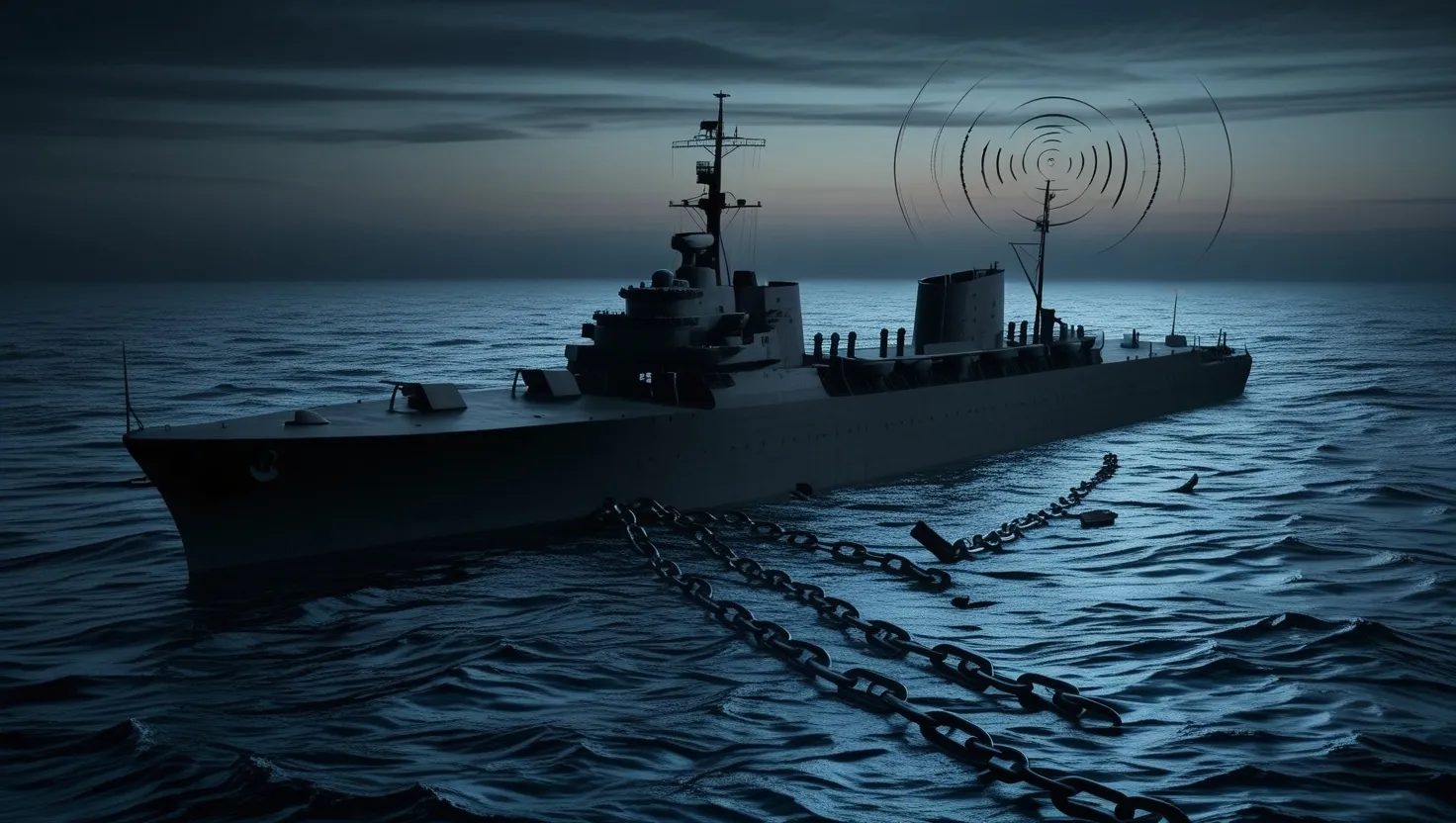
Naval history has plenty of tragic sinkings, but a tiny group of cases sits in a much stranger category: big, modern ships that more or less “disappear,” often in decent weather, with little warning and almost no wreckage. These are not campfire ghost stories; they sit in official logs, court records and naval archives, where even very serious investigators are forced, in the end, to write one frustrating word: “unknown.”
When you and walk through these events together, forget the idea that every disaster has a neat cause. Ships are giant engineering projects, run by trained crews, packed with radios, compasses and safety gear. When one simply vanishes, the puzzle is not just “What broke?” It is “How can so much metal and so many people leave so few fingerprints on history?” If that sounds obvious, hold on to it, because that blind spot – “surely there must be evidence somewhere” – is one of the biggest traps in thinking about the sea.
“We are more often in error than in doubt.” – A. N. Whitehead
Take the USS Cyclops, the case you have probably heard of. A huge U.S. Navy collier, over 500 feet long, she vanished in 1918 between Barbados and Baltimore with more than 300 people on board. No confirmed distress call. No wreck found. On paper, this is a modern steel ship in regular service, on a known route, in water that is busy with traffic. If an airliner of that size disappeared on a normal scheduled flight today, countries would tear the sky apart looking for it. With Cyclops, the ocean simply kept its mouth shut.
Now, Cyclops is often dumped into “Bermuda Triangle” talk. But if you peel away the pop culture, what is left is actually more interesting. You have a ship carrying a heavy cargo of manganese ore that may have been loaded unevenly. You have reports that the captain was eccentric, even unstable, and may have been making odd decisions. You have a hull already known to have some structural weaknesses. None of these facts alone “solves” the case, but together they suggest a different picture: not magic, not sea monsters, but a fragile system where several small problems line up at once. Can you see how much harder that is to prove than a single dramatic cause like a torpedo?
This is one of the key patterns in “vanishing fleets”: systems at the edge of complexity. A warship looks solid and simple from the outside, but inside it is a chain of dependencies – metal fatigue, navigation practices, command culture, radio discipline, weather forecasting, even politics. When people later ask, “How could such a big ship just disappear?”, they are unknowingly asking, “How could a long chain fail in many small places at the exact same time?” There is no easy diagram for that.
“For want of a nail, the shoe was lost.” – traditional proverb
Another clue comes from timing. Many of these disappearances happen not in the worst storms, but at the edges: after a storm has passed, or in seas that are rough but not yet “record breaking.” Why does that matter? Because crews tend to relax a little once the obvious danger seems to pass. Imagine staying tense for twenty hours straight in high seas; the human body just cannot do it. So checks get a tiny bit looser. Maybe the watertight door is left open for “just a few minutes.” Maybe a lookout assumes the radar has him covered. The ship may already be weakened by the worst of the weather, and that small lapse is where the final failure hides.
Think of the French Navy cruiser that went missing in the early 20th century after entering rough but expected seas, or Soviet-era submarines that stopped responding during what should have been routine movements. In more than one case, postwar studies pointed to something like “progressive flooding” or “sudden structural failure” as a guess. Notice the word “progressive.” That means not a Hollywood-style explosion, but a slow, sneaky chain: water in one compartment, then another, then the ship silently reaching a point of no return. Would you expect a clean radio message from a crew who might not even realize they are in their last ten minutes until it is far too late?
Now imagine the opposite extreme: nuclear submarines and missile boats disappearing during peacetime in the late Cold War. Official statements often talk about “probable technical failures,” but these ships were also swimming in secret. They carried weapons and sensors that both sides wanted to hide at all costs. That secrecy does two strange things. First, it blocks outside help. A submarine in trouble cannot always shout, “This is where we are, this is what broke,” without exposing missions and technology. Second, it blinds the public record. Even decades later, the files that might answer simple questions can still be classified.
Here is a question to think about: if a navy has two choices – protect its secrets or satisfy historians – which do you think it picks? That simple fact bends the entire story of unexplained naval losses. Pieces of the puzzle may exist, but they sit behind doors you and never get to open.
“The most dangerous secrets are the ones we keep from ourselves.” – often attributed in various forms
Another underappreciated piece is the way the sea erases evidence. It is not just that the ocean is deep. It is that it is noisy and constantly moving. Wreckage of a ship that breaks apart can scatter over hundreds of square miles. Currents can drag pieces in different directions. Paint flakes, wood swells, metal corrodes. A plane search that would be enough on land becomes a tiny flashlight in a dark stadium.
People often say, “But we have satellites and sonar now – how can we still lose things?” Here is why that thinking is off. Satellites see the surface, not the bottom. Sonar works like a flashlight, not like a glowing room; you only “see” where you have actually swept. Mapping every bit of ocean floor at high resolution is like trying to read every grain of sand on a beach. Even when wrecks are located, identifying them, recovering the data recorders (if any), and then interpreting what happened is slow, expensive and politically messy.
We pay far less attention to something else: the bureaucratic side of loss. After a disaster, navies must write reports, assign responsibility and move on. There is pressure to narrow the cause to something manageable: “likely storm,” “likely structural failure,” “possible human error.” But probability language can harden into fake certainty in public memory. A line in a summary – “bad weather likely contributed to the loss” – shrinks over time into “It sank in a storm,” even if the real story was a weird combination of design flaw, miscommunication and a freak wave.
Let me ask you plainly: if your job was to keep public trust in a navy, would you highlight every weird detail that makes an event more mysterious, or would you smooth the story as much as you honestly could? That quiet smoothing process is one way genuine maritime puzzles get archived as “solved enough,” even when the core question – “Why so little trace?” – remains unanswered.
“The greatest enemy of knowledge is not ignorance, it is the illusion of knowledge.” – often attributed to Stephen Hawking
There is also a psychological angle that almost no official report talks about: how the human brain hates pure randomness. When a ship disappears with little warning, families, sailors and the wider public feel a kind of insult: “Things are not supposed to just happen.” So, two reactions kick in. One is conspiracy thinking: secret weapons, mutinies, invisible enemies. The other is myth-making: cursed waters, triangles, ghosts. Both are ways of giving the event a shape. A story feels better than a blank.
But here is the twist: militaries sometimes quietly benefit from both reactions. Conspiracy stories can be shrugged off as wild, while myths distract from hard questions about maintenance budgets, training standards, or risky deployment schedules. Is it a coincidence that some of the world’s most famous “mystery zones” line up with areas of heavy military traffic, complex weather and intense political competition? The label “mystical” is a handy way to avoid talking about mundane, fixable stress on ships and crews.
If you step back, “vanishing fleets” tell an uncomfortable truth: even well-funded forces often run closer to the edge than they admit. Warships push their engines hard, stretch their hulls in bad seas, and rely on equipment that is sometimes older than many crew members. Training time is limited. Paperwork can say “all checks complete” when everyone involved knows corners were cut just to keep to schedule. Disasters without clear cause may be the visible tip of that wider, invisible strain.
Another rarely discussed factor is information decay over time. In the hours and days after a disappearance, memories are fairly fresh. People remember strange noises on the radio, odd weather changes, unusual orders. But human memory is slippery. Witnesses talk to each other, shaping a shared story. Official interviews filter what is recorded. Details that do not fit common explanations get dropped as “irrelevant.” By the time historians dig into the case decades later, a lot of that raw confusion is gone. What is left looks cleaner and more coherent than the real moment ever was.
So when you hear, “No distress call was ever sent,” be cautious. It might mean no call was received, or no call was logged, or the equipment failed, or the call was misheard and misfiled, or the call exists in a record that no one has yet connected to that ship. Lack of official proof is not the same as proof of silence. Part of the “mystery” of these disasters lies not in what happened at sea, but in what happened in archives and offices afterwards.
“The sea has never been friendly to man. At most it has been the accomplice of human restlessness.” – Joseph Conrad
What does all this say about us? First, that the ocean is still one of the few places where modern systems can fail in a way that feels like a whisper instead of a shout. Second, that institutions built to project power are often poor at admitting when they do not know something. Third, that our own minds quickly trade “we don’t know” for “it must be something big and hidden.”
If you want a simple way to think about unexplained naval disasters, try this: imagine a long chain of weak links, many of them invisible. Some are physical – a crack in a weld, a loose valve, a mis-calibrated compass. Some are human – a tired officer, a rushed mechanic, a misheard order. Some are organizational – a delayed repair, a bad policy, a culture of not questioning seniors. Most of the time, maybe 99.9 percent, these weak links never line up. But every so often they do, and because the stage is the open ocean, the result can be total disappearance.
The real “vanishing” here is not magic; it is information evaporating faster than we can catch it. Radios fail. Witnesses die. Records are misfiled. Seafloors lie unmapped. Secrecy walls off part of the story. What we are left with are official summaries that feel unsatisfying, and folk tales that feel suspiciously neat. If you feel uneasy with both, your instincts are working.
So, when you think of the Cyclops and of other squadrons and ships that went silent on clear days, resist the urge to jump straight to the supernatural or to dismiss the mystery as overblown. Instead, ask yourself some better questions. How close to the limits was that ship pushed? What political and military pressures shaped how its loss was described? Which parts of the story are based on hard evidence, and which are confident guesses? And where, along the long chain from dock to deep water to dusty archive, did the most important clues likely slip away?
Those questions do not give you a tidy ending. But they do something more honest: they accept that the sea, and the systems we build to cross it, are still more complicated than our favorite stories – and that sometimes, the most truthful sentence anyone can write in a report about a vanished fleet is also the hardest one to accept: “We do not know.”