Plants' Secret Language: Quantum Entanglement in Forests Reveals Nature's Hidden Network
Quantum entanglement in plants sparks curiosity. Scientists explore the idea of plants using quantum mechanics for efficient photosynthesis and communication. Research suggests quantum coherence aids energy transfer in photosynthesis. Speculation about a quantum internet for plants raises questions about forest responses and invasive species adaptation. While intriguing, challenges remain in proving quantum communication in complex ecosystems.
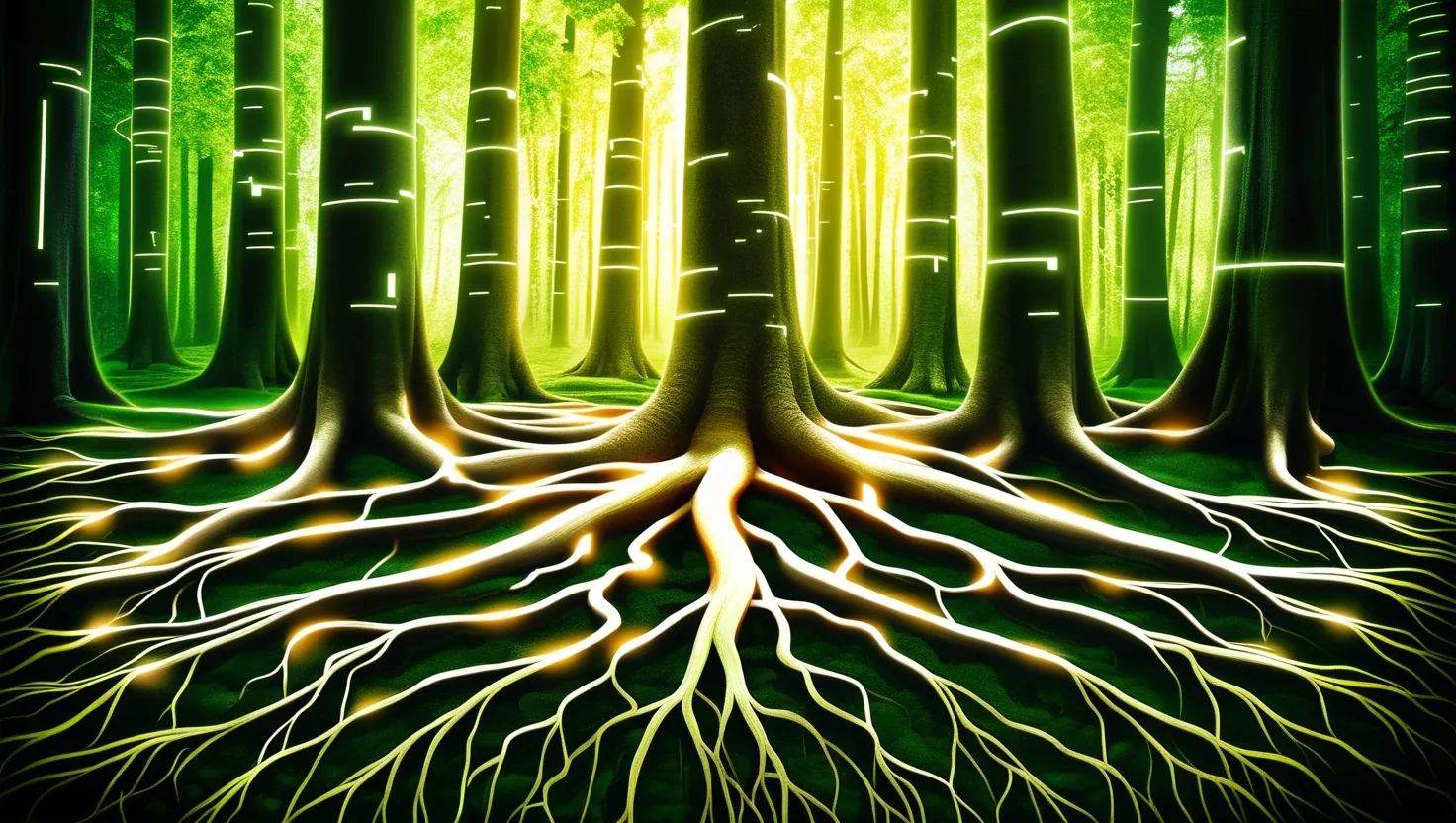
Imagine walking through a forest, surrounded by the rustling of leaves and the chirping of birds, and wondering if the trees around you are secretly communicating with each other in a way that defies our conventional understanding of reality. This intriguing idea is rooted in the concept of quantum entanglement, a phenomenon where particles become interconnected in such a way that the state of one particle instantly influences the state of the other, regardless of the distance between them.
In the realm of quantum physics, entanglement is not just a curiosity but a fundamental aspect of many emerging technologies, including quantum computing and secure quantum communication. However, the possibility that plants might be using this same principle to communicate raises a host of fascinating and somewhat unsettling questions.
To begin with, let’s consider the efficiency of photosynthesis, a process that is crucial for plant life and yet remains somewhat mysterious. Photosynthesis involves the transfer of energy from sunlight to chemical bonds in plants, a process that occurs with nearly 100% efficiency. This is far more efficient than any human-made technology, and it has led some scientists to suggest that plants might be using quantum mechanical effects to achieve this.
One of the key findings in this area came from a group of MIT physicists who discovered that the energy transfer in photosynthesis might be facilitated by quantum coherence. Essentially, this means that the energy excitons in plant cells can exist in multiple states simultaneously, allowing them to explore different pathways to reach the reaction center where photosynthesis occurs. This quantum “beat” or interference pattern was observed in experiments, suggesting that plants could indeed be leveraging quantum mechanics to optimize their energy transfer processes.
But what if this quantum behavior is not limited to internal processes within a plant? What if plants are using entangled particles to communicate with each other and even with their environment? This idea might seem like the stuff of science fiction, but it is an area of active research and speculation.
For instance, consider the coordinated responses of forests to threats such as wildfires. When one tree senses danger, it can release chemical signals into the air or soil to warn its neighbors. However, this process is often slower than the observed responses, leading some to wonder if there might be a more immediate, quantum-based communication mechanism at play.
Invasive species, too, seem to adapt to new ecosystems with surprising speed. Could it be that these plants are tapping into a quantum network that allows them to share information about resources and threats across vast distances? While this is highly speculative, it highlights the complexity and interconnectedness of plant life in ways that traditional biology alone cannot fully explain.
The concept of a “quantum internet” for plants is both captivating and challenging. If plants can indeed communicate through entangled particles, it opens up new avenues for understanding ecological systems. For example, could forests be influencing weather patterns through some form of collective, quantum-coordinated behavior? This might sound far-fetched, but it’s an idea that aligns with the growing recognition of the intricate web of life in ecosystems.
To understand how this could work, let’s look at the principles of quantum entanglement in other contexts. In quantum communication, entangled photons are used to create secure channels for data transmission. Any attempt to measure or intercept these photons would disrupt their entangled state, making it clear that the communication has been compromised. Similarly, if plants were using entangled particles to communicate, any external interference could potentially disrupt this network.
Researchers at the Max Planck Institute for the Science of Light have recently demonstrated a way to entangle photons with acoustic phonons (sound waves), which is resilient to external noise. This breakthrough could have implications for how we think about quantum communication in various domains, including potentially in plant biology.
However, there are significant challenges to overcome before we can say with certainty that plants are using quantum entanglement to communicate. One of the main issues is the fragility of entangled states; they can easily collapse when exposed to the environment. This makes it difficult to study and harness entanglement in practical applications, let alone in the complex and dynamic environment of a forest.
Despite these challenges, the idea that plants might be communicating through quantum entanglement is a compelling one. It suggests a world where the natural and the quantum are deeply intertwined, where the boundaries between different forms of life and their environments are more fluid than we ever imagined.
As we explore this green-tinged quantum mystery, we are forced to question everything we thought we knew about the secret lives of plants. Are we walking through hidden networks of information every time we step into a forest? The answer, much like the quantum world itself, remains shrouded in mystery and intrigue.
In the end, whether or not plants are using quantum entanglement to communicate, the mere possibility opens up new and exciting avenues for research. It challenges us to think differently about the interconnectedness of life and the role that quantum mechanics might play in the natural world. As we delve deeper into this fascinating area, we may uncover secrets that not only reshape our understanding of plant biology but also our place within the intricate web of life on Earth.