Spontaneous Human Combustion: 5 Documented Cases Science Still Cannot Fully Explain
Explore 5 chilling documented cases of spontaneous human combustion — where bodies turned to ash while surroundings stayed intact. Science still has no complete answer.
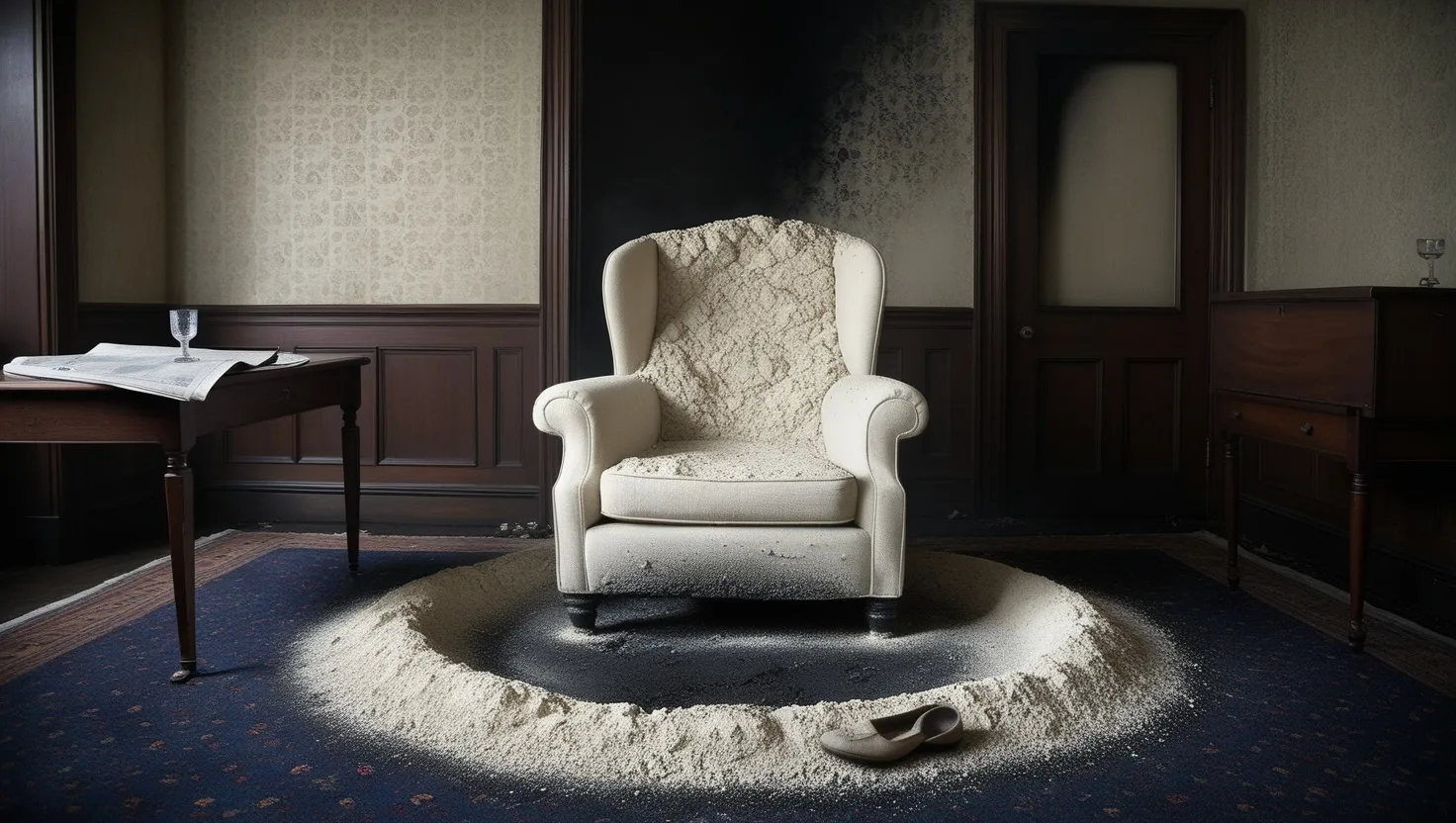
There are fires that make sense. A candle tips over, curtains catch, smoke alarms scream. We understand those fires. They follow rules.
Then there are fires that don’t.
Imagine walking into a room and finding a chair reduced to ash, a human skeleton crumbled to powder, and a ceiling lightly blackened — but the newspaper on the table next to it? Untouched. The plastic cup on the shelf? Still standing. The carpet beneath the body? Burned in one precise circle, like someone took a compass and drew the boundary of destruction by hand.
This is not fiction. This has happened. Multiple times. Across different countries, different centuries, and different circumstances. And the most honest answer science has given us so far is: we’re not entirely sure what happened.
Let’s walk through five of the most documented cases of what researchers call Spontaneous Human Combustion — or SHC — and ask some uncomfortable questions along the way.
Mary Reeser — St. Petersburg, Florida, 1951
On the morning of July 2nd, 1951, a landlady named Pansy Carpenter knocked on Mary Reeser’s apartment door to deliver a telegram. The doorknob was warm. When police arrived, they found a four-foot circle of ash, a skull shrunken to the size of a baseball, a single left foot still wearing a slipper, and a liver fused to a vertebra. The rest of Mary — all 175 pounds of her — was gone.
The apartment itself was barely touched. A candle on a nearby table had not fallen. A stack of newspapers sat intact. The ceiling had a thin coat of soot above the circle of destruction, but the walls, the furniture, the curtains — fine.
The FBI investigated. Their conclusion was essentially: she was a heavy smoker who may have fallen asleep with a cigarette. But here’s what that theory quietly ignores — crematoriums operate at temperatures between 1,400 and 1,800 degrees Fahrenheit for two to three hours to reduce a body to ash. A cigarette, or even a house fire, cannot produce that kind of focused, sustained heat in a four-foot radius without igniting everything around it.
What exactly does it take to reduce a human skull to the size of a child’s fist while leaving a slipper intact?
Dr. John Irving Bentley — Coudersport, Pennsylvania, 1966
A meter reader named Don Gosnell visited Dr. Bentley’s home in December 1966. He noticed a strange, sweet odor — described by others in similar cases as a mix of burnt fat and something almost floral — and found a hole burned through the bathroom floor. All that remained of the 92-year-old doctor was his lower right leg, still wearing a slipper, standing upright next to the hole.
The hole was the size of a body. The surrounding tiles, the toilet, the bathtub — untouched. The basement below had a small pile of ash.
Dr. Bentley used a walker and was known for dropping pipe embers on his robe, which had burn holes in it. But his robe, even if fully ignited, could not generate temperatures sufficient to burn through a ceramic-tiled floor. Ceramic tiles require approximately 2,000 degrees Fahrenheit to crack.
“The most beautiful thing we can experience is the mysterious. It is the source of all true art and science.” — Albert Einstein
Nicole Millet — Reims, France, 1725
This case is where the term “spontaneous combustion” effectively entered legal record. A innkeeper named Jean Millet was initially charged with murdering his wife Nicole after she was found burned to death in her chair. What saved him was a surgeon named Nicholas le Cat, who argued in court that Nicole had consumed so much wine over her lifetime that her body had essentially become flammable from the inside.
The court accepted this theory and Jean Millet was acquitted.
The “alcohol saturation” theory sounds bizarre, and scientifically it is — the human body cannot actually store enough alcohol in tissue to act as an accelerant. But what makes this case historically significant is that it forced the medical and legal establishment to acknowledge that a human body could, under some circumstances, burn in ways that defied conventional fire behavior.
Charles Dickens used spontaneous human combustion to kill off the character Krook in Bleak House. When scientists criticized him for it, Dickens actually wrote a preface to the novel defending the phenomenon and citing documented cases.
Henry Thomas — Gwynedd, Wales, 1980
In January 1980, the son of 73-year-old Henry Thomas arrived at his father’s home and found the living room destroyed from within. The television was melted. The ceiling was blackened. And Henry Thomas had been reduced almost entirely to ash — except for his feet and lower legs, still in their trousers, sitting undisturbed in front of the chair where he had apparently been watching television.
No external flame source was ever identified.
What makes this case particularly strange is the selective nature of the destruction. The trousers on the lower legs were not burned. The feet inside the shoes were intact. But the upper body — the torso, the arms, the skull — was ash. The heat appeared to originate somewhere around the abdominal region and radiate outward and upward.
Why does this keep happening with the feet? Why does the lower extremities survive in case after case?
Michael Faherty — Galway, Ireland, 2010
This is the case that made scientists sit up a little straighter, because it came with an official ruling. West Galway coroner Ciaran McLoughlin recorded the cause of death as spontaneous human combustion — making it one of the very few times an official government inquiry has used that term on a death certificate.
76-year-old Michael Faherty was found burned to death in his home on December 22nd, 2010. His body was near a fireplace, but investigators confirmed the fireplace fire had not spread. The ceiling above him was damaged. The floor beneath him was damaged. Nothing else in the room was. His body was almost entirely incinerated.
The coroner stated, after thorough investigation: “This fire was thoroughly investigated and I’m left with the conclusion that this fits into the category of spontaneous human combustion.”
“There are more things in heaven and earth, Horatio, than are dreamt of in your philosophy.” — William Shakespeare, Hamlet
So what is actually going on?
The most popular scientific theory is called the “wick effect.” The idea is that clothing acts like a candle wick, and human body fat acts as the fuel. Once ignited — by a cigarette, say — the body slowly burns like a candle, hot enough in the center to calcify bone, while the heat dissipates before reaching surrounding objects.
It’s a reasonable theory and has been partially demonstrated in lab conditions using pig tissue. But it has serious gaps. It doesn’t explain the shrunken skulls. It doesn’t explain why feet and lower legs survive. It doesn’t explain cases where no ignition source existed at all. And it doesn’t explain why the temperatures implied by the bone calcification — temperatures no wick-effect simulation has ever replicated — didn’t char the furniture three feet away.
Some researchers have proposed that internal body gases, triggered by some unknown biochemical process, could ignite under specific conditions. Others have pointed to ball lightning, geomagnetic anomalies, and even mitochondrial chain reactions. None of these theories have been proven, and most have been quietly abandoned after failing basic scrutiny.
What we are left with is this: in each of these five cases — and in the roughly 200 documented cases researchers have catalogued since the 1600s — the physical evidence shares the same signature. Localized, intense incineration. Intact extremities. A greasy residue coating nearby surfaces. A distinctive odor. No credible external ignition. And destruction of the core of the body so complete that identification is often impossible.
Could it be that there is a mechanism within the human body, under specific and rare conditions, that we simply haven’t identified yet? The history of medicine is full of things that were once dismissed as impossible and later explained. Prions. Epigenetic inheritance. The gut-brain connection. All of these were once the fringe.
“The first step toward knowledge is to know that we are ignorant.” — Richard Cecil
Ask yourself this — if you walked into a room and found what Mary Reeser’s landlady found, what explanation would satisfy you? Because “she fell asleep with a cigarette” and “the wick effect” don’t produce a skull the size of a baseball. They don’t melt the fat and leave the newspaper. They don’t burn a precise hole through a ceramic tile floor.
Something happened in those rooms. Something that followed its own rules. And the most intellectually honest position any of us can hold right now is that we don’t fully understand what those rules are yet.
The fire didn’t spread because it didn’t need to. It already had exactly what it came for.