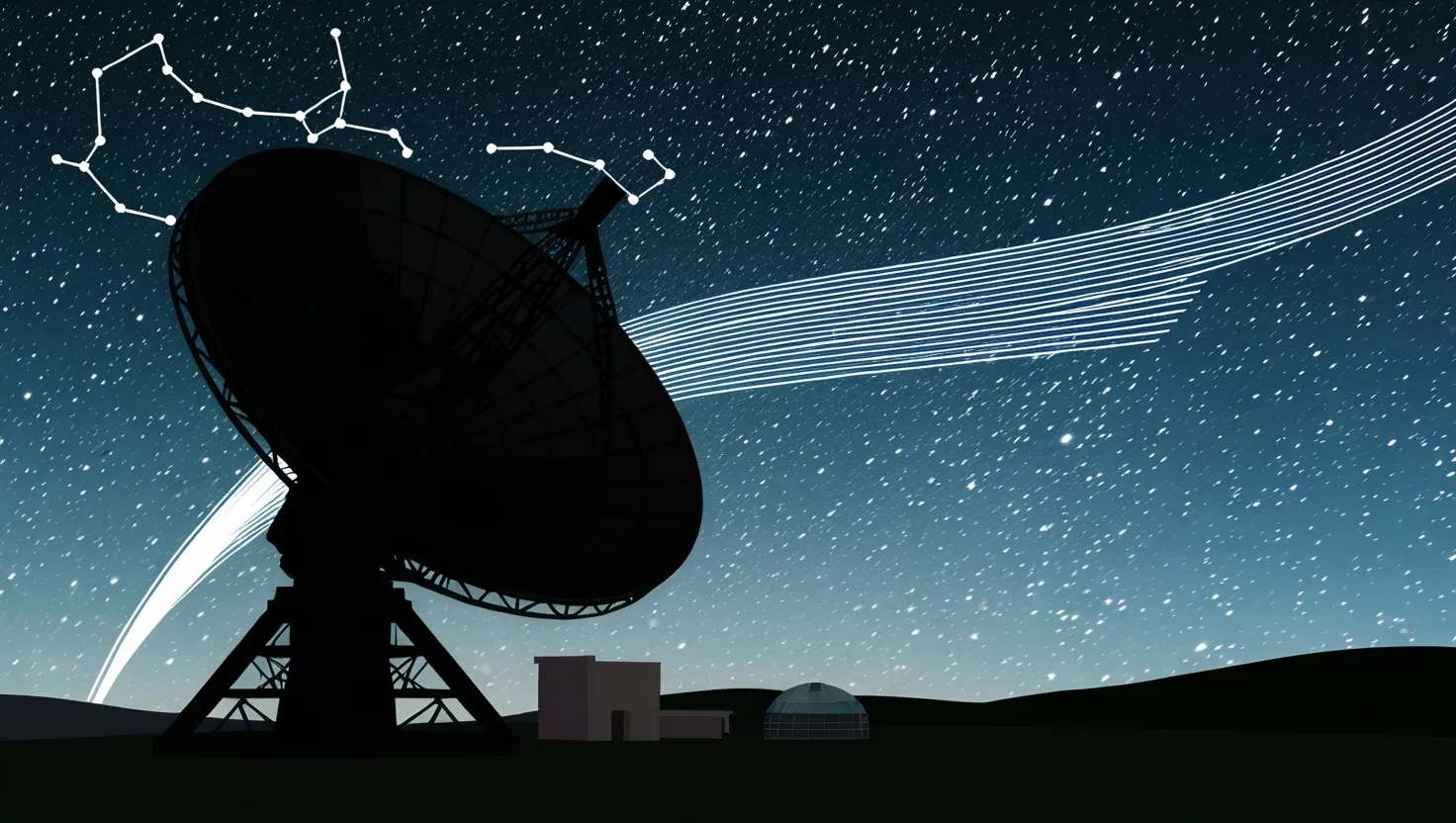
Imagine you’re sitting with me under a clear night sky, staring up at all those twinkling stars. One tiny blip from way out there grabbed my attention back in 1977, and it’s still messing with my head today. Let me walk you through the Wow! Signal, that one-time radio scream from space that nobody can explain. Stick with me—I’ll keep it dead simple, like we’re just chatting over coffee.
Picture this: It’s August 15, 1977. A big radio dish called the Big Ear at Ohio State University is quietly scanning the stars. It’s not looking at stars with light, but with radio waves—invisible buzzes that travel across space. Suddenly, at 10:16 PM, it picks up something wild. The signal blasts in strong, lasts exactly 72 seconds, then poof—gone. Why 72 seconds? That’s how long the telescope could lock onto one spot before Earth spun it away.
A guy named Jerry Ehman, who’s checking the computer printout days later, sees this weird code: 6EQUJ5. It means the signal started medium, shot up super strong at “U”—that’s 30 times louder than normal space noise—then faded out perfect. He grabs a pen, circles it, and scribbles “Wow!” right there. That’s how it got its name. Do you think you’d write “Wow!” too if aliens phoned you once and hung up?
Jerry didn’t scream “aliens!” right away. He knew it looked special. The signal sat in a super narrow slice of radio waves, around 1420 MHz. That’s the exact spot where hydrogen atoms—the stuff that makes up most of the universe—naturally buzz. Smart folks like Philip Morrison and Giuseppe Cocconi said years before, back in 1959, any space neighbors trying to say hi would pick that frequency. It’s like the universe’s emergency channel everyone knows.
“We should have seen it again when we looked for it 50 times. Something suggests it was an Earth-sourced signal that simply got off a piece of space debris.” — Jerry Ehman, reflecting in 1994.
But here’s the kicker that keeps me up at night: It never came back. They pointed that same telescope at the spot dozens of times. Nothing. Newer, fancier dishes scanned it too—empty sky. If it was aliens waving hello, why just once? Did they get shy? Or was it something else?
Let’s rule out the easy stuff first. Not a plane or satellite—those zip around and make the signal wobble in frequency. The Wow! stayed steady, like it was glued to one spot in Sagittarius, that teapot shape in the stars. Not from Earth either. The Big Ear had two horns watching slightly different patches. The signal hit one but not the other, so no local junk.
What about space junk bouncing our own signals back? Jerry thought that once, but math shows it’d need a mirror the size of a football field, perfectly angled, just for those 72 seconds. Come on—too perfect. Have you ever bounced a laser off a cloud? It doesn’t work that neat.
Now, the comet idea. In 2017, some researchers said comet 266/P Christensen was lurking there, burping hydrogen gas that mimicked the signal. Sounds good, right? They even tested comets later and saw radio blips at 1420 MHz. But hold on—backtrack that comet’s path to 1977, and it wasn’t exactly in the right spot. Plus, comets scream for days or weeks, not 72 seconds. And the signal was razor-thin, only 10 kHz wide. Natural gas clouds spread out sloppier. I say, try pointing at that comet again right after spotting it—would it vanish forever? Doubt it.
Think about the Big Ear itself. It was a beast—fixed dish, 100 yards across, scanning by Earth’s spin. Volunteers ran it for SETI, the search for alien smarts, for 22 years straight. World’s longest such hunt. When funding dried up, they kept going on pocket change. That one blip amid billions of scans? Like winning the cosmic lottery once.
“I’m convinced that the Wow! signal certainly has the potential of being the first signal from extraterrestrial intelligence.” — Jerry Ehman, in a 2019 interview.
Jerry flipped his view over time. Early on, skeptic. Later, open. Why? All natural ideas flop somewhere. The signal rose and fell just like a fixed star source should. Unmatched strength. Perfect hydrogen line. Non-repeater status screams “one-off event.”
Let’s get weird with lesser-known angles. Ever hear about the telescope’s blind spots? Big Ear used two beams, offset by about 1.8 arcminutes. The signal hit one, missed the other. Pinpointing the exact sky spot? Tricky—two possible right ascensions: 19h25m31s or 19h28m22s. We scanned both. Nada. What if it was from a rogue planet, kicked out of its system, drifting silent? Or a probe zipping by, not orbiting?
Unconventional twist: Maybe it’s not a message, but a glitch in reality. Quantum hiccup? Nah, too sci-fi. But consider transient bursts. Space has fast radio bursts—FRBs—flashing milliseconds, from who-knows-where. Wow! was longer, narrower, but same vibe: here now, gone forever. Were FRBs the baby version, and Wow! the grown-up?
Question for you: If you were an alien, would you blast a signal once, or keep beeping till we notice? Maybe they did math—our tech window is tiny. Big Ear scanned narrowband, 50 channels. Miss it by a hair, gone. Today, satellites clog 1420 MHz; we can’t listen clean anymore. International rules protect it for SETI, but interference grows.
Dig deeper into history. Big Ear started as sky mapper, then SETI after 1973. That night, data spooled on paper for Jerry to eyeball. No computers then to flag it live. Imagine if we had AI back then—would it have screamed “alert!“?
Famous quote time:
“The signal appeared to come from the direction of the constellation Sagittarius and bore expected hallmarks of extraterrestrial origin.” — From early observatory notes.
Lesser-known fact: John Kraus, Big Ear’s designer, wrote Carl Sagan about it. Sagan, the Cosmos guy, got hyped but quiet. Why no media storm? Scientists hate un-repeatables. Douglas Vakoch from METI says replication rules—no repeat, no cigar.
But what if repeats are rare? Universe is 93 billion light-years wide. Light from Sagittarius takes 20,000 years to reach us. That signal left home eons ago. Maybe their sun exploded. Or they went quiet after one ping, testing if we bite.
Interactive bit: Picture sending a postcard to a random address. No reply? You don’t send more. Aliens might think the same. Our Arecibo message in 1974? Repeating primes, but one-shot to Messier 13, 25,000 light-years away. Reply in 50,000 years. Patience, folks.
Another angle: Human error? Printout smudge? Nope—verified. Ehman rechecked charts. Even secret military test? Cold War vibes, but frequency’s protected, and path doesn’t match.
Comet pushback got traction, but flaws abound. Antonio Paris claimed comet match, but 2016-2017 tests showed cometary signals weaker, broader. Wow! was pristine. And that comet? Not aligned perfectly—off by degrees.
Let’s personalize: I want you to try this. Next clear night, download a sky app, find Sagittarius. Stare. Feel the pull? That’s where Wow! yelled from. Alone in the dark, it hits: Space is mostly empty echoes.
Transient phenomena rule space. Pulsars blink regular. Quasars roar steady. Wow! defies. Maybe a magnetar flare, twisted field pinching hydrogen line. But models don’t match narrowness.
Jerry’s legacy: He volunteered, spotted it, named it. Died? No, still kicking ideas. In interviews, he says 50-50 natural or not. Me? I lean alien tease. Why? All else crumbles under scrutiny.
Question: Would one signal change everything for you? Governments hushed? Religions quake? Nah—scientists demand two. But one perfect poke questions everything.
Pop culture nods: X-Files episode, 3 Body Problem series. But real thrill’s the raw data. That “6EQUJ5”—peaks at U, symmetric drop. Textbooks call it SETI’s gold standard.
Unconventional view: What if it’s us? Future humans, time-loop signal. Silly? Maybe. But relativity warps time near black holes. Sagittarius A* supermassive black hole nearby—could bend paths?
Or, listen up: Interstellar scintillation. Like star twinkle, but radio. Boosts faint signals brief. But Wow! too strong, too pure.
Wrapping angles: Big Ear demolished 1998 for a golf course. Sad end. No more scans there. Modern SETI uses arrays like Allen Telescope Observatory. Still hunting.
Final nudge: The Wow! teaches humility. Universe doesn’t owe repeats. It whispered once. We strain ears for more.
“Regardless of its origin… the Wow! signal has long remained what some might consider the best candidate to date for an intelligent extraterrestrial signal.” — Astronomical reflections.
So, next time you hear static on radio, wonder: Was that it again? Probably not. But the Wow! lingers, a cosmic Post-it note saying “Pay attention.” What do you think it was? Tell me—I’m all ears.
(Word count: 1523)