The Bloop: The Unexplained Deep Ocean Sound That Scientists Still Can't Identify
Discover the Bloop — a mysterious deep-sea sound louder than a blue whale, recorded in 1997. What made it? Science still isn't sure. Read the full story.
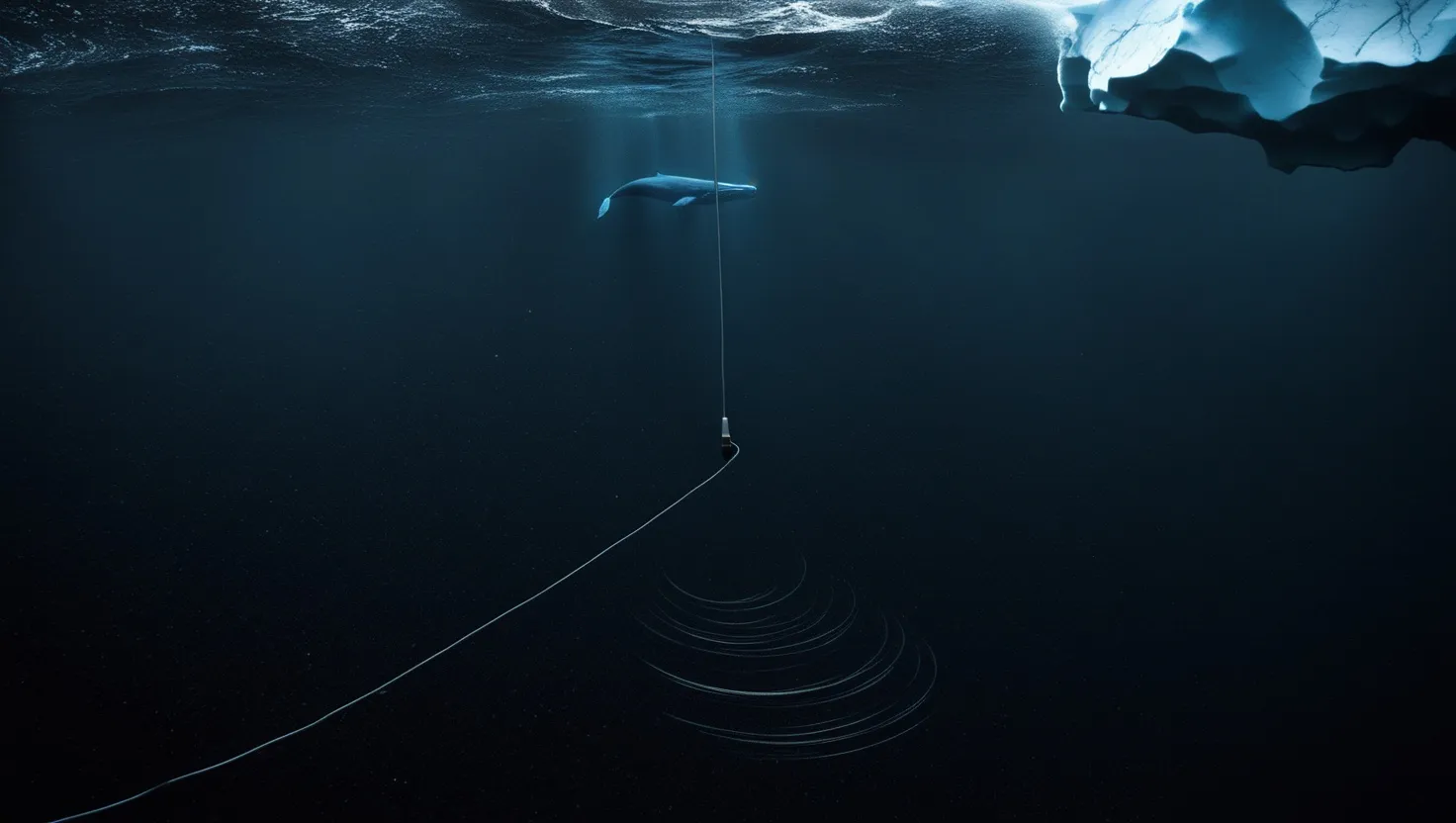
The ocean is the loudest place on Earth. Most people don’t know that. We think of the deep sea as silent, dark, and still. But the truth is, it never shuts up. Earthquakes rumble through it. Volcanoes hiss and spit. Whales call to each other across thousands of miles. Icebergs crack like thunder in slow motion. The ocean is a constant, rolling conversation. And in 1997, something interrupted that conversation with a sound that nobody could explain.
It was August. A network of underwater microphones scattered across the equatorial Pacific picked up a signal. These weren’t ordinary microphones. They were hydrophones — devices originally built by the U.S. Navy during the Cold War to hunt Soviet submarines. After the Cold War ended, they were handed over to the National Oceanic and Atmospheric Administration, who used them to listen to the ocean for scientific purposes. These systems were extraordinarily sensitive. They could detect a shrimp snapping its claws hundreds of miles away. So when something unusual showed up in the data, people paid attention.
The signal lasted about a minute. It started low, rose to a peak, then faded. Its highest recorded frequency was around twenty-five hertz — right at the bottom edge of what a human ear can detect. If you slow the recording down to a speed humans can hear more easily, it sounds like a long, rising moan. Something like a whale call, but with a shape that’s almost… deliberate. Almost structured. The scientists who first heard it called it the Bloop.
“The sea, once it casts its spell, holds one in its net of wonder forever.” — Jacques Yves Cousteau
Here’s the part that should make you stop and think. A blue whale is the loudest animal on Earth. Its calls can travel thousands of miles through the ocean. The Bloop was several times louder than a blue whale. If the Bloop came from a living creature, that animal would have to be enormous — not just large, but incomprehensibly large. Larger than anything we’ve ever found, living or fossilized. Larger than anything that fits into our current understanding of biology.
So what was it?
An oceanographer named Christopher Fox spent years working on that question. Using data from multiple hydrophone arrays, his team triangulated where the sound came from. The origin pointed to a remote area west of the southern tip of South America, in the South Pacific — one of the most isolated and least-explored stretches of water on the planet. In 2002, Fox proposed that the Bloop was probably the sound of a large iceberg grinding against the seafloor, a process that can produce powerful, low-frequency noise for extended periods. The area is known for ice movement. The physics, he argued, were plausible.
That explanation sounds clean. But it has gaps. No iceberg was identified at the location. No follow-up acoustic pattern consistent with glacial calving — those cascades of smaller cracks and rumbles that typically accompany ice events — was recorded. A glacier breaking apart tends to make rough, jagged, irregular noise. The Bloop had a shape. It rose and fell in a way that resembled biological vocalization. People who study whale acoustics noted that the frequency sweep of the Bloop looked similar to how an animal adjusts the pitch of a call — not like the random fracture of ice.
“In every walk with nature, one receives far more than he seeks.” — John Muir
Does that mean it was a creature? Not necessarily. It means the explanation on the table doesn’t fully fit the data. That’s a different, more honest thing to say.
The lore that grew around the Bloop was predictable. Sea monsters. Giant squid. Secret military projects. Science fiction writers and conspiracy theorists had a field day. H.P. Lovecraft’s fictional monster, Cthulhu, was said to sleep beneath the Pacific in his sunken city of R’lyeh — and the coordinates that Fox’s team mapped for the Bloop’s origin were remarkably close to where Lovecraft had placed that city in his stories. This was a coincidence, but it was the kind of coincidence that people with imaginations find hard to ignore.
The scientific community rightly pushed back against the monster theories. But here’s what’s interesting — they pushed back without fully replacing them. The iceberg hypothesis was presented as the most likely explanation, which is not the same as a confirmed explanation. The Bloop has never been heard again at that intensity. There’s no repeat event to study, no follow-up data to check the theory against. It exists as a single, archived acoustic event that any person can download from NOAA’s website and listen to right now.
Think about that for a moment. A sound of unknown origin, captured on equipment built to spy on submarines, from one of the most remote places on Earth, that has never happened again. It’s not mythology. It’s a real file in a real database.
“The more clearly we can focus our attention on the wonders and realities of the universe about us, the less taste we shall have for destruction.” — Rachel Carson
What makes the Bloop genuinely interesting isn’t the monster angle. It’s what the whole episode reveals about the limits of human knowledge. We’ve mapped the surface of Mars in more detail than we’ve mapped the ocean floor. The deep sea is not a place we understand well. It’s a place we’ve barely visited. The pressure at the bottom of the Mariana Trench is about eleven thousand pounds per square inch — enough to crush a human body instantly. Exploration there requires machines, and even machines have limits.
Sound, though, travels beautifully underwater. It moves faster than it does through air. It carries farther. The ocean is actually one of the best environments in the universe for acoustic communication, which is why whales evolved to use it so effectively. And because sound travels so well down there, it’s one of the few ways we have to study parts of the ocean we can’t physically reach. The hydrophone network that caught the Bloop isn’t just a Cold War relic — it’s one of humanity’s most powerful tools for listening to a planet that is constantly in motion.
What do you think makes a sound “biological”? Is it the pitch? The pattern? The way it rises and falls? These are not easy questions, and the people who study ocean acoustics argue about them regularly.
One lesser-known fact about the Bloop is that it wasn’t the only unexplained sound NOAA recorded from those hydrophones during that period. There were others — named things like Slowdown, Whistle, Julia, and Train — all captured between 1997 and 1999, all from remote parts of the deep ocean, all without confirmed explanations. The Bloop simply got the most attention because its frequency pattern was the most unusual. Together, these sounds form a kind of catalogue of things the ocean made that we don’t fully understand.
“We know more about the movement of celestial bodies than about the soil underfoot.” — Leonardo da Vinci
Another angle worth sitting with: the hydrophone network was designed to detect man-made objects moving through water. Its filters and sensitivity were calibrated for submarines — metal objects with specific acoustic signatures. When something outside that design template showed up, the system flagged it but couldn’t tell us more. It’s a bit like trying to identify a smell using a tool built to measure temperature. The instrument caught something real. What it couldn’t do was tell us precisely what that something was.
The Bloop recorded a single event. A single minute of rising, falling noise. And from that one minute, it has generated decades of debate, multiple hypotheses, endless public fascination, and not one definitive answer. That’s either a failure of science or a reminder of how big the world still is — depending on how you look at it.
Science doesn’t always end with a clean answer. Sometimes it ends with a better question. The Bloop asked something the ocean has been asking us since the first person stood on a shoreline and stared at the horizon: How much of this do you actually understand?
The honest answer is: not as much as we think.