The Cosmic Cold Spot: Is This Anomaly in the CMB Proof of Another Universe?
Explore the Cosmic Cold Spot — a mysterious anomaly in the CMB that baffles physicists. Could it be a supervoid, a multiverse bruise, or a statistical fluke? Find out.
Somewhere in the southern sky, in a constellation most people couldn’t point to on a star map, the universe appears to be broken. Not cracked, not dented — broken in a way that makes physicists uncomfortable, that keeps cosmologists up at night, and that no one, despite decades of effort, has been able to fully explain. The place is called the Cosmic Cold Spot, and if you’ve never heard of it, you’re about to understand why it might be the strangest thing in the observable universe.
Let me set the scene simply. About 380,000 years after the Big Bang — which, in cosmic terms, is basically the morning after creation — the universe cooled just enough for light to finally move freely through space. Before that moment, everything was so hot and dense that light couldn’t travel anywhere. It was like trying to shine a torch through a brick wall. Then, suddenly, the wall came down. Light rushed outward in every direction, and that ancient light is still traveling today. We call it the Cosmic Microwave Background, or CMB. Think of it as the universe’s baby photo.
“The most incomprehensible thing about the universe is that it is comprehensible.” — Albert Einstein
Now here’s the thing about that baby photo. It should look almost perfectly uniform. The early universe was, according to every model we trust, extraordinarily smooth. Yes, there were tiny temperature variations — about one part in 100,000 — like gentle ripples on an otherwise still pond. Those ripples eventually grew into galaxies, stars, and everything you’ve ever touched. But no single region should be dramatically colder or hotter than any other. The rules of physics say so. Our best mathematics says so.
And yet, there it is. A vast patch of sky in the direction of the constellation Eridanus, sitting quietly, and stubbornly cold.
Have you ever looked at a perfectly painted wall and noticed one strange dark stain that shouldn’t be there? That’s roughly what scientists felt when they first saw this anomaly in the data from the WMAP satellite in 2004, and again when the Planck satellite confirmed it in 2013 with even sharper resolution. The Cold Spot spans an area on the sky equivalent to nearly a thousand full moons. Its temperature is measurably lower than the surrounding CMB. Not slightly lower. Significantly, persistently, uncomfortably lower.
The first explanation people reached for was something called a supervoid. A supervoid is exactly what it sounds like — a gigantic region of space with far less matter in it than average. When light travels through such a region, something interesting happens. The gravitational pull inside the void is weaker, and as photons pass through, they lose a tiny amount of energy. Less energy means lower temperature. This effect is real, it’s measurable, and it’s called the Integrated Sachs-Wolfe effect. The problem is the math.
For a supervoid to explain the Cold Spot’s depth and size, it would need to be roughly a billion light-years across. To put that in perspective, our entire Milky Way galaxy is about 100,000 light-years wide. We’re talking about a structure ten thousand times larger. No structure that big has ever been confirmed anywhere in the universe. And if one did exist in that direction, it would challenge one of the most fundamental assumptions in cosmology — the idea that on very large scales, the universe looks roughly the same everywhere you look.
“We are just an advanced breed of monkeys on a minor planet of a very average star. But we can understand the universe. That makes us something very special.” — Stephen Hawking
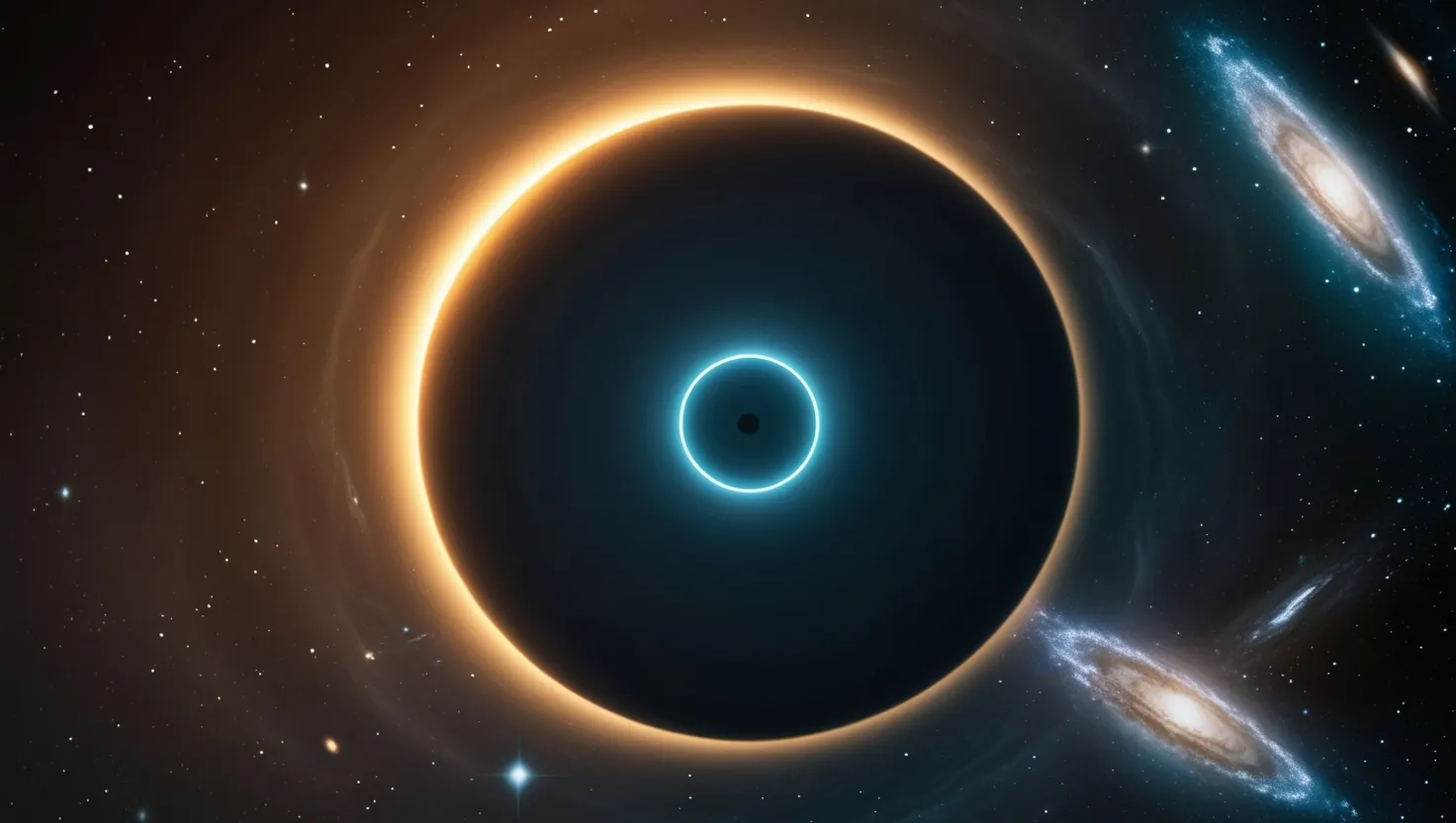
So if a supervoid doesn’t cut it, what does? This is where things get genuinely strange. Some cosmologists have put forward the idea that the Cold Spot is a scar — a physical imprint left by a collision between our universe and another universe entirely. If you accept the idea that our universe is one bubble in a much larger multiverse, then other bubbles might exist nearby. If two universes collide, the impact would leave a mark. A bruise. And the Cold Spot, with its unusual depth and shape, fits the profile of what such a bruise might look like in the CMB.
What do you think? Could the universe have neighbours? It sounds like science fiction, but the mathematics behind the multiverse is serious physics taken seriously by serious people. The problem is that it’s essentially untestable with any instrument we currently have or are likely to build soon. You can’t send a probe to the edge of our universe to check. You can’t build a detector that measures another cosmos. So the multiverse explanation is, for now, an idea with good bones and no proof.
There’s another possibility that deserves attention, and it’s one scientists are often reluctant to say out loud: maybe it’s a fluke. Statistics allows for anomalies. If you flip a coin a trillion times, you’ll occasionally get a run of results so unlikely they look meaningful. The Cold Spot, statistically speaking, has roughly a one-in-a-few-thousand chance of occurring by chance. That sounds rare, but the CMB map has thousands of regions, and rare things happen somewhere in large datasets. Scientists have cross-checked the Planck data against other instruments, looked for processing errors, and tried to rule out a simple mistake. Nothing has been found. The Cold Spot keeps showing up, clean and cold, right where it has no business being.
“The universe is not only stranger than we suppose, but stranger than we can suppose.” — J.B.S. Haldane
Here’s a fact most people don’t know: the Cold Spot isn’t just cold. Its shape is unusual too. It has a ring-like structure around it — a slightly warmer ring surrounding a colder centre — which is precisely what some collision models predict. That’s not nothing. A random statistical fluke wouldn’t necessarily produce that kind of structured shape. It’s the kind of detail that keeps the multiverse theory alive even among skeptics.
Ask yourself this — if the universe has an edge, what’s on the other side?
Researchers have looked at whether the Cold Spot could be connected to known large-scale structures in that part of the sky. In 2015, a team studying galaxy surveys announced they had found a supervoid in the right direction, roughly 1.8 billion light-years away. For a moment, headlines suggested the mystery was solved. But the numbers still didn’t add up completely. The void they found was real, but not large enough or empty enough to account for the full temperature drop. It could explain part of the anomaly. Not all of it.
What makes the Cold Spot philosophically unsettling isn’t just the temperature. It’s what it represents. Cosmology is built on the assumption that physics works the same way everywhere, that the universe follows consistent rules across all of its unimaginable expanse. The Cold Spot, if it turns out to be something truly exotic, threatens that assumption. It suggests that our model of the universe might be missing a piece — possibly a very large piece.
“Not only is the universe stranger than we think, it is stranger than we can think.” — Werner Heisenberg
Think of it like building a puzzle. You’ve got 999 pieces placed perfectly, the picture is coming together beautifully, and then there’s one piece that doesn’t fit anywhere. You can force it into a gap, but the image looks wrong. The Cold Spot is that piece. Every explanation tried so far either requires something we’ve never observed, involves physics we cannot test, or falls short mathematically.
The Planck satellite has retired. The data it gave us will be analyzed for decades. Future missions, including surveys using next-generation radio telescopes, will map the distribution of galaxies in that region of sky with far more precision. If a supervoid of the right size and emptiness really does exist in the direction of Eridanus, we’ll eventually be able to see enough of it to settle the question. If the galaxy distribution looks perfectly normal, the supervoid theory dies, and we’re left with the multiverse bruise or the statistical fluke — neither of which is entirely comfortable.
The Cold Spot sits in the data like a quiet question with no clear answer. It’s been staring back at us for twenty years. The light that created it traveled for over 13 billion years before landing on our instruments, carrying a message from the very dawn of time. Whether that message says “statistical noise,” “impossible void,” or “hello from next door,” we haven’t been able to read it clearly yet.
The universe, it turns out, is not always forthcoming with its secrets.