Some of the most advanced codebreakers on Earth are stuck on problems that look like doodles from a bored teenager.
That fact alone should make you pause.
If we can send robots to Mars and crack enemy codes in war, why are we still confused by a weird plant book from the 1400s, some scratched symbols on ancient stones, and a letter full of numbers from a secret society?
I want to walk you through these undeciphered codes as if you and I were sitting together with the pages in front of us. No fancy language. No technical talk unless we really need it. Just simple ideas, clear pictures, and honest questions.
Because the big secret is this: these codes are not only about “being clever.” They are also about human memory, chance, loss, and sometimes pure chaos.
And that is why they still win.
“The most beautiful thing we can experience is the mysterious. It is the source of all true art and science.”
— Albert Einstein
Let’s start with the strange celebrity of the code world: the Voynich Manuscript.
Imagine a book that looks like a herbal guide written by someone who had never seen a real plant. The pages are full of odd flowers that do not exist, naked women bathing in green tubes, star diagrams that look half-astrology, half-board-game, and text written in a script no one has ever found anywhere else.
For more than a hundred years, people have tried to read it: military codebreakers, mathematicians, medieval historians, hobbyists, and modern AI systems. Some say it is a medical book. Some say it is a women’s health manual. Some say it is pure nonsense.
Here is the problem that experts quietly admit: it looks too much like a real language.
Letters repeat in patterns. Some “words” appear more in certain sections, like how the word “medicine” appears more in a medical book. The text follows statistical rules that real languages follow. So if it is a hoax, it is an extremely smart one, many centuries ahead of its time.
Now ask yourself: what if it is written in a normal language, but changed so heavily that we no longer recognize it? Maybe the writer removed vowels, or mashed several letters into one, or mixed two languages in one word. Can you imagine trying to read English if every vowel was deleted and half the letters were swapped with made-up shapes?
EVN THS SNTNC WLD B HRD T RD F YU DDNT KNW HW T FLL N TH GAPS
That is the scale of the task.
And here is a less obvious twist: even if we finally “solve” the Voynich Manuscript with computers, we might still argue for years over whether the answer is right. There is no bilingual version, no clear “key,” no known author, no “Rosetta Stone” to compare it with. We might end up with several “solutions,” and no simple way to prove which one is true.
So the first quiet truth about undeciphered codes is this: for many of them, we do not just lack answers; we lack a way to check answers.
“It is not the answer that enlightens, but the question.”
— Eugène Ionesco
Now think bigger. Some puzzles are not secret messages at all. They are full writing systems from entire civilizations.
Take the Indus Valley inscriptions. Thousands of tiny seals and objects from a very old civilization in South Asia carry short strings of symbols: animals, shapes, signs that repeat. You might expect that by now, with all our tools, we would have cracked them.
We have not.
The messages are very short. Many are only a handful of symbols long. That is like trying to learn English when the only phrases you get are “NO SMOKING,” “EXIT,” and “PUSH.”
Can you really learn a language from that?
We also have no long bilingual text that says, “Here is the same thing in the Indus script and in another language we already understand.” Without that, we are working blind. People argue over basic questions: is it a full language? Is it a set of religious symbols? Is it mostly about trade marks and names?
Here is something people rarely say out loud: some ancient writing systems might never be readable again, not because we are stupid, but because too much context is gone. The culture, the spoken language, the teaching tradition, the commentaries, the “schoolbooks”—all of it is lost.
Let me ask you this: if all books and recordings of music vanished, and someone 5,000 years from now only found a few scraps with song lyrics and no recordings, would they ever really know how those songs sounded?
They might get the words. But the life in them would be mostly guesswork.
Now move to a different kind of puzzle: the Copiale Cipher.
This was a thick, boring-looking book from an old German secret society. For a long time, it sat in archives, full of lines of strange symbols, sprinkled with the occasional normal letter. For around 250 years, nobody could read it.
Modern researchers finally cracked it, but here is the surprising part: to make progress, they basically gave up on the idea that the symbols stood for letters directly. Instead, they realized that some strange symbols were just pretending to be meaningful while the real information was hiding in the smaller, less noticeable signs.
The book turned out to be about initiation rituals, eye surgery metaphors, and secret meetings. But the method used to write it teaches something deeper. People who design codes are not always trying to be “mathematically perfect.” They are trying to delay, distract, and waste the attacker’s time.
The Copiale Cipher shows that confusion can be a tool. If you were looking at it centuries ago, you would chase the wrong patterns. You would waste years on the “big symbols,” ignoring the plain letters doing the real work.
Has it occurred to you that some codes stay unsolved not because we lack brains, but because we start with the wrong assumptions?
“We see only what we know.”
— Johann Wolfgang von Goethe
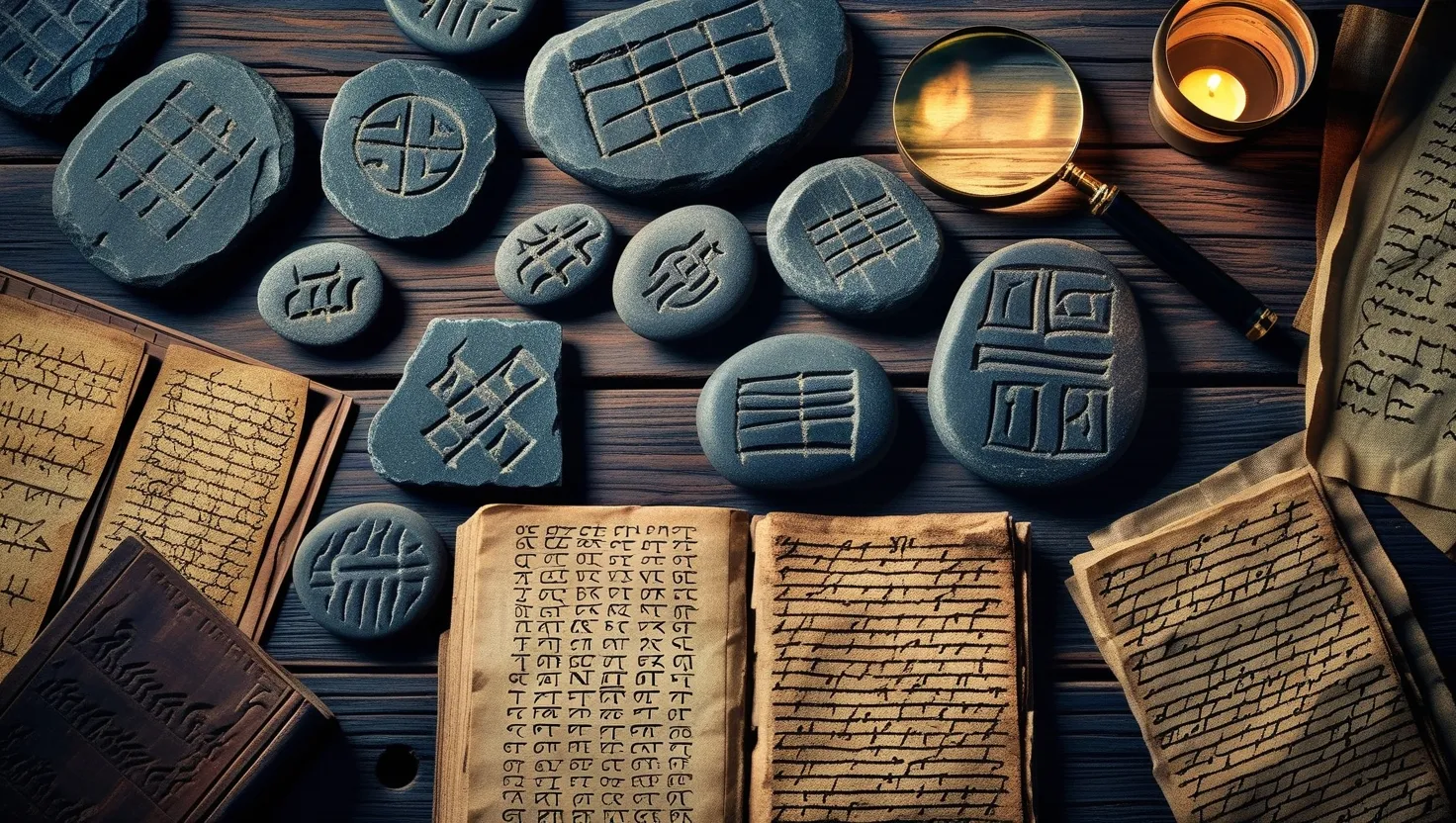
The same story appears again with other codes and scripts. Think of rongorongo, the carved signs from Easter Island. The boards are read in a strange back-and-forth direction. The signs might record genealogy, prayers, or something else entirely. But almost all the people who knew how to read them died or were killed in the 19th century.
So now we have wooden tablets but no living chain of teachers. A writing system without teachers is like a musical score without musicians. Everything becomes silent ink.
Then there is a simple letter from the court of Louis XIV of France, written partly in code. We have many coded letters from that time that have been solved. We even know who some code designers were. But this particular code, used in a small set of letters, still has no key.
This shows another quiet lesson: some unsolved codes are not grand world-changing mysteries. They may hide nothing more than routine politics or gossip. The difficulty does not always match the importance. A simple, messy private code, used by only a few people, can beat historians for centuries simply because nobody left the key lying around.
Does that change how “romantic” these puzzles feel to you?
Now let us talk about something that people rarely think about: noise.
We like to believe that every code has meaning. But what if some do not?
There are famous sets of ciphers, like the Beale papers (connected to a buried treasure story), where experts argue seriously about whether the whole thing is a hoax. Someone could fill pages with numbers made from a simple rule or from random choices. Our brains hate randomness. We instinctively search for patterns even when there are none.
Have you ever stared at clouds and “seen” faces and animals? That is the same trick of the mind.
For many undeciphered codes, we cannot be fully sure if we are dealing with:
A real language hidden by a method.
A private shorthand only the writer understood.
Meaningless scribbles that only pretend to hide a message.
That last option feels disappointing, so we resist it. But if we are honest, we have to keep it on the table.
“Where we cannot speak, we must pass over in silence.”
— Ludwig Wittgenstein
There is also a technological catch that few people notice.
Modern codebreaking tools, including AI, are very good at some things and quite weak at others. They shine when we have lots of data: long texts, many examples, known languages to compare. They struggle when the text is short, one-of-a-kind, and possibly written in a language that no longer exists.
Imagine trying to learn a language from a single tweet. That is what some of these inscriptions are like.
So when people say, “Why hasn’t AI solved the Voynich Manuscript?” they are mixing two ideas:
“Computers are fast” and
“We have enough clear clues to work with.”
Speed cannot replace missing information. If the signal is too thin, the smartest machine in the world will just produce nicer-looking guesses.
Now, at this point, you might be thinking: if some codes might be hoaxes, some might be too short, some might be missing context, and some might never be fully checked, why do people keep trying?
Because these puzzles are not just about reading old texts. They are about testing how we think.
Each unsolved code is a mirror. It shows us our habits:
We assume meaning when there might be none.
We cling to familiar methods when we might need new ones.
We underestimate how fragile knowledge is when teachers and traditions break.
Here is a question I often ask myself: what current systems—our programming languages, our file formats, our digital jokes—will become undecipherable in a few thousand years when all the supporting tools and explanations are gone?
Someone might dig up a hard drive, see “😂🔥💯” and a string of binary, and write long papers arguing over the “ancient ritual signs.” They might completely miss that it was just someone reacting to a meme.
That is not far from what we do now with some ancient texts.
“Those who cannot remember the past are condemned to repeat it.”
— George Santayana
But there is one more practical value in these undeciphered records.
Even when we cannot read them, we can still measure them.
We can count how often symbols appear.
We can see which signs like to stand at the beginning or end.
We can spot repeating patterns that look like names or titles.
We can compare them to known languages to see if they behave similarly.
From this, we learn things like:
“This script probably wrote a real spoken language.”
“This one behaves more like a list of labels or numbers.”
“This one might mix sound signs and idea signs.”
So even without full translation, we can place these systems on a map of writing practices across history. We can see that humans in different places kept inventing similar tricks: mixing pictures and sounds, creating short signs for common words, compressing speech to save effort.
In that sense, undeciphered scripts are like fossils of half-heard voices. We cannot catch every word, but we can see the shape of their thinking.
Now let me turn back to you for a moment.
What do you expect from a secret text?
Do you hope it hides lost scientific wisdom?
Do you imagine a shocking religious message?
Or are you okay with the idea that some of them might say simple things like “I own this,” “This is an offering,” or even “Practice tablet number 5”?
Understanding that our expectations color our search is important. When codebreakers look for messages, they are never truly neutral. They test patterns that match what they secretly hope to find. That can blind them.
The brave position is to admit: “We might decode this perfectly and still be disappointed by how ordinary it is.”
And yet, the effort is still worth it.
Because each attempt improves our methods. New ways of modeling unknown languages. Better tools for spotting structure in small data. Clearer thinking about what “meaning” even is.
Undeciphered codes sit at the edge of what we can know. That edge is where new tools are born.
“In questions of science, the authority of a thousand is not worth the humble reasoning of a single individual.”
— Galileo Galilei
So, why do these codes endure?
They endure because:
Some are missing key pieces of context that can never be recovered.
Some are too short, too unique, or too cleverly disguised.
Some may be nonsense that only pretends to hide meaning.
Our tools, while powerful, still depend on having enough clean clues.
And we, as humans, bring biases, hopes, and blind spots into every attempt.
And what might they hold?
Perhaps a few hide forgotten rituals, technical knowledge, or personal memories. Others might only hold routine records, prayers, or names. The real “secret” they share, taken together, is larger:
Human knowledge can vanish faster than stone or ink.
Writing alone does not guarantee understanding.
Without living teachers, even clear messages can become permanent questions.
Let me ask you one last thing: if you could choose, would you rather these codes all be solved tomorrow, or would you prefer that at least a few of them remain stubborn forever, reminding us that not everything yields to our tools?
Personally, I am almost glad that some of them still stand. They keep us curious. They keep us honest about our limits. And they remind us that, no matter how “smart” we think we are, there will always be texts that look back at us and say, very simply:
“You do not know me.”