What Cosmic Giants Gave Birth to the Universe's Largest Black Holes?
Cosmic Titans in a Dance of Light and Darkness
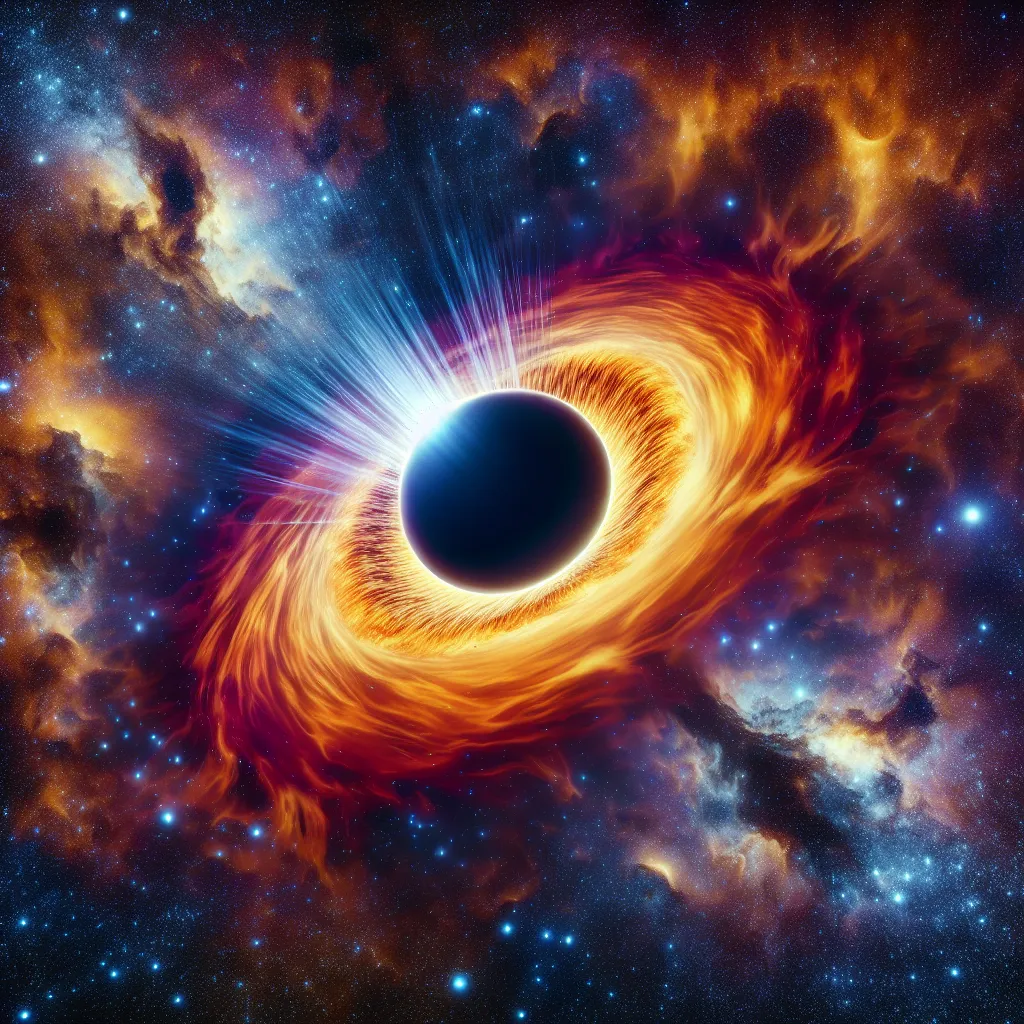
Black hole stars are fascinating cosmic phenomena that take the peculiarities of black holes and blend them with the grandeur of stellar formations. These stars weren’t just massive—they were cosmic titans, bigger and brighter than any stars that exist today or could ever exist in the future. The unique twist? At their core, these colossal stars harbored a ravenous black hole.
Imagine something vastly beyond our typical understanding of star formation. Black hole stars, which could only form during a brief window of the early universe, challenge everything we know. The largest stars we see today have up to 300 solar masses, but black hole stars boasted a staggering 10 million solar masses of nearly pure hydrogen. Visualize the sun, then a giant star, then a black hole star, which would be over 800,000 times wider than our sun and 380 times larger than the most massive stars we know today.
Ordinarily, stars are born from massive gas clouds that collapse under gravity. These clouds heat up as they get denser, eventually igniting nuclear fusion and blowing away the surrounding gas. This limits how big any star can grow because the radiation from nuclear fusion pushes against gravity. But black hole stars were born in a much denser and hotter early universe, where dark matter played a crucial role. Dark matter halos pulled in vast amounts of gas, forming enormous stars far larger than anything we see now.
Unlike regular stars, these cosmic behemoths kept growing and growing. Their enormous mass meant their cores got hotter under intense gravity, and when the core material collapsed, it didn’t end in a typical supernova. Instead, a black hole formed at the star’s heart. While today’s black holes feed slowly, limited by the heat and radiation they generate, black hole stars were crushed by such overpowering gravity that the black holes devoured matter at an astonishing rate.
In their final phase, black hole stars swelled to over 30 times the width of our solar system. They became cosmic lighthouses, with intense magnetic fields spewing jets of plasma from the black hole’s poles. But this led to their ultimate destruction. The intense radiation and the immense gravity of the black hole eventually ripped the star apart, leaving behind a supermassive black hole with the mass of 100,000 suns.
Why does this matter? If black hole stars existed, they could explain the mystery of supermassive black holes at the centers of galaxies. Conventional black holes grow slowly, but black hole stars could have seeded these massive black holes early in the universe’s history, allowing them to grow to unimaginable sizes in a relatively short time.
The James Webb Space Telescope might soon give us answers. As it looks into the farthest reaches of the universe, it may catch glimpses of these peculiar stellar giants, providing evidence of their existence and offering new insights into the nature of black holes and the formation of the universe.
For now, let’s marvel at the sheer scale: stars are big, but black hole stars are on a whole other level.