What If Our Cosmic Neighbors Decided To ZAP Us?
Cosmic Wargames: Imagining Alien Tactics for Interstellar Annihilation
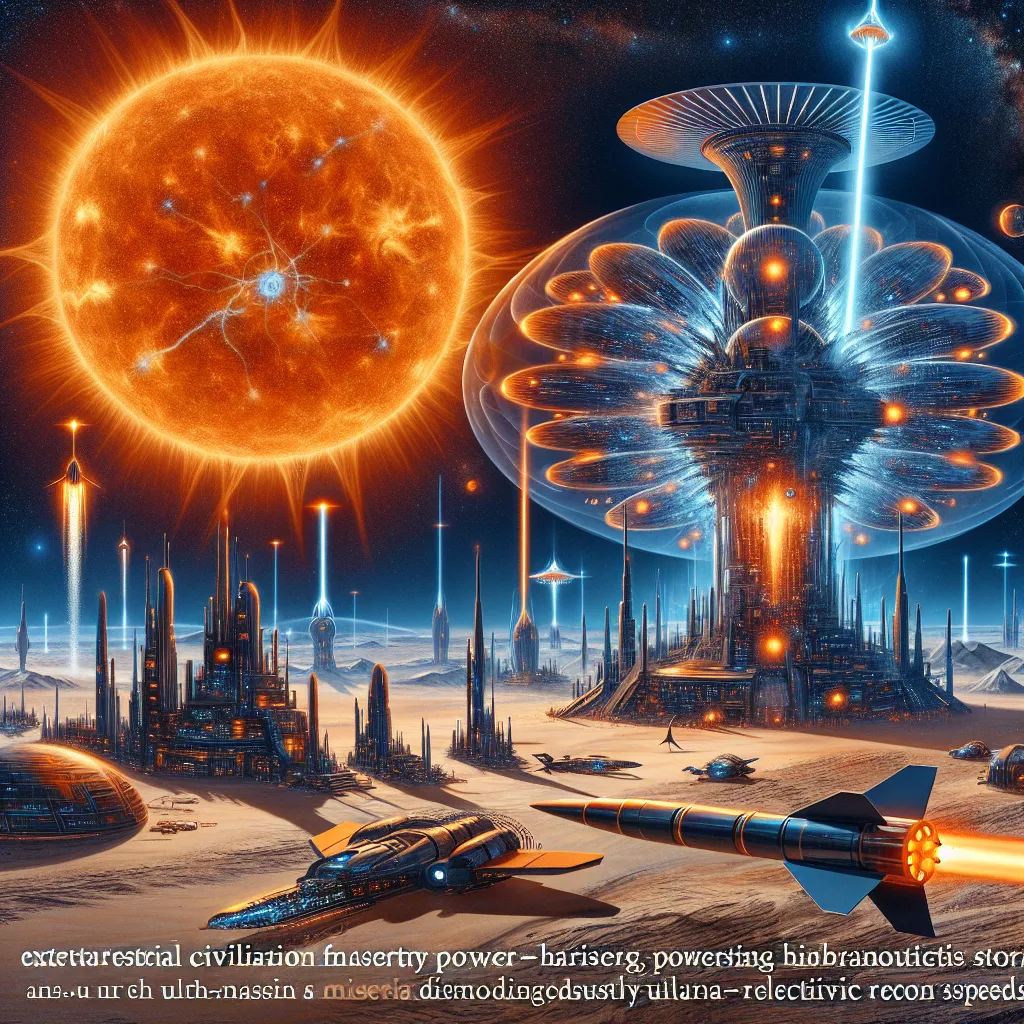
Could aliens destroy us from light years away? This question popped up at our Labs today, and it got us thinking about how civilizations might wage war across interstellar distances. Imagine two players: humans in our yellow dwarf star system and the Smorpians around the orange dwarf star HD 40307, 42 light years away. The Smorpians are way ahead technologically and have a Dyson swarm for near-limitless energy. They notice humans and decide to build a hyperspace bypass through our solar system, meaning humans need to be eradicated.
Interstellar war isn’t like Earth wars. Front lines, tactics, and logistics don’t work when decades pass between firing a weapon and knowing if it hit. Sending an invasion fleet is impractical—humans would have tons of time to prepare. So, the Smorpians need a weapon that guarantees a one-shot win with no chance for human retaliation. Our ingenious bird scientists have come up with three ideas: the Star Laser, the Relativistic Missile, and the Ultra-Relativistic Electron Beam. Let’s break them down.
First up, the Star Laser. The Smorpians could turn their Dyson swarm into a massive, solar-powered laser. This laser, focused by millions of kilometer-wide mirrors, could target Earth from millions of light years away. On firing, countless beams merge into one gigantic column of green light, visible even in space. Traveling at the speed of light, it hits Earth after 42 years. Here, 1% of a star’s energy melts Earth’s crust, burns the seas, and vaporizes everything in minutes, turning our planet into a glowing lava ball.
Then, there’s the Relativistic Missile. Instead of a laser, the Smorpians could launch a missile using antimatter reactors for insane acceleration—99.9999996% of light speed. The missile, loaded with enough antimatter to destroy a continent, takes about 42 years to reach Earth. When it arrives, it turns the atmosphere into a series of massive fireballs, obliterating everything on the surface.
Lastly, there’s the Ultra-Relativistic Electron Beam (UREB). The Smorpians would use an enormous particle accelerator, over 100,000 kilometers long, to fire electrons at nearly the speed of light. This beam would travel vast distances without spreading out, hitting Earth silently. Unlike the laser or missile, there are no big explosions—just lethal radiation that destroys DNA. People get sick and die, while Earth’s surface becomes sterile like treated food.
Each weapon has its strengths, but also drawbacks. A major downside is that firing these weapons could reveal the Smorpians’ location to other civilizations, painting them as aggressors. Perhaps the smartest move for now is to keep watching the universe quietly, hoping that, if star-shooting civilizations exist, they don’t notice us.
In conclusion, while the Smorpians might be fictional, the science behind these hypothetical weapons is based on real technology. The idea of interstellar war is both fascinating and terrifying, and staying inconspicuous might be our best defense.