What Mysteries Lurk Beneath the Moon's Strange Craters?
The Moon's Mysterious Craters and Their Astonishing Impact on Scientific Understanding
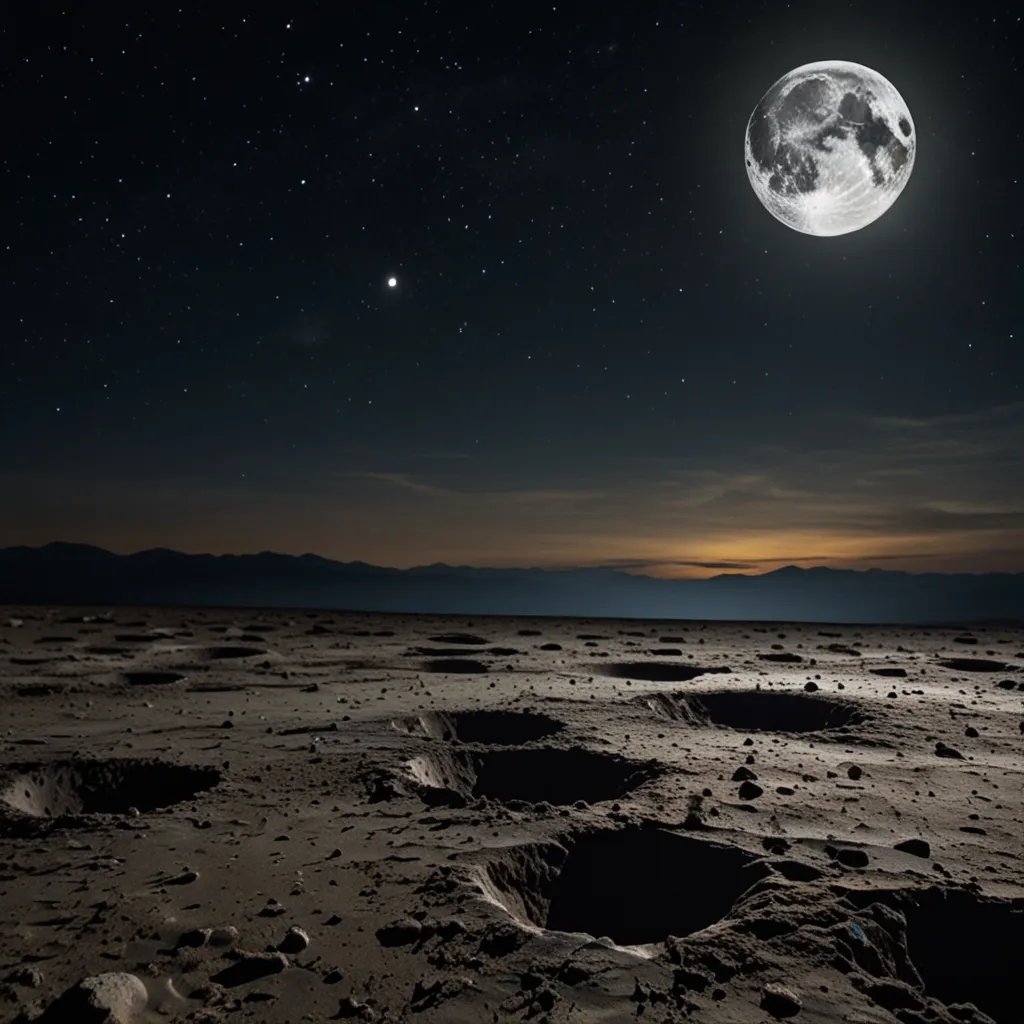
Have you ever gazed at the moon and wondered about its mysterious craters? Turns out, the moon is scarred with tens of thousands of these craters, varying in size but equally fascinating. Unlike Earth, the moon has no atmosphere to shield it from space debris, no winds to smooth its landscape, and no geological activity to mask the impact scars over eons.
One compelling aspect of these craters is that they present a saturated surface. Imagine craters within craters, all the way down to the tiniest scale. It sounds like a messy cosmic painting, doesn’t it? But what grabs scientists’ attention is not just their abundance, but the peculiar uniformity in their depth. You’d think with all those different sizes, there’d be some variation, right? But no, they all seem to be quite similar in depth. This oddity stumps conventional geophysics.
To add to the curiosity, the craters on the moon are often wide and have a convex shape—center bulges upward rather than dipping down. It’s like something underneath is preventing craters from being deeper. You might wonder if there’s some sort of harder rock or even a metallic barrier just beneath the surface. This hypothesis sends minds spinning because it hints at something much more resilient than just moon rock and dust.
But let’s circle back to a historical event that’ll blow your mind. On November 20, 1969, astronauts Charles Conrad Jr. and Alan Bean, during their Apollo 12 mission, released their lunar launch vehicle and let it crash back onto the moon. What happened next was nothing short of astounding. When the rocket impacted the moon’s surface, it caused the moon to reverberate like a bell for over an hour. This was just the beginning.
When Apollo 13 came around, Dr. Wernher von Braun of NASA decided they’d intentionally crash a heavier rocket portion into the lunar surface. This time, the moon didn’t just ring; it gonged for over three hours, with reverberations extending to an astonishing depth of over 20 miles.
This mysterious bell-like ringing left scientists puzzled. The crust of the moon is predominantly made of a type of lightweight rock called basalts. For a rock that absorbs impact well, you’d expect the moon to behave differently. The strong, long-lasting vibrations suggest something hollow.
The “moon is hollow” theory conflicts with established knowledge of physics, yet it tempts the minds of those eager to solve these lunar riddles. Imagine, if that theory holds any truth, it would rewrite our understanding of not only the moon but also its formation and place in our cosmic neighborhood.
So next time you look up at that bright, crater-filled moon, remember it’s not just a barren celestial body but a curious, mysterious world in itself. Its surface craters, unusual depth, and those reverberating tales tell stories that challenge our understanding and stretch the boundaries of scientific exploration. And who knows what secrets it still holds, waiting to be uncovered as we learn more about our enigmatic lunar neighbor?