What Mysteries Unfold on a 4.5 Billion-Year Ride Through Earth's History?
From Molten Hell to Mammalian Majesty: Earth's Epic Evolution Unfolded in Seconds
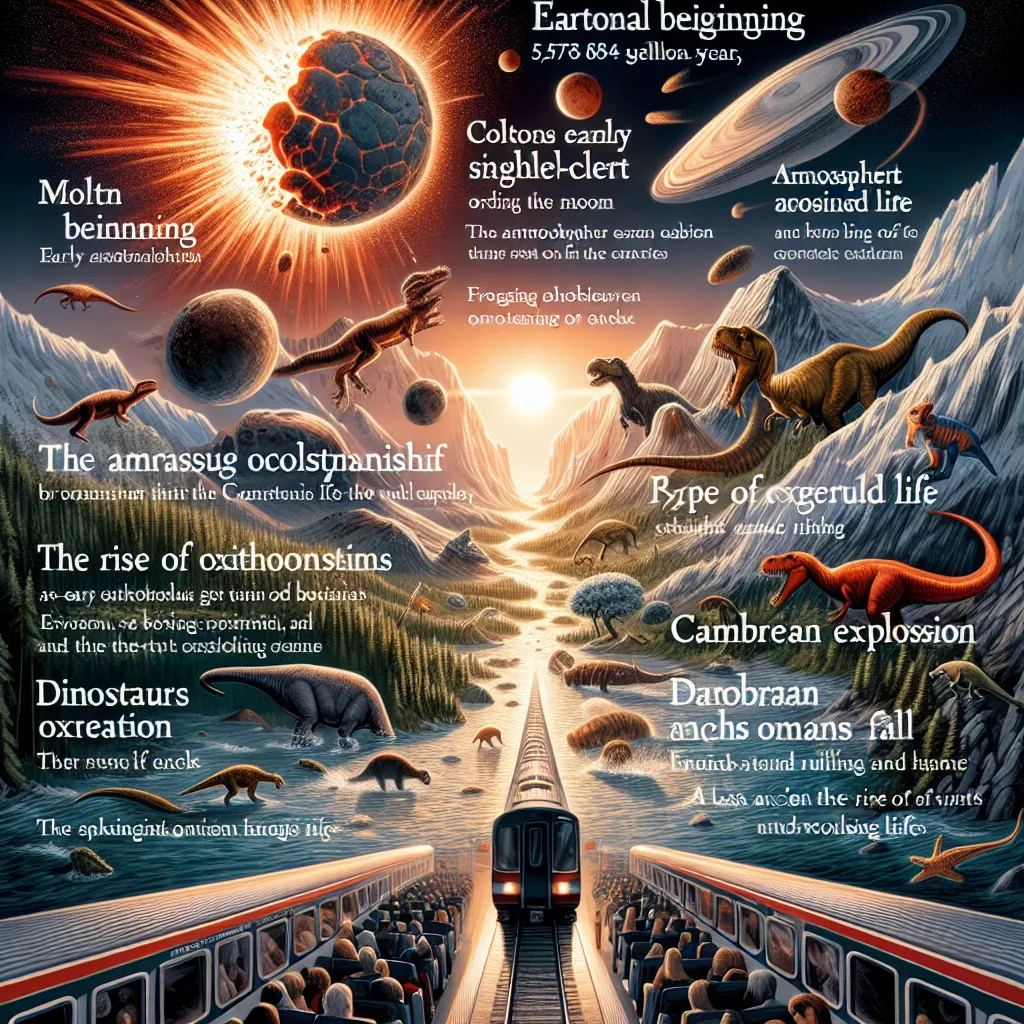
Earth is 4.5 billion years old, which is hard to imagine. Let’s take a journey through Earth’s history, viewing it like a train ride. Each second represents 1.5 million years, and in an hour, you’d see it all.
4.5 billion years ago, Earth was a molten hell. It collided with an object called Theia, forming the moon. Back then, the moon looked much bigger and has been slowly moving away since.
During the first eon, the Hadean, Earth was covered in lava with an atmosphere full of CO2. This period is mostly lost to time. For the next 90 million years, asteroids bombarded the young Earth. Despite the Sun being dimmer, greenhouse gases kept the planet hot.
Life began early. Single cells emerged, and Earth began cooling, raining for millions of years to form oceans. Hydrothermal vents might have been life’s birthplace.
As we enter the Paleoarchean, Earth’s days were shorter due to its faster rotation. Stromatolites, our first life evidence, appeared. Photosynthesis also kicked off around this time.
By the Mesoarchean, tectonic plates started forming continents. The seas were like hot tubs, and the atmosphere was deadly with no oxygen. However, life was spreading, mainly as single cells.
During the Neoarchean, plate tectonics enabled complex chemistry, fostering life. Bacteria began colonizing Earth. Then, 2.5 billion years ago, the Great Oxidation Event started, introducing oxygen into the atmosphere. This led to cooling and Earth’s first ice ages.
Around 2.05 billion years ago, a massive asteroid hit Earth. Supercontinents started forming, with significant impacts on the planet’s geology.
By 1.6 billion years ago, Eukaryotic cells appeared, leading to more complex life. Life remained cellular, with Earth’s crust thickening and continents forming. Fungi-like organisms emerged around this time.
1.2 billion years ago, the first algae might have invented sex, which changed reproduction forever. By 1 billion years ago, a race for survival began among microbes, increasing diversity.
720 million years ago, Earth froze over but life persisted, evolving further. The supercontinent Gondwana formed about 635 million years ago, and multicellular organisms became widespread.
The Cambrian Explosion, starting 539 million years ago, brought a burst of life. Plants began to colonize land. Massive extinctions followed, but life kept adapting.
During the Carboniferous, 359 million years ago, lush forests thrived and eventually became the coal we use today. Pangea formed around 299 million years ago. Another huge mass extinction event occurred, wiping out most species.
252 million years ago, the Triassic began. Dinosaurs ruled. But then, 66 million years ago, an asteroid wiped most of them out. Mammals took the stage, and our ancestors emerged.
As the continents settled into their current positions, mammals diversified. Human history is just a blink in this long timeline.
Earth’s history is vast, and our existence is just a tiny part of it. This journey through time shows how life evolved, changed, and adapted. Celebrate this incredible history and the work that has gone into understanding it.