Religions all over the world tell stories where the usual rules of nature seem to pause for a moment. I want to walk you through six of these strange moments, not just to repeat the stories, but to ask a simple question together: what happens when people act as if the invisible is just as real as the visible?
“There are more things in heaven and earth, Horatio,
Than are dreamt of in your philosophy.”
— William Shakespeare
Let’s start with something basic. You and I live in a world where causes and effects follow patterns: push a cup, it slides; light a fire, wood burns; people get sick, they usually recover slowly or not at all. When a story claims that someone walks on water or a body repairs itself in a second, it is not just a nice picture. It is a direct challenge to what we think “always” happens.
I will walk you through six types of religious transitions that seem to cross that line: walking where you should sink, food that should run out but does not, bodies that should stay broken but do not, objects that should not appear but do, environments that should destroy but cannot, and lives that should end but somehow continue. As we go, ask yourself: even if you doubt every story, what does the pattern of these stories tell us about how humans see reality?
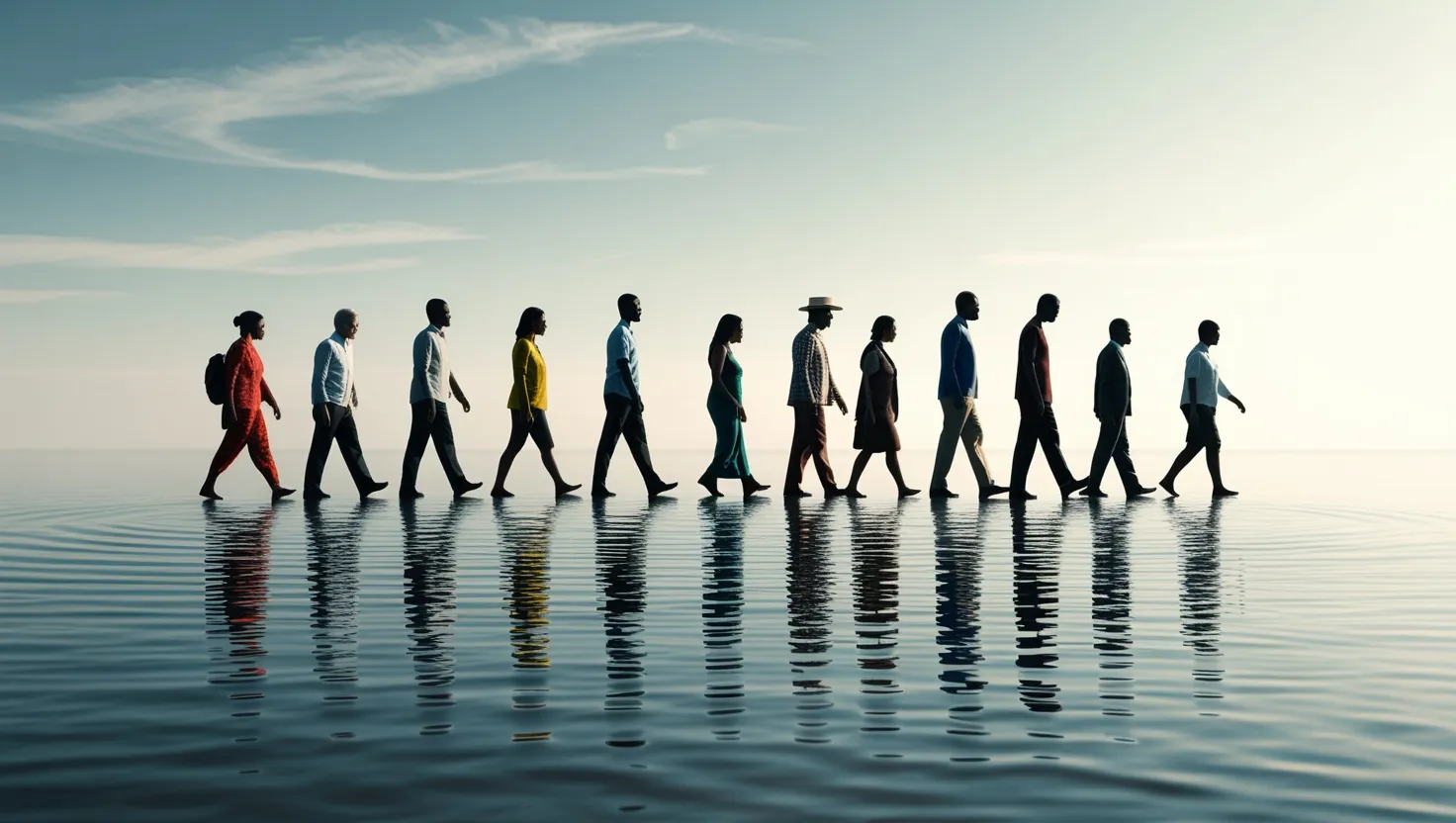
First, walking on what should not hold you. The most famous example in the West is Jesus walking on the Sea of Galilee while a storm rages. But the idea is older and wider. In some Buddhist traditions, advanced monks are said to cross rivers by walking over them, not as circus tricks, but as the outcome of a mind so focused that matter obeys it. In Hindu stories, certain yogis float above the ground in deep meditation. All these accounts suggest one core claim: that weight is not only a physical fact but a spiritual one. The person is “lighter” not just in kilos but in attachment.
Have you noticed how often these stories happen during fear? The sea is violent, the disciples are scared, the monk is being tested, the pilgrim is desperate. The “natural law” that seems to bend is gravity, but the human law being tested is trust. A simple but uncomfortable question for us: do we ever treat our own fears as if they were “laws of nature” that cannot be questioned?
“Faith is to believe what you do not see; the reward of this faith is to see what you believe.”
— Saint Augustine
Second, food that should run out but doesn’t. Almost every major tradition has at least one story where a tiny amount of food feeds a crowd. In the Hebrew Bible, a poor widow’s jar of oil keeps pouring until her debts are paid. In the New Testament, a few loaves and fish feed thousands. In Sikh history, the langar (community kitchen) is described as feeding more people than the visible food supply should allow. In some Buddhist and Jain stories, alms placed in a bowl somehow suffice for all who are present.
On the surface, these look like “magic catering” stories. But there is a deeper pattern: the miracle appears when someone refuses to hoard. Oil multiplies when it is poured out, bread stretches when it is shared, the kitchen “never runs out” because the rule of the space is that no one is turned away. Have you ever noticed that we rarely hear of miracles in locked rooms with full fridges? The unseen threshold here is not just the moment food appears; it is the decision to give even when it looks like there is not enough.
Ask yourself something simple: in your own life, how often do you wait to feel “abundant” before you start sharing? These stories suggest the opposite: sharing is sometimes the trigger, not the result.
Third, bodies repairing in a moment. Instant healing is one of the most controversial types of religious claim. In Christian, Hindu, Buddhist, Islamic, and indigenous stories, people with long-term illnesses or injuries recover suddenly after prayer, touch, or ritual. Skeptics point to misdiagnosis, exaggeration, or coincidence, and those things do happen. Still, the stories keep coming, across centuries and cultures, with similar patterns.
Look at the patterns, not only the claims. The person often reaches a point of total surrender: “I have tried everything, I cannot fix this.” Often, the healing happens in a community setting — a shrine, a church, a temple, a sacred spring — where many people around them are focused on the same intention. Many reports include a sense of time slowing down or disappearing, as if a moment stretches and something “snaps” inside.
You may or may not believe any specific case. But here’s a practical, honest question: why does the human mind keep tying inner surrender, shared focus, and physical change together? Even modern medicine acknowledges placebo effects, stress-related illness, and mind–body interactions. Religious stories simply go further and say that under certain conditions, the body can cross a limit we did not know it had.
“The most beautiful thing we can experience is the mysterious. It is the source of all true art and science.”
— Albert Einstein
Fourth, objects appearing where they logically should not. In several Hindu and Sikh traditions, there are accounts of sacred objects appearing inside sealed containers or altars: flowers that were not there before, food that appears in a closed pot, or written messages that no one claims to have written. In Catholic history, some Eucharistic miracles describe a host changing properties in a locked tabernacle. In some Afro-Caribbean and shamanic traditions, healers are said to extract physical objects — bits of glass, nails, stones — from a patient’s body that symbolically represent the illness.
If we take these at face value, they are direct hits on the idea that matter needs a physical path to move from point A to point B. But even if we treat them as stories that may be partly symbolic, they show another thing: people often experience an emotional or spiritual “release” when something physical is moved, removed, or appears. Put simply, it feels right to externalize the invisible.
Have you ever written down a worry, put it in a box, and felt a tiny bit lighter? Imagine that multiplied by a culture that fully expects the invisible to show itself through matter. The threshold in these stories is not just about objects passing through walls. It is about feelings and intentions passing into bodies, rooms, and things.
Fifth, environments that should destroy but do not. Think of fire-walking rituals in Hindu, Buddhist, Christian, and indigenous contexts. Participants walk over burning coals or heated stones without serious burns. Physicists can explain some of this with heat capacity and short contact time, and those explanations are useful. But even with those facts, some cases still push the limits: long walks, repeated passes, people who “should” get hurt but somehow do not.
Similar accounts appear in older texts. In the book of Daniel, three young men are thrown into a furnace heated far above normal, yet they walk inside it unharmed. In some hagiographies (saints’ lives), holy people stand in snow, fire, or storms for long times without the damage we would expect.
Again, look at the shared picture: people go into dangerous environments with a strong sense of protection, often after ritual preparation — fasting, confession, chants, blessings. Their inner state is not casual; it is concentrated. The group around them is united in expectation. Ask yourself: is it possible that our usual relationship with the environment is not neutral, that our beliefs change how we meet risk?
“We are what we repeatedly do. Excellence, then, is not an act but a habit.”
— Often attributed to Aristotle
Why include this quote here? Because repeated exposure with a certain inner stance might train the body and nervous system in ways we do not yet fully measure. Religious stories describe this training in spiritual terms — purification, surrender, grace — but the pattern is still practice over time, then a moment of crossing a limit.
Sixth, lives that continue where they should end. Resurrection stories are among the boldest. In Christianity, the resurrection of Jesus is central. In some Buddhist and Hindu stories, masters are said to die consciously and then return to their bodies, or appear elsewhere. In some shamanic traditions, the healer “dies” in vision and returns with new knowledge, sometimes accompanied by physical changes that the community sees as signs.
Even if we set aside complete bodily resurrection, many traditions include near-death experiences, last-minute recoveries, or bodies that do not decay as expected. These events sit right at the edge of what we call “natural law,” because death is the one limit most of us think of as final.
Here is a simple way to think about these claims, even if you remain skeptical. At the very least, humanity has always suspected that the border between life and death is not as simple as it looks. Rituals for the dead, prayers for the dying, and stories of return all express a hunch: consciousness may not map neatly onto heartbeat and brain waves. Ask yourself: why does this hunch keep returning, no matter how often cultures rise and fall?
“Death is but a door; time is but a window; I’ll be back.”
— Popular modern paraphrase echoing ancient themes
Now, let’s stand back and look at these six transitions together. One way is to dismiss them all: people exaggerate, remember wrongly, or tell stories for power. That happens, and we should be honest about it. But even if you explain ninety percent of cases this way, there is still a pattern worth noticing.
The pattern is that religious communities insist there is a line where ordinary cause and effect can be interrupted or redirected by a higher intention, presence, or order. And this line is almost always tied to three things: a focused state of mind or heart, a shared ritual or community frame, and an act of trust or surrender in the face of fear, lack, or danger.
Have you noticed that none of these stories are about someone casually showing off at a party? They cluster around suffering: hunger, sickness, danger, grief, despair. The “signs” appear where people feel trapped. That alone tells us something quiet but important: when humans feel pressed to the edge, we start looking for exits that are not visible.
So where does this leave you and me, sitting here in a more ordinary life? I am not asking you to accept any miracle report. Instead, try this simpler experiment: look at your own idea of “what is possible.” Where did you get it? From school, from family, from your job, from your culture’s stories? How often do you test that idea against your own experience, especially in areas like healing, habit change, or how groups can behave?
One practical question you can ask yourself is: “What do I treat as a law of nature that might only be a habit of thought?” For example, “people never change,” “I can never forgive that,” “this relationship will never heal,” “I will always be anxious.” To you, these may feel as solid as gravity. Religious narratives of thresholds point to one simple challenge: some “laws” turn out to be local customs of the mind.
“Whether you think you can, or you think you can’t — you’re right.”
— Henry Ford
This quote is not about floating on water or feeding thousands. It is about the smaller, daily thresholds inside us. If entire traditions keep telling stories where belief, intention, and ritual seem to shift the usual outcomes, then maybe our first step is not to copy their miracles but to question our limits.
Imagine, for a moment, that even one of the six kinds of transitions we talked about has ever happened, just once, in all of history. What would that mean? It would mean that “natural law” might be more like a stable pattern with rare exceptions, rather than an absolute cage. And if that is true, then our understanding of both nature and spirit is still incomplete.
Even if you decide that none of these events ever happened as told, the stories still do something powerful: they push our minds up against the border of what we think is possible, and they ask us not to worship that border as final truth. They invite a kind of humble curiosity: “What if I do not yet see the whole picture?”
So as you go back to your regular life after reading this, you do not need to walk on water or call food from thin air. You can start much smaller. Pick one “law” you have been living under — something you say about yourself or others as if it could never be different. Then ask, calmly and honestly: “Is this really a law, or is it a story I have repeated so often that it feels like gravity?”
That quiet question might be your own unseen threshold. Beyond it, there may not be instant miracles. But there may be possibilities you have never seriously allowed yourself to test. And that, in its own smaller way, is still a collision between the world you can see and the one you have barely started to imagine.