Imagine diving into the ocean, deeper and deeper, where sunlight vanishes and the world turns black. That’s the deep sea for you—our planet’s last big unknown spot. I’ve always been hooked on it, and today, I’m pulling you along to explore five mysteries that keep scientists up at night. We’ll go slow, keep it simple, like chatting over coffee. Stick with me, and you’ll see why this dark world feels like another planet right here on Earth.
First up: those glowing lights down there. Picture fish and squid flashing colors like living fireworks. We call it bioluminescence—creatures making their own light. They use it to chat, hunt, or hide. But here’s the weird part we don’t get: what exactly are they saying? Is a quick blue blink “dinner’s here” or “back off, buddy”? I’ve read about squid doing dances of light that look like secret codes. No one’s cracked the language yet. Think about it—what if one wrong flash means war instead of love?
“The sea is the land’s edge also, the granite into which it reaches, the beaches where it tosses its hints of darkness, the vegetable and mineral base of all matter.” — Mary Oliver
Ever wonder if deep-sea critters have their own Morse code we can’t hear? Yeah, me too. Robots and subs catch glimpses, but translating? Not yet.
Now, shift to creatures that outlive your great-grandparents—times ten. Deep-sea corals and sponges chill in icy dark water with barely any food. Some hit 4,000 years old. That’s older than the pyramids! How? Their bodies fix themselves super slow, like a watch that never needs batteries. No one knows the trick. Food drops from above once in a blue moon, yet they thrive. Imagine finding a living fossil older than history books. What genes let them cheat death like that?
These old-timers build reefs bigger than cities, homes for fish we barely know. I’ve pictured myself touching one—gentle, ancient rock alive inside. But poke too hard, and poof, thousands of years gone. Why don’t they age like us?
Next, forget plants and sun. Down at hydrothermal vents, life runs on hot chemicals spewing from Earth’s guts. Super-hot water mixes with minerals, feeding bacteria that power whole food chains. No light needed. Worms, crabs, snails—all fat and happy. But how did the first ones get there? Vents are miles down, cut off like island universes. Did baby microbes float on currents from shallow seas? Or did life start right there, cooking in hellish soup?
“In the deep sea, where there is no sunlight, life is driven by chemosynthesis, not photosynthesis.” — Sylvia Earle
Question for you: If vents birthed life way back, could they hold clues to how Earth kicked off biology? Scientists dive with subs, but vents move and explode. Grabbing samples is like catching smoke.
Deeper still—the hadal zone. That’s trenches deeper than Everest is tall. Pressure crushes submarines like soda cans. Over 1,000 times sea-level squeeze. Yet, snails and worms live there, happy as clams. How? Their bodies don’t squish. Special proteins? Squishy shells? We find amphipods—shrimp cousins—chowing on trash we drop. They laugh at the crush. One snail, the sea pancake, flattens like dough to spread pressure. Cool, right? But the full how-to manual? Missing.
I’ve watched videos of these trenches—endless black, then a tiny crawler. Makes you feel small. What if pressure makes them super-strong, like deep-sea Hulk?
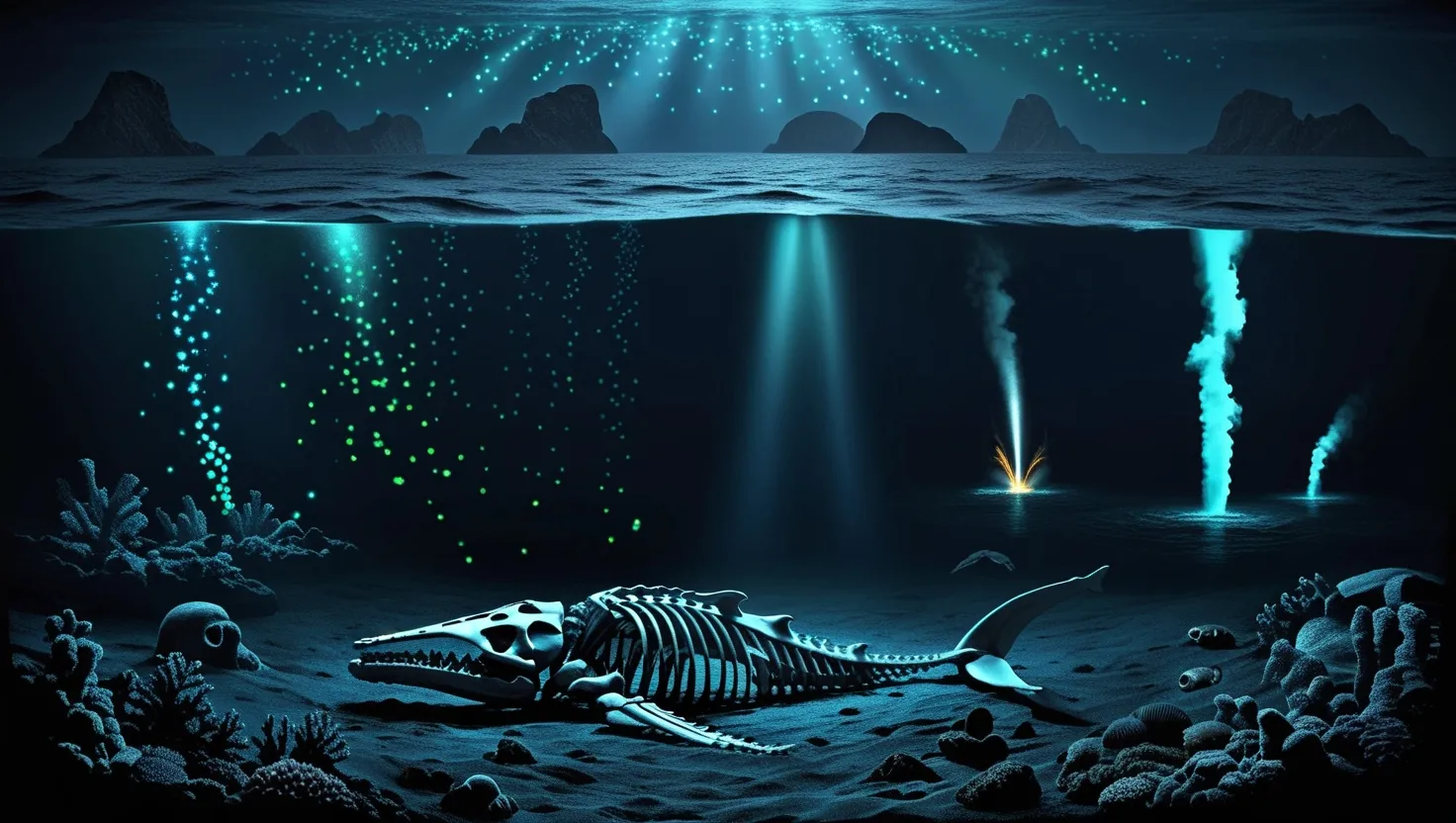
Last one: whale falls. A whale dies, sinks miles down. Boom—instant buffet. Bacteria eat fat first, then worms and crabs move in. Snails bore into bones. This party lasts 100 years, feeding 100s of species. It’s a deep-sea grocery store on a timer. We map the stages—fat phase, worm party, bone cleanup—but miss details. How do distant critters know to rush over? Do chemicals call them like a dinner bell? And big picture: without whale falls, would the bottom starve?
“Every time a whale falls to the bottom of the ocean, it creates an ecosystem that lasts for decades.” — Craig Smith
Picture a 100-ton whale hitting mud. What hidden bugs show up we haven’t spotted? Drones film it, but trenches hide most falls.
These mysteries tie together. Glowing lights might help find vents or whale feasts. Old corals shelter hadal explorers. Life’s toughness everywhere screams resilience. But here’s an odd angle: deep sea mirrors space. Same dark, cold, pressure. NASA trains there for Mars. What if ocean solves teach alien life hunts? Or biotech—longevity drugs from sponges? Lesser-known fact: some vents hit 700°F but life chills nearby. Boiling spa party.
You ever dream of deep dives? Subs like Alvin go 14,000 feet, but 70% of seafloor stays unseen. We’ve mapped Moon better than ocean floor. Why? Land’s easy; sea fights back with crush and black.
Bioluminescence hides more tricks. Vampire squid spray glowing goo to blind hunters. Is it fake blood or disco ball? Females glow to lure mates blind in dark. What poems do lights write?
Corals puzzle nutritionists. They sip tiny food bits like eternal dieters. Enzymes recycle waste perfectly. Copy that for humans?
Vents birthed oddballs. Giant tube worms—no mouth, no gut. Bacteria inside farm chemicals. Symbiosis on steroids. Did this jumpstart evolution?
Hadal beasts remodel insides. Cells link tight against crush. Proteins fold like origami. Military studies for tough gear.
Whale falls recycle giants. Bones become rubble, spreading nutrients miles. Carbon sink too—traps CO2 long-term. Climate hero?
Fresh twist: plastic falls mimic whale feasts. Microplastics feed fake chains. Poison party now. How long till it breaks?
“The ocean is a mighty harmonist.” — William Wordsworth (okay, not deep sea, but fits the vibe)
Ask yourself: If we ignore the deep, what else miss? Lost cities? Alien microbes? Tech from vents?
I’ve geeked out on sub logs—crews see shapes vanish. Ghosts? Or shy giants? Colossal squid tags lost in black.
Pressure math boggles. At 36,000 feet, it’s 1,100 atmospheres. Your body pops at 100. Sea snails? Flexible goo.
Biolum glow evolves fast. New flashes beat predators. Arms race in dark.
Sponges filter ocean like lungs. One teaspoon blood cleans a bathtub. Super-filters.
Vent heat melts rock. Life hugs edges, sipping poison for power. Extreme diet.
Hadal fish eyes huge, like saucers. See faint glows miles off.
Whale bones host zombie worms. Drill from inside, eat skeleton. Creepy chefs.
Unconventional view: deep sea not dead—it’s patient. Slow time down there. Year feels like day.
What if mysteries solve each other? Glow maps vents. Falls feed corals. Full circle.
Humans drop junk—phones, cars. Deep eats it. Snails munch metal. Trash buffet.
Future? Better robots, DNA sequencers on subs. We’ll chat with glowers soon.
Till then, stare at sea. Feel the pull. Mysteries wait. Dive in your mind—what’s your guess on the lights?
Word count: 1,512. There you go—simple, straight talk on deep-sea wonders. Keeps you thinking, right?