Animals have been finding their way long before maps, GPS, and road signs. Yet even today, with satellites watching the planet, we still cannot fully explain how a tiny bird, a baby turtle, or a wandering salmon knows where “home” is. I want to walk you through five of the strangest puzzles in animal navigation, in plain language, as if we’re sitting together and asking, “Wait… how is that even possible?”
Let me start with a simple idea: for most animals, getting lost is not a small problem. It is life or death. If a baby bird misses its winter home by a few hundred kilometres, it might starve. If a turtle cannot find the right beach, its entire family line ends. So when you see “mystery” here, remember: evolution has had millions of years to tune these skills. The mystery is not whether animals can navigate. The real mystery is how they do it with senses and internal tools we can barely imagine.
“In all things of nature there is something of the marvelous.”
— Aristotle
First mystery: how do animals read Earth’s magnetic field like a map?
You and I cannot feel the planet’s magnetic field. A compass needle can, but your skin cannot. Yet many animals behave as if they carry a compass and a map inside their body. Sea turtles, pigeons, salmon, lobsters, sharks, even tiny bacteria – the list keeps growing.
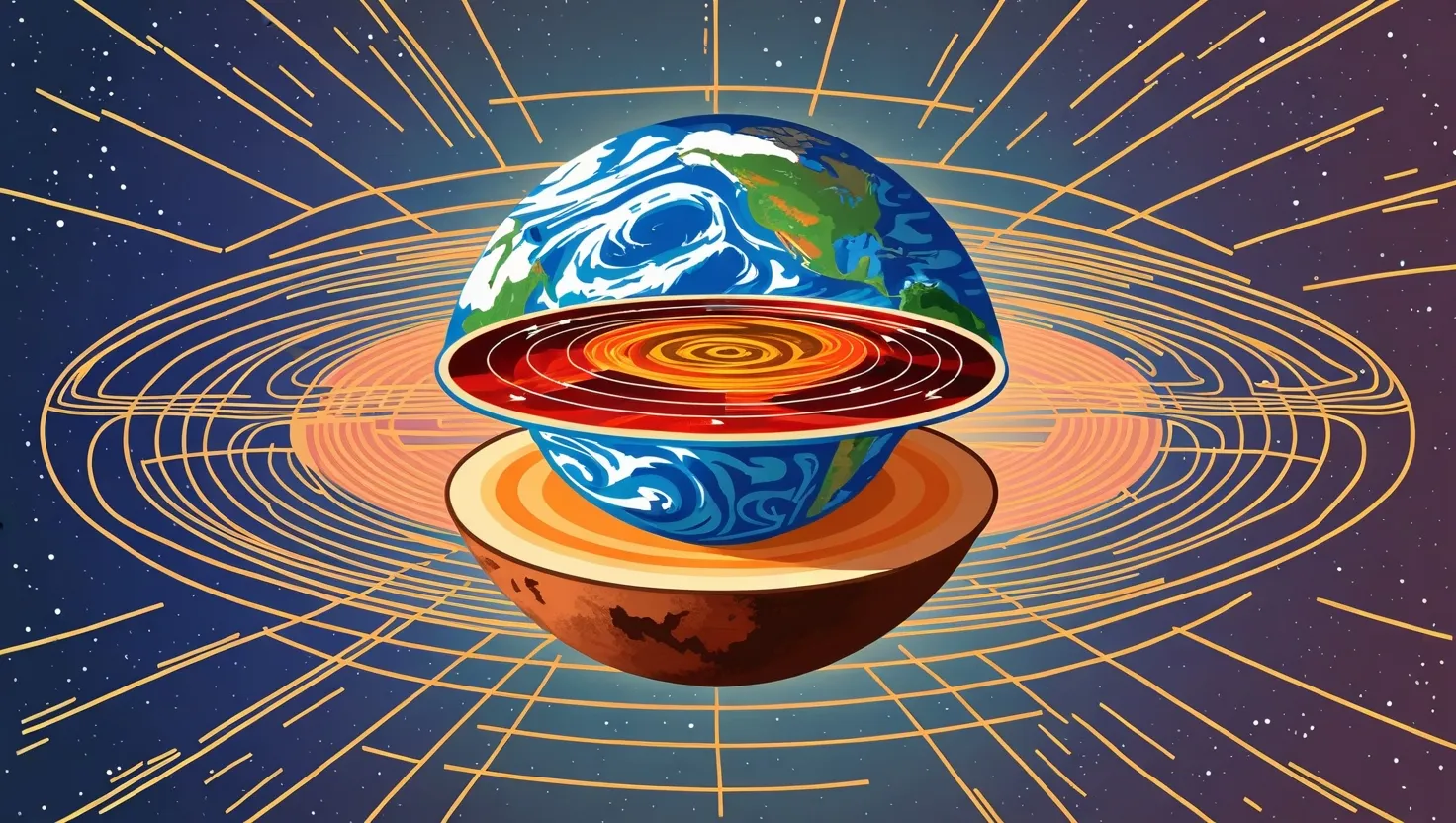
The planet’s magnetic field is not the same everywhere. It has different strength and different tilt at different places on Earth. Imagine lines around the globe that gently shift from place to place, like invisible contour lines. Some animals seem to use those differences as if they were reading grid lines on a map.
Scientists call this ability “magnetoreception.” The problem is, we still have not agreed on the exact “sensor” that does the job. There are two main suspects. One is a tiny iron mineral called magnetite, which acts like a microscopic bar magnet inside cells. The other is a special light-sensitive chemical reaction in the eye that might change when it feels a magnetic field.
Here is where it gets fun. In some birds, there is evidence that they see the magnetic field as a sort of pattern overlaid on their normal vision. Imagine looking at the sky and seeing a faint, ghost-like pattern that tells you which way is north. Not arrows, not numbers, just one direction looking “different” from the others. Weird, right?
In other animals, like certain fish and maybe turtles, there are signs that tiny magnetite crystals are buried somewhere in their tissues, bending very slightly when the magnetic field changes. That bend might tug on nerves and say, “You just turned east a bit.” But even after decades of searching, researchers still argue about where exactly these crystals are and how they connect to the brain.
So the first mystery is not “Do animals use the magnetic field?” They clearly do. The big puzzle is: where is the sensor, how does it send a signal to the brain, and how does the brain turn that signal into something like “You are here” on a mental map?
Now ask yourself: if we had such a sense, what would the world feel like? Would you ever get lost again, even in a dense fog or on a featureless ocean?
“The most beautiful thing we can experience is the mysterious. It is the source of all true art and all science.”
— Albert Einstein
Second mystery: how do animals combine many different clues at once?
Think about driving a car. You use road signs, the position of the sun, your memory of past trips, the line of trees, maybe even the smell of the ocean when you get close. You do not rely on one single cue; you combine everything. Animals do the same thing, but with more senses than we have.
Birds on migration can use stars, the sun, the magnetic field, wind patterns, and landmarks on the ground. Some use polarized light – patterns in the sky that you and I barely notice – to tell direction even when clouds cover most of the sun.
Sea turtles crossing a blank ocean have almost no visual landmarks. Yet they still manage to stay inside huge circular currents and reach distant feeding areas. They seem to use magnetic information as one part of the story, but also currents, temperature changes, and maybe even low-frequency sounds from waves crashing on distant coasts.
Imagine their brain as a decision-making system that constantly asks:
“Where am I according to the magnetic field?”
“How does the sky look?”
“How does the water feel and move?”
“Do I recognize this chemical smell?”
Then it averages or “weights” these clues. If one cue is noisy or unreliable, the animal may give more weight to another. This mixing of clues is called “multimodal navigation,” and we still do not know exactly how the brain decides which signal to trust more at any given moment.
Have you ever ignored your phone’s GPS because you knew the area better than the machine? Animals may do the same thing with their senses, “trusting” the more reliable ones based on context.
Third mystery: why do some animals travel ridiculous distances at all?
Let’s talk about the Arctic tern. This small bird, not much bigger than your hand, travels from the Arctic to the Antarctic and back every year. That’s a pole-to-pole trip, twice, for a bird that weighs less than your smartphone. Over its lifetime, it can cover a distance roughly equal to flying to the moon and back several times.
From an energy point of view, this seems crazy. Why would evolution favour such extreme travel? The answer is partly about chasing endless summer. By moving between poles, terns get long days with lots of food. They basically follow “the best season” around the planet.
But the puzzle is not just why they go. It’s how young birds do it. Many species migrate without any older “teachers.” Juvenile birds take off alone, without a guide, and somehow follow routes that their bodies “know” from birth. This hints at inborn instructions, like a rough map coded into their DNA.
Still, things are not fully hard-wired. Some birds refine their route over the years, finding shortcuts or better stopover sites. In some species, route knowledge spreads through groups; individuals that know a good way influence others. Over generations, this can create what some scientists call “migratory culture” – routes and timing passed on socially, not just genetically.
Picture a flock where older, experienced birds act as flying “libraries,” gently steering youngsters along traditional paths. If those elders disappear, that cultural knowledge can vanish too, even if the genes stay the same.
So the third mystery is about evolution plus learning: how much of long-distance migration is born into the animal, and how much is learned from experience or from the group? And why did nature “choose” such extreme journeys instead of shorter, simpler ones?
“Not all those who wander are lost.”
— J.R.R. Tolkien
Fourth mystery: how do animals store and recall “home” in the brain, especially smells and magnetic memories?
Consider salmon. Born in a particular stream, they drift downstream to the ocean, spend years wandering widely, then somehow swim back to that same small river to spawn. This is not “almost the right river.” In many cases, it is the exact stream where they began life.
Scientists think salmon use a form of “olfactory imprinting.” In simple words: as young fish, they store the smell of their home water in their nervous system. Years later, as adults, they smell different rivers until one matches that stored pattern. That “click” tells them they are home.
Now think about what that requires at the brain level. The fish must store a complex chemical mix as a memory that lasts for years. Its nervous system must keep that pattern safe while the animal grows, changes habitats, and experiences thousands of other smells. Then, at exactly the right phase of life, that memory becomes the organising goal: “Go back there.”
The same kind of puzzle appears with magnetic memories. Some turtles and birds seem to “imprint” on the magnetic field of their birth area. Over time, the planet’s field slowly drifts. Yet animals keep finding their way home generation after generation. That suggests their inherited “magnetic map” is not fixed forever but is adjusted over evolutionary time as the field changes.
So we have two layers. At the individual level, a young animal stores a snapshot: “This smell, this magnetic signature, this is home.” At the species level, natural selection tunes how those memories are used, so that each new generation still ends up in suitable spots, even though the field and environment subtly shift.
Have you ever tried to recall the smell of your childhood home? You might feel something, but it is vague and fuzzy. For salmon, that smell is not nostalgia. It is a precise address.
“Memory is the diary that we all carry about with us.”
— Oscar Wilde
Fifth mystery: what is it like to have senses we do not share?
This may be the biggest puzzle of all. We can measure magnetic fields with instruments, record infrasound, detect tiny chemical traces. But we do not feel those things directly. Animals live in a different sensory world, one where signals we call “invisible” or “silent” are obvious and constant.
Imagine being a pigeon that sees magnetic patterns in the sky the way we see colours. You might never feel “lost,” because the world always has a built-in north arrow. Or imagine being a turtle that can sense the shape of the ocean’s magnetic field like gentle slopes and valleys. You would “feel” yourself slipping off the safe path long before danger appears.
Some whales may sense long, low sounds that travel across entire ocean basins, using them as acoustic signposts. Some insects can see light we call ultraviolet and use subtle patterns on flowers as landing guides. Desert ants may count their steps and use the position of the sun to travel in straight lines across featureless sand, then return in near-perfect fashion to their nest.
From our human point of view, these feats look magical. From the animal’s point of view, they are normal daily life. The real challenge for us is to stop assuming that our senses show the whole picture. They do not. We live in a filtered version of reality.
So when scientists struggle to explain how an animal navigates, it is not because animals are “doing the impossible.” It is because our minds evolved around sight, sound, touch, taste, and smell in a particular human way, and their minds evolved around a richer set of signals.
Here is a question I like to ask: if a turtle could talk, and you asked, “How do you know where to go?”, what would it say? It might respond, “I just feel it,” the same way you say, “I just know how to walk to my kitchen.” For the animal, this is not a conscious calculation. It is built-in comfort with the structure of its world.
“Nature uses only the longest threads to weave her patterns, so that each small piece of her fabric reveals the organization of the entire tapestry.”
— Richard Feynman
So where does this leave us?
We have five big mysteries: how animals sense magnetism, how they blend many cues, why some travel so far, how they store “home” in their brains, and what it is like to experience a world full of signals we never notice.
Even with hundreds of studies, satellite tracking, brain scans, and very clever experiments, we are still piecing the puzzle together. New findings appear every year. A fossil might show that ancient animals already had magnetic tools. A study on baby turtles might reveal they can feel tiny differences in field strength. A tracking project on birds might show that route knowledge spreads socially.
But for now, some of the most basic questions stay open. Where exactly is the magnetic sensor in many species? How does a brain combine smell, sound, stars, and magnetism into a single “go this way” signal? How does a young animal switch from blindly following instincts to holding a mental map of the world?
I like that we do not have all the answers yet. It reminds me that our picture of reality is still small. Animals are not just cute or useful or decorative. They are living experiments in solving problems we still find hard, like precise navigation in a noisy, changing world.
Next time you see a bird fly overhead, a butterfly in your garden, or a documentary showing a turtle returning to its beach after years at sea, ask yourself a simple question:
If I woke up in the middle of an ocean, with no phone, no map, no landmarks, could I point to home?
They can. And that, more than anything else, should make us look at them with fresh respect.