Imagine standing in a forest, thinking you are the only one really “aware” there. The trees just stand. The bushes just sit. The grass just… exists. Now let me ask you: what if you are the slowest, least tuned-in creature in that scene, and the plants are busy doing things you never learned to notice?
I want to walk you through five strange mysteries about plant intelligence and communication, but in plain language, step by step, as if we are both starting from zero. Plants do not have brains. They do not have nerves like ours. Yet they still act as if they choose, remember, warn each other, and even show something that looks a bit like personality. That sounds crazy at first, but keep going with me and see if your idea of “intelligence” starts to stretch.
“If you look at a tree and see only a tree, you have not really seen the tree.”
— Traditional Zen saying
Let us start with the most famous idea: trees talking under your feet.
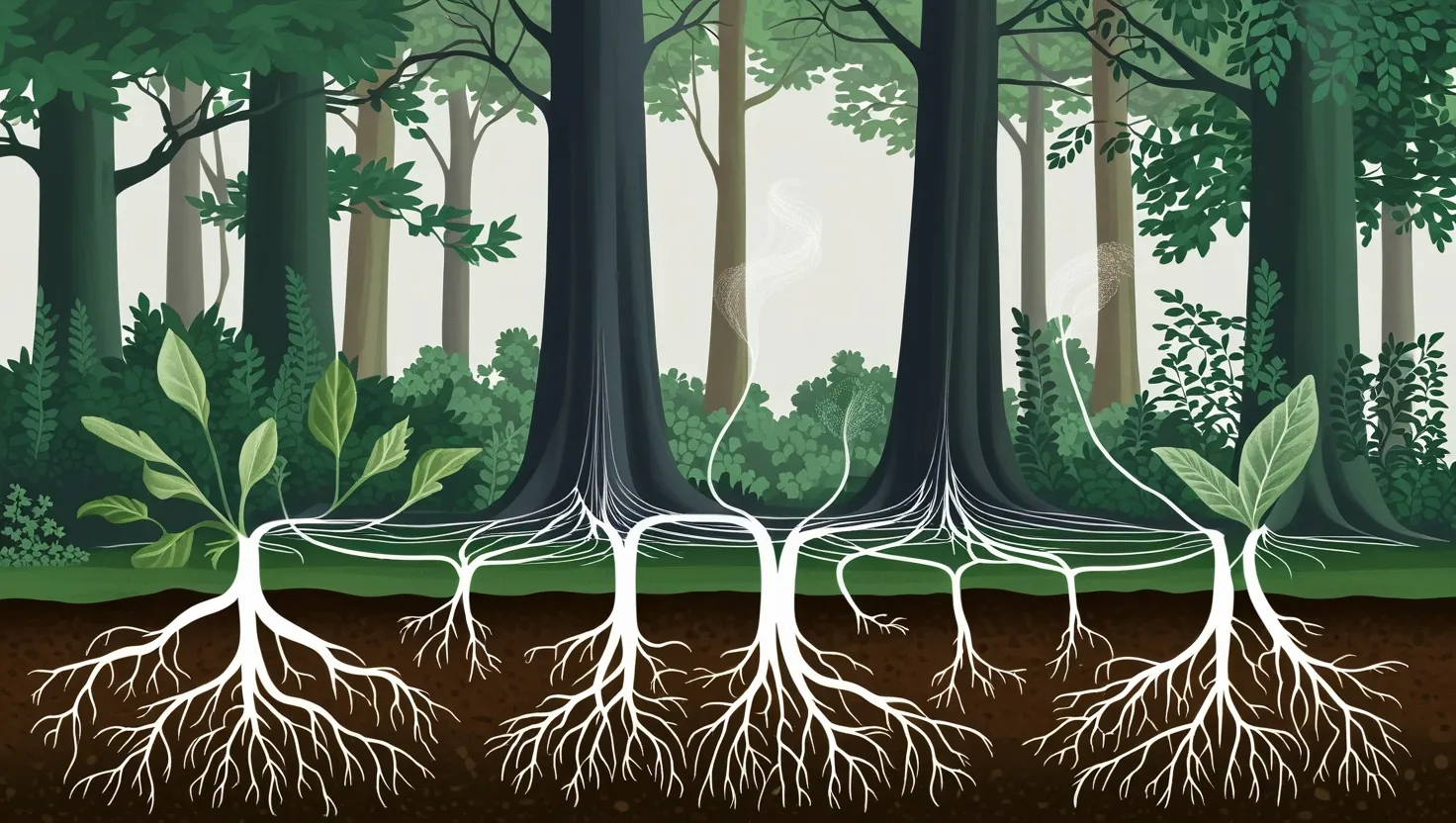
You may have heard of the “Wood Wide Web,” the idea that tree roots connect with special fungi in the soil and form a kind of living network. The fungi act like little cables that connect one plant’s roots to another’s. Through this shared system, trees send nutrients like sugar, nitrogen, and water. They also send chemical messages, a bit like tiny letters written in molecules.
Here is a simple example. Imagine one tree gets attacked by insects. Its leaves get chewed, and it reacts by changing its chemistry. It can send warning signals down to its roots and then into the fungal network. Neighboring trees “receive” this chemical warning and start boosting their own defenses before the insects even reach them. They may make bitter or toxic compounds in advance, so the attackers get a nasty surprise.
Now, stop and think: if a tree can change what it does now because of what happened to another tree nearby, is that just “automatic,” or is there something more like a decision there? No brain, no nerves, but still a coordinated response.
Here is a twist many people do not know. Not all trees seem to use this network in the same way. Some studies suggest “mother trees,” usually older and larger, are more connected than others. They seem to send extra carbon to shaded seedlings under their canopy so those tiny trees stay alive in low light. In a way, it is like feeding your kids while they are too small to fend for themselves.
But this idea is still debated. Are trees really “favoring” their own offspring, or are we just seeing resource flow that feels similar to parental care? We cannot climb into a tree’s mind because it has no mind like ours. Still, the pattern is odd: resource sharing looks selective, not random.
Here is a question for you: if you saw humans doing the same kind of sharing, would you call it social behavior?
“The tree which moves some to tears of joy is in the eyes of others only a green thing that stands in the way.”
— William Blake
Now let us move from forest networks to plant memory, which sounds even stranger.
People often think memory means remembering your birthday or where you left your keys. Plants obviously do not do that. But they do show what scientists call “biological memory.” That is a fancy way of saying: “What happened before changes how they react later.”
Take a simple case. Some plants faced with repeated stress — like touching, wind, drought, or sudden cold — start to respond differently after a while. They “learn” that a stimulus is harmless or, in other cases, they learn that a threat is likely to return.
There are experiments where plants are exposed to a repeated harmless touch. At first they respond strongly, changing their chemistry or growth. After many repetitions, they start to respond less, as if they have “decided” this touch is nothing to worry about. The plant saves energy by no longer overreacting. Some tests show that this new calm response can last even after days without any stimulation, like a form of long-term memory.
Here is another curious example, explained in simple terms. There are plants that track day and night length very carefully. They build up energy during the day and then slowly use it at night. Some species do this with surprising accuracy. It is almost like they do “division”: they figure out how long the night will be and spread their stored energy across that whole period so they do not run out too early. If they used it too fast, they would starve before sunrise. If they used it too slowly, they would waste growth potential. They adjust night after night.
You and I might say, “So what? It is just chemistry.” But what if I told you that this strategy changes depending on their past daylight experience? That suggests they keep a record of past conditions and use it to plan future use. Planning without a brain is a weird idea, but that is what this behavior looks like from the outside.
Let me ask you: if the same pattern happened in a robot, we would call it “algorithmic planning.” Why do we call it “just a reaction” when a plant does it?
“We do not see things as they are, we see them as we are.”
— Anaïs Nin
Now let us talk about a strange kind of “hearing.” No, plants do not have ears. They do not enjoy your favorite playlist. But some experiments point to plants reacting to sound in a targeted way.
In simple lab setups, roots of young plants, like pea seedlings, have been shown to grow toward the sound of running water, even when the water is inside a closed pipe that they cannot reach directly. The roots still bend in that direction. If this result holds up across more tests, it means the plant can detect vibrations that mean “water is there,” and then grow toward it.
Think of what that means. The plant is not just growing randomly until it hits moisture. It is using a clue — sound vibrations — to make a directional choice. That is a kind of problem-solving: “Where should I grow to find what I need?”
There are also early hints that some plants can sense the presence of neighbors without smell, touch, or light cues. In a few experiments, seeds grew differently if a competitive plant species was nearby, even when chemical and light signals were blocked. Some scientists suspect subtle physical signals like tiny vibrations or maybe electromagnetic fields. The mechanisms are still unclear. This is not fully proven, and it is still controversial, but it points to a bigger idea: plants may be tuned to their environment in many more ways than we can easily see.
So let me throw this back to you: if you had a sense humans do not have, and people could not detect it, would they assume you are less intelligent?
“The limits of my language mean the limits of my world.”
— Ludwig Wittgenstein
Another area where plants surprise us is their chemical “language.” To us, smell is just a feeling in our nose. For plants, airborne chemicals are like words and sentences.
When a plant gets attacked by insects, it can change the mix of chemicals it releases into the air. These substances can do at least three jobs at once.
First, they warn other plants nearby: “Something is eating me. Get ready.” The neighbors then boost their own defenses early.
Second, they can signal inside the plant itself, traveling from leaf to leaf to coordinate defense across the whole body.
Third, and this is my favorite, they can call in helpers. Some plants release specific smells that attract predators or parasites of the insects eating them. To put it plainly, the plant is calling a bodyguard. For example, a plant under attack by caterpillars can emit chemicals that draw certain wasps that lay eggs inside those caterpillars. The wasp gets food and a home for its larvae; the plant gets pest control.
What is more, the chemical “message” can get quite precise. Some plants appear to send slightly different warning signals depending on what kind of insect is attacking. The mix of molecules changes like a code. In a few plant species, individuals even seem to vary in how “nervous” they are: some send strong warnings quickly, others respond more slowly. That looks a bit like personality, even though there is no mind in the way we usually imagine.
Here is something to think about: if two plants of the same species send different strengths of warning for the same threat, are we seeing a primitive kind of “risk tolerance”?
“Nature is not mute; it is man who is deaf.”
— Terence McKenna
Now we come to the biggest question: are plants in any way aware?
Many scientists argue we should be careful with that word. Consciousness is usually tied to animals with brains. Plants do not feel pain the way you do. They do not form pictures in their heads. They do not think in sentences. Some people worry that calling plants “conscious” confuses the public and mixes science with wishful thinking.
On the other hand, researchers studying plant behavior point out a problem. If we define “intelligence” only in terms of things brains do, then plants can never qualify, no matter what they show us. That is like designing a test that only humans can pass, then declaring humans the only smart beings.
So some scientists propose a different idea: maybe we should think about “intelligence” as the ability to solve complex problems in changing environments, using memory, prediction, and flexible behavior. If that is our definition, plants score much higher than we thought.
Let us look at what they do, using very simple language.
They sense light, gravity, water, chemicals, touch, and sometimes sound.
They integrate signals from roots, stems, and leaves across their whole body.
They change direction of growth based on both present and past conditions.
They keep track of rhythms like day length and seasons.
They form partnerships with fungi and bacteria and adjust their chemistry to support those allies.
They send and receive signals to and from other plants and even insects, and they respond differently to those signals depending on context.
All of this is done without a central command center. Instead of one boss “brain,” every part of the plant participates. Some researchers call this a “distributed” style of intelligence. That is a fancy way of saying: decision-making is spread out.
Here is a question for you: do you think a mind must be in one place, like your skull, or could many little decision units across a body together form a kind of mind?
“The mind is not a thing but a process.”
— William James
The real mystery is not just that plants are clever in their own way, but what that means for us.
If we accept that a plant can show a form of memory, problem-solving, communication, and even something very faintly like personality, then our normal way of ranking life — humans at the top, then animals, then plants as background — starts to look too simple.
You and I live in a world mostly designed by humans for humans. Because plants are quiet and slow, we treat them like scenery or raw material. But the research on plant intelligence suggests they are active participants in ecosystems, making choices — in their own way — that shape forests, fields, and even climate.
So what changes if we take plant intelligence seriously?
First, we might design agriculture differently, working with plant signaling instead of just forcing plants to grow as we want. For example, farmers could use plant-to-plant warning signals and underground fungal networks to boost natural pest control instead of relying only on chemicals.
Second, we might see conservation differently. Cutting down a forest would not just mean losing “trees,” but destroying communities of beings connected through long-lived networks and shared memories of past fires, floods, and droughts written into their bodies and soil partnerships.
Third, it might change how we define our own intelligence. If plants can solve complex problems slowly, over long times, maybe speed is not everything. We rush, react, and forget. Plants respond slowly, but they stick with solutions that work over decades.
Let me leave you with one last question: if you were judged by the standards of a plant — patience, long-term stability, careful use of resources, deep cooperation with neighbors — how intelligent would you seem?
“Look deep into nature, and then you will understand everything better.”
— Albert Einstein
So next time you walk past a tree or a patch of weeds, I want you to pause for a moment. Ask yourself: what is this plant sensing right now? What quiet decisions is it making? Which neighbors is it connected to? What messages are floating through the air and the soil that I, with my human senses, am too limited to notice?
If you can hold that question for even a few seconds, you are already starting to see that plant intelligence is not about plants acting like animals. It is about a totally different style of being smart — rooted, silent, and slow, but far from simple.