Sometimes I find it astonishing that plants, things we often overlook, might be hiding some of the most baffling secrets in biology. You could walk past a patch of grass and never suspect the mysteries growing beneath your shoes. Let’s get right to it—plants may be a lot smarter than most of us think. Sure, they’re silent and rooted, but they act in ways that defy simple explanations. Here are five puzzles about plant intelligence that still confuse scientists, and maybe you too.
“The most beautiful experience we can have is the mysterious. It is the fundamental emotion that stands at the cradle of true art and true science.” — Albert Einstein
Chemical signaling is my first stop. I want you to imagine a leaf being chewed by a caterpillar. Instead of just suffering quietly, the plant releases chemicals into the air. Think of these as emergency signals—smelly clouds floating in the wind. Neighbor plants pick up these cues and start beefing up their own defenses. But here’s the strange part: nobody really knows how they ‘understand’ these airborne messages. Did you ever wonder how a plant knows it’s being warned by its neighbor and not simply hit by some random scent? What’s going on inside those cells—what process allows a plant to pick just the right response? We think plants interpret these signals like a coded language, but the details are still a puzzle. Why do some respond strongly while others seem deaf to danger? Could two different plants talking to each other use slightly different chemical ‘languages’? If so, who taught them the dictionary?
Have you ever asked yourself, Can a tree ‘hear’ another tree’s warning smoke? Or does it just react by chance?
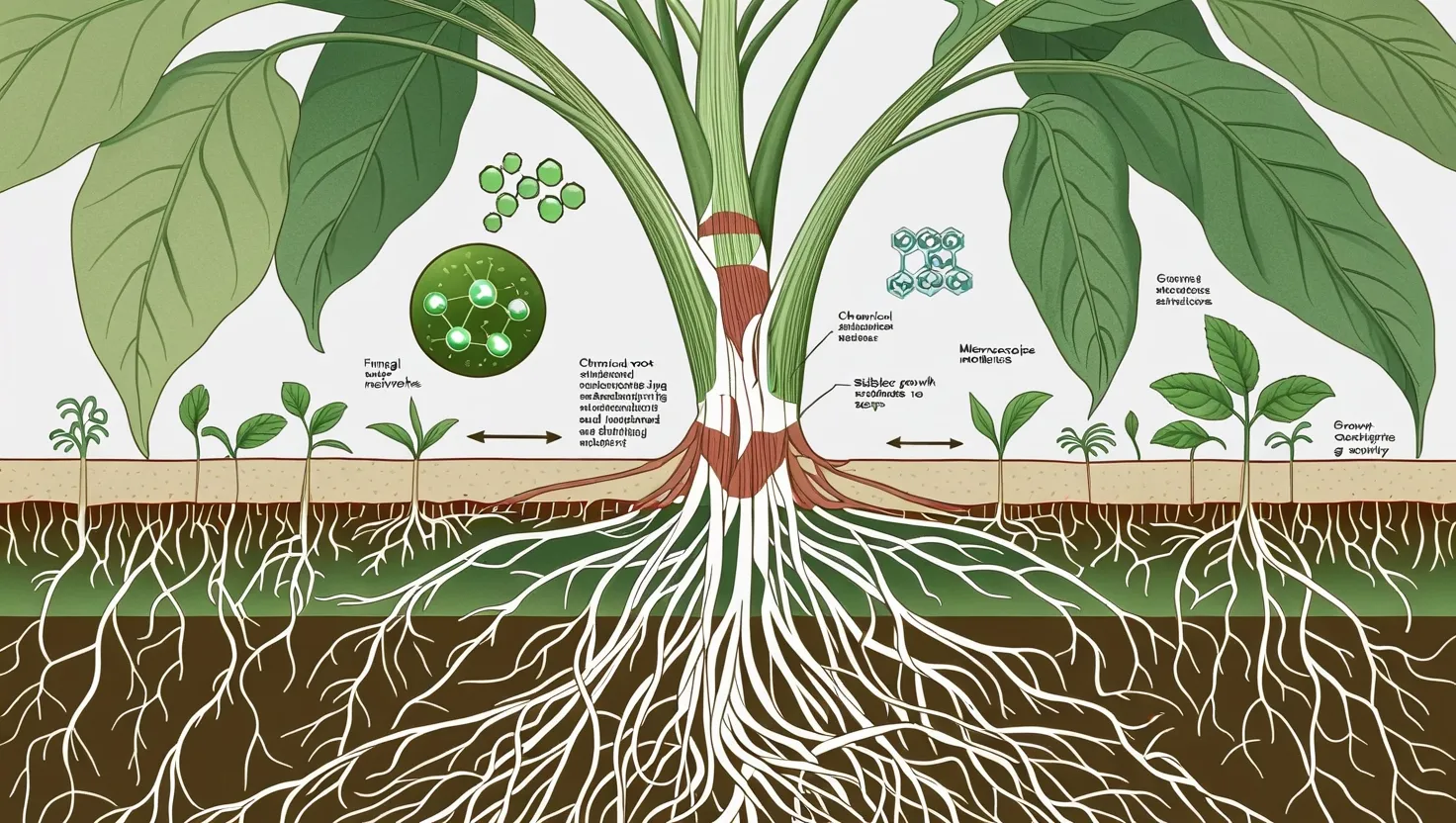
My mind jumps next to the roots under our feet. Below the ground, there’s a massive network that we hardly see. Fungi help plants connect their roots, creating pathways for swapping nutrients and even warnings—a sort of plant internet. Scientists call this the “wood wide web.” But the full size and inner workings of this underground system remain shadowy. Some plants give away nutrients as gifts. Others take more than they share, acting like greedy neighbors. Why do mushrooms, busy forming links between trees, sometimes push one plant up and let another fail? Fungi themselves seem to pick favorites. Are they helping plants for some grand reason, or just playing with the system to get what they want?
How would you feel if you suddenly learned that an ancient oak out back decided to help— or ‘ghost’—a smaller sapling, all through its root connections?
“Science is exciting because it is full of unsolved mysteries… The public, of course, imagines science is just a set of facts. But it’s not. Science is a process of exploring, which is always partial.” — Freeman Dyson
Now let’s talk about behavioral memory. Yes, some plants seem able to “remember” past events. If you brush the leaves of a certain plant every day, it may learn not to curl up in fright. What is that? How can something without a brain recall any experience? Scientists struggle to explain it. Did you know that if you shine a light on some seedlings at regular intervals, they change behavior as if predicting the pattern? Are they storing information in their cells? Do these combinations of proteins and changes in cell walls count as memory, the way we remember names or birthdays? Or is plant memory something else entirely?
Can a bean sprout “learn” over time that gentle touches are safe? If so, do you ever wonder what else it might remember?
“We are small enough.” — Franklin D. Roosevelt
Then there’s the riddle of sensory mechanisms. Plants somehow sense gravity and light with stunning precision. Sunflowers turn their faces to follow sunlight. Some roots point down, others up. There’s no brain, no nerves. So what is the tool they use to keep track? Tiny structures inside cells do part of the job, but the exact process seems too accurate to be random. Some experiments even suggest that plants sense sound—roots grow toward vibrations, and peas in noisy trays behave differently than quiet ones. Does this mean they have a built-in system for picking up tiny signals, just sitting there in their cells? How can a rose bush “know” which way is up or where the brightest light is shining, when we’d get lost if our eyes were shut?
Imagine trying to “feel” the world around you, with no eyes or ears. Do you think you could manage as well as a simple weed?
“It is through science that we prove, but through intuition that we discover.” — Jules Henri Poincaré
Finally, the biggest and wildest debate: do plants have something like consciousness? Some scientists say plants only react to changes—basic cause and effect. Others hint at something deeper. When a tree shifts resources, prepares for an attack, or even helps its neighbor, is it just following instructions, or is it making a choice? Philosophers join the argument. They ask if plants feel anything or simply act automatically. We don’t have the answers yet. The puzzle grows: can awareness exist in beings that don’t have a brain at all? Is our own way of thinking the only way that counts, or do we need a new word for what plants do?
Would you agree with those who say, If it doesn’t think, it cannot be aware? Or do you feel there might be something more— a sort of basic “knowing”— lurking in that silent green stalk?
“Our knowledge can only be finite, while our ignorance must necessarily be infinite.” — Sir Karl Popper
If you let your mind wander in a garden, you might start to notice how strange these puzzles are. If trees can warn each other and mushrooms can direct traffic underground, are plants somehow listening, talking, or keeping records? Can we ever really say we’ve solved their secrets?
When I water a houseplant and see it stretch toward the window, I sometimes think: maybe the plant is just doing what it was programmed for all along. Yet, that answer feels thin. Maybe, as science keeps asking sharper questions, we’ll start to see a rich drama happening in even the quietest leaf.
So, what questions do you still have about plants after reading this? Do you picture them as passive spectators, or maybe active players in a world full of mystery? Are we missing something big about how life works, or peeking at the edges of something we barely understand? The truth is, every root, every shoot might be holding answers we’re not ready for. That’s what makes the study of plant intelligence such a lively field.
“The real voyage of discovery consists not in seeking new landscapes but in having new eyes.” — Marcel Proust
Next time you walk among the trees, perhaps stop and wonder—Are these plants thinking? Or are they simply the best chemists, memory keepers, and network builders we’ve never truly met? The mysteries stay open, and that’s exactly what keeps science moving.