5 Things About the Moon That Still Baffle Scientists With Expensive Equipment
Discover 5 unsolved Moon mysteries that baffle scientists — from its split personality to ancient magnetism. Explore the secrets hiding in plain sight. Read more.
The Moon hangs up there every night, looking simple and obvious, like a lamp someone left on. But the more scientists study it, the more it refuses to make sense. It is not a dead, boring rock. It is a puzzle box that keeps producing new questions every time we think we have answered one.
Let me walk you through five things about the Moon that genuinely baffle scientists — not the soft, vague kind of bafflement, but the kind where very smart people with very expensive equipment sit back and say, “We genuinely do not know.”
The Moon Has Two Completely Different Faces
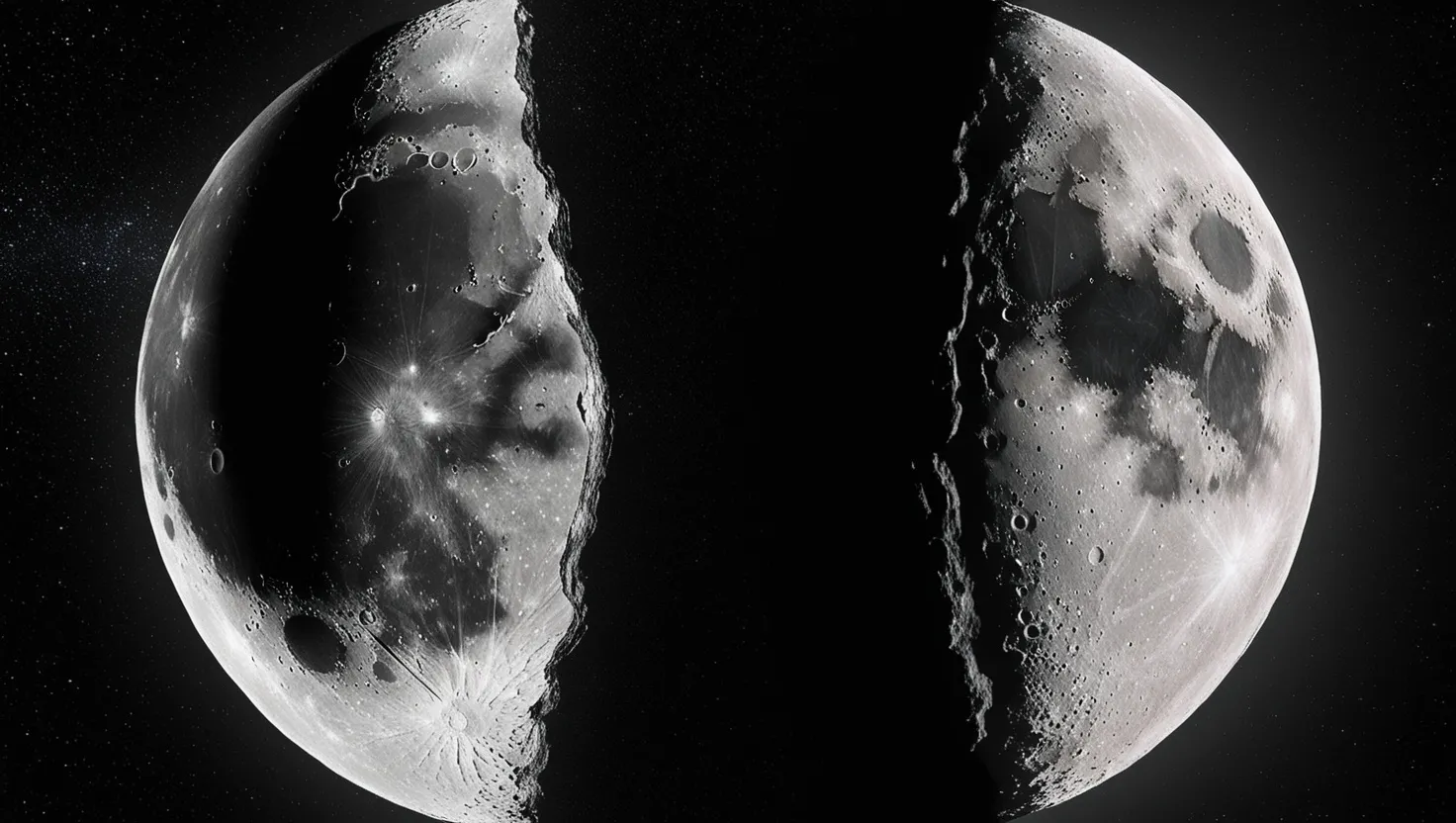
Flip the Moon around and you would think you were looking at a different world. The side that always faces Earth — the near side — is covered in wide, dark, flat plains called maria. These are ancient lava fields, smooth and spread out. The far side? Completely different. It is heavily cratered, geologically ancient, and has almost none of those flat lava plains.
Here is the strange part: both sides were supposedly formed from the same original material, at the same time, in the same solar neighborhood. So why do they look so radically different?
One theory says the crust on the far side is thicker, which would have stopped lava from breaking through. But why is the crust thicker there in the first place? That question does not have a clean answer. Some researchers think a second, smaller moon may have existed billions of years ago and slowly merged with the Moon, piling extra material on one side. Other researchers find that idea messy and unconvincing.
What we know for certain is that the two hemispheres behave like geological strangers. The near side is volcanically active in its ancient past. The far side looks like it never really warmed up the same way. No current model explains this cleanly, which is exactly why it stays on the mystery list.
“The universe is under no obligation to make sense to you.” — Neil deGrasse Tyson
The Moon Once Had a Magnetic Field — And Nobody Knows How
Here is something that should not be possible. Moon rocks brought back by Apollo astronauts are magnetized. Certain ancient rocks, some nearly four billion years old, carry traces of a magnetic field that once existed on the Moon.
That alone is not strange. Earth has a magnetic field too. What is strange is that Earth’s magnetic field comes from its liquid iron core spinning and churning — a process called a dynamo. For a dynamo to work, you need a large, hot, active core.
The Moon’s core is tiny. Maybe 300 kilometers across. A body that small should not have been able to sustain a magnetic dynamo long enough to magnetize those rocks. The physics say the dynamo should have switched off very early. The rocks say it kept going for hundreds of millions of years longer than it should have.
Some scientists think the Moon’s early orbit around Earth was more chaotic — more tilted and stretched — and that the gravitational tugging from Earth kept the Moon’s interior stirred up and warm. Others suggest impacts from asteroids may have temporarily powered the dynamo back up. Both explanations are creative. Neither one fully fits all the evidence.
So you have ancient Moon rocks sitting in labs telling us something happened that the models say should not have happened. That is the kind of contradiction that keeps planetary scientists awake at night.
Ice Sitting in Eternal Shadow
Think of the darkest, coldest place you can imagine. Now make it colder. Some craters near the Moon’s poles have not seen sunlight in over a billion years. Not because they are deep underground — just because the Moon’s axis is almost perfectly straight up, so sunlight never reaches certain spots inside these craters.
Scientists call these permanently shadowed regions, and they have found water ice inside them. That part is not the mystery — ice surviving in extreme cold makes sense. The mystery is how the ice got there and how it has survived in such fragile conditions.
Water molecules are delicate. Radiation from the Sun and cosmic sources should break them apart over time. Even tiny amounts of sunlight scattered from crater walls could slowly destroy them. Some models predict the ice should not exist at the concentrations we detect. And yet it does.
Where did the water come from? Comets crashing into the Moon are one candidate. Asteroids carrying water-bearing minerals are another. There is even a theory that hydrogen from the solar wind reacts with oxygen in Moon rocks to make water molecules that then drift toward the poles. Possibly all three processes are happening at once.
The deeper question is how the ice survives long enough, in high enough quantities, to be detectable today. Our models of ice stability in those craters keep needing adjustment every time we get new data.
“We shall not cease from exploration, and the end of all our exploring will be to arrive where we started and know the place for the first time.” — T.S. Eliot
The Atmosphere That Keeps Refilling Itself
The Moon technically has an atmosphere. It is so thin that a single breath from you would temporarily double it in your immediate surroundings, but it exists. Scientists call it an exosphere.
What is in it? Mostly sodium and potassium atoms, some argon, traces of other elements. These atoms float just above the surface, bouncing around, eventually escaping into space. And here is the thing — they keep escaping. Every day, the Moon loses atoms from this wispy atmosphere.
So why does the exosphere not run out?
Something is constantly replenishing it. Scientists believe micrometeorites — tiny specks of rock hitting the surface constantly — kick atoms off the lunar soil and into the air. There is also a process called photon sputtering, where sunlight itself physically knocks atoms loose. Both processes contribute, but when you do the math, the numbers still do not quite add up to explain everything we observe.
The composition of the exosphere also changes in ways that are not fully predictable. After meteorite showers, sodium levels spike. But there are fluctuations at other times that do not match any obvious cause. Something is feeding the Moon’s atmosphere in ways we have not fully mapped.
Have you ever thought about the fact that even the Moon’s near-vacuum has mysteries hiding inside it?
The Giant Impact That Made the Moon — And Still Does Not Quite Add Up
The leading theory for how the Moon formed goes like this: about 4.5 billion years ago, a Mars-sized object called Theia crashed into the early Earth. The collision threw an enormous amount of material into orbit, and that material eventually clumped together to form the Moon.
This theory is called the Giant Impact Hypothesis, and for decades it was considered largely settled. But the more we study Moon rocks and run computer simulations, the more awkward details keep appearing.
Earth and the Moon share almost identical oxygen isotope ratios — meaning the material in both is chemically almost identical. But in most simulations of the giant impact, the Moon forms mostly from Theia’s material, not Earth’s. So the Moon should look chemically different from Earth. It does not.
To explain this, researchers have proposed that Theia was made of almost the same material as early Earth — which would be an extraordinary coincidence. Others suggest the impact was so violent that it completely vaporized and mixed both bodies before the Moon condensed out of the cloud. That version requires a much more energetic collision than the standard model describes.
Then there is the Moon’s orbit. Computer simulations of the giant impact produce a Moon that orbits closer to Earth’s equatorial plane. The actual Moon’s orbit is tilted about five degrees from it. Five degrees sounds small. In orbital mechanics, it is a significant discrepancy that requires additional explanations about how the orbit changed over billions of years.
“The most beautiful thing we can experience is the mysterious. It is the source of all true art and science.” — Albert Einstein
Every fix to the giant impact model creates new questions. Every simulation that matches one observation fails to match another. It is not that the theory is wrong — it is that it keeps being incomplete.
The Moon is not sitting up there solved and understood. It is sitting up there holding secrets that challenge the very tools we use to study it. Our models of planetary formation, magnetic fields, atmospheric physics, and orbital dynamics all run into the Moon and come out slightly crumpled.
And that is actually wonderful. It means there is still something genuine to figure out. Every mystery listed here represents a real gap in human knowledge — not a small, trivial gap, but a large, uncomfortable one. The kind that will likely require new missions, new instruments, and new thinking to close.
What other secrets is our nearest neighbor hiding? Honestly, given its track record, probably more than we expect.