Are Cosmic Catastrophes the Key to Life in the Universe?
Cosmic Drama: How Volcanoes and Mega Storms Shape the Fate of Planets and Life
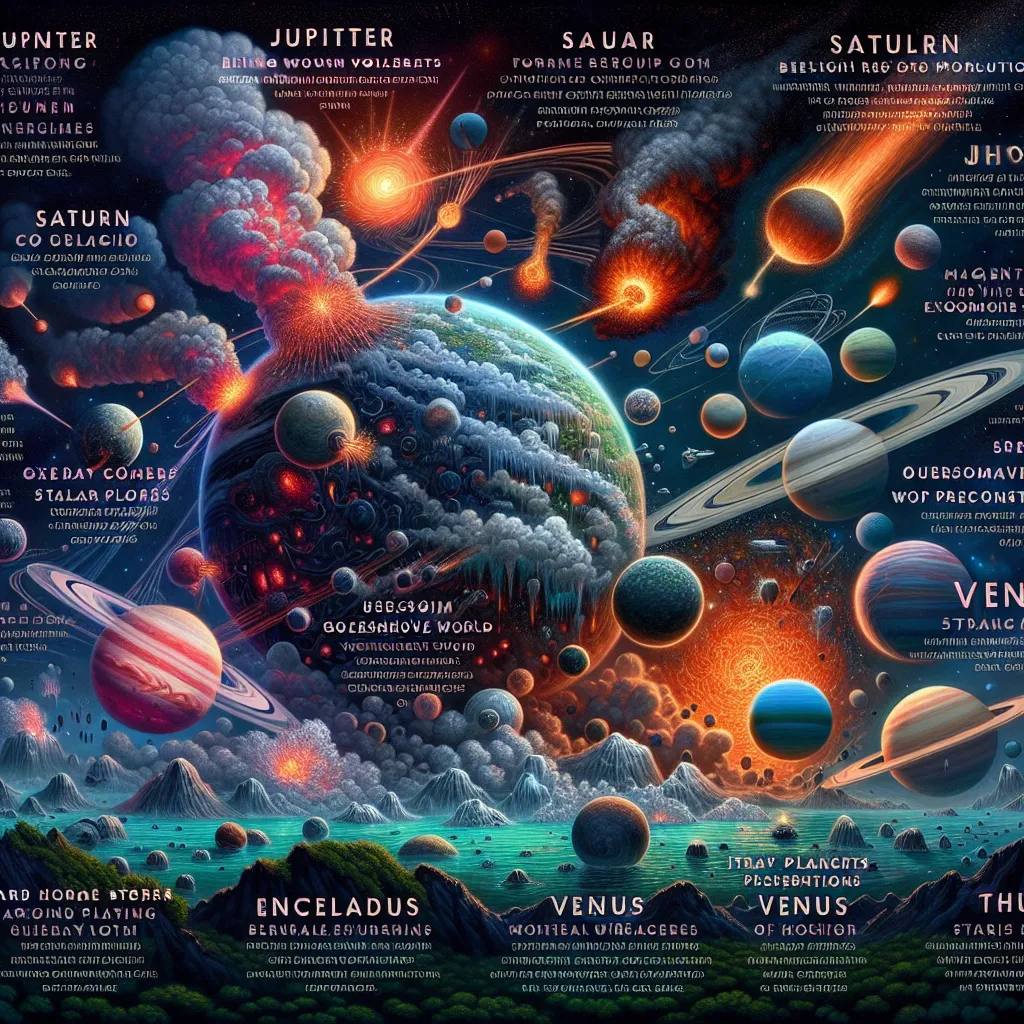
Our universe is a vast and often violent place, where planets, stars, and entire galaxies engage in cosmic battles that shape their destinies. This concept becomes strikingly clear when we explore the phenomena of volcanoes and Mega storms throughout our own solar system and beyond. These devastating forces not only cause destruction but also create the conditions necessary for life.
Volcanoes have played a crucial role in shaping Earth, spewing gases into the atmosphere and creating new landmasses. Without them, life as we know it might never have begun. Our exploration of the cosmos reveals volcanoes on moons and planets we once thought were dead, raising hopes that these geological activities could foster life elsewhere. Jupiter’s moon Io, for instance, is covered with active volcanoes, belching sulfur and creating a landscape reminiscent of an otherworldly pizza. This volcanic activity is driven by Jupiter’s immense gravitational forces, which stretch and compress the moon, generating intense internal heat.
Saturn’s moon Enceladus presents another fascinating example. This icy moon is home to ice volcanoes that shoot plumes of water vapor and organic molecules into space. These plumes suggest the presence of a subsurface ocean where life might exist, making Enceladus one of the most promising places in our solar system to search for extraterrestrial life.
The story of Venus provides a stark contrast. Once similar to Earth, Venus experienced a runaway greenhouse effect, turning it into a hellish world with surface temperatures hot enough to melt lead. Its atmosphere, thick with carbon dioxide from ancient volcanic activity, traps heat like a suffocating blanket, rendering the planet uninhabitable.
Moving further out, the giant of our solar system, Jupiter, hosts the Great Red Spot, a storm that has raged for hundreds of years with winds topping 300 mph. This behemoth of a storm, driven by the planet’s internal heat, dwarfs any weather system we’ve ever experienced on Earth.
On Neptune, we find the fastest winds in the solar system, reaching speeds of over 1,200 mph. Despite being billions of miles from the Sun, Neptune’s internal heat fuels violent weather, demonstrating that extreme conditions can exist in the most unexpected places.
As our technology advances, we continue to discover more planets outside our solar system, known as exoplanets. Some of these are nothing short of nightmarish. Coro 7B, for instance, is a rocky exoplanet with one side perpetually facing its star, reaching temperatures high enough to vaporize rock. These rock vapors then condense and fall as pebbles on the cooler twilight zones of the planet.
We’ve also come across rogue planets, ejected from their star systems and doomed to wander the galaxy in perpetual darkness. Despite their isolation, the sheer number of these rogue planets suggests that they may be quite common.
But it’s not just distant planets that pose potential risks. Our own Sun, often seen as a stable source of light and warmth, is capable of unleashing colossal coronal mass ejections (CMEs) that can disrupt satellites and power grids on Earth. While our planet’s magnetic field protects us from the worst of the Sun’s wrath, we remain vulnerable to these solar storms.
In the vastness of the universe, even more formidable entities reside. Magnetars, the most magnetic objects in the cosmos, can unleash flares with the power to obliterate any nearby planet. These stellar behemoths are a reminder of the immense and often hazardous forces at play in our universe.
Our quest to find another Earth is still ongoing. The discovery of exoplanets within their star’s habitable zone offers hope, but many of these planets present extreme and hostile environments. Yet, this search also underscores the robustness and resilience needed for life to thrive.
The universe, with its ferocious volcanoes and towering Mega storms, is both a cradle and a destroyer, continuously shaping the fate of planets and the potential for life. Through our exploration, we’re learning not just about distant worlds but also about the very forces that made life on Earth possible.