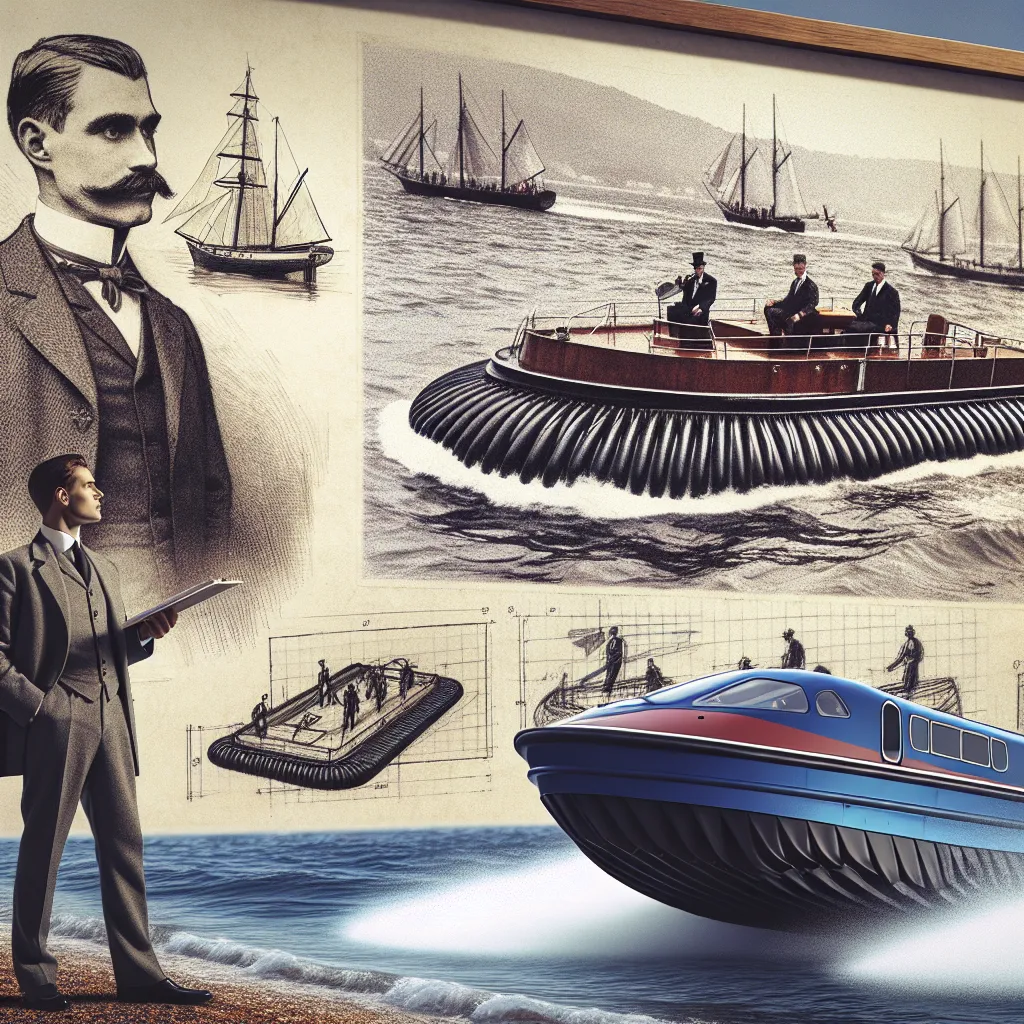
In 1877, John Thornicroft, a clever British boat designer, tackled the problem of boats not reaching high speeds due to hull-water friction. He had the bright idea of using trapped air to reduce friction. Testing this theory, he experimented with a flat-bottomed scale model that had a recess underneath. The trapped air lifted the boat out of the water a bit, making it faster. He even tried a more advanced model with a clockwork mechanism and bellows to pump air under the boat, acting like a lubricant. This idea worked too, but the technology needed to make it practical just wasn’t there yet, and his patents were never used.
Fast forward over fifty years, and Christopher Cockerell picked up where Thornicroft left off. Cockerell believed in the air cushion concept and eventually created the first full-sized hovercraft. This invention was met with skepticism at first. Headlines called it a “Flying Saucer,” doubtful it could glide over water. To prove them wrong, he took it out onto the bay, and it sailed perfectly, astonishing everyone.
Cockerell, a respected engineer already with many patents, was confident the hovercraft would work. Using early experiments involving two tin cans and an air blower, he demonstrated that a circular jet of air could support heavier loads. In 1955, he built a prototype that proved his theory. When he tried to market his idea, he faced hurdles. The aircraft industry said it wasn’t an aircraft, and shipbuilders said it wasn’t a ship. Finally, he got the British government’s attention. Impressed, they classified the project top secret, tapping experts from the armed forces to check it out. The initial response from the Navy, Army, and Air Force wasn’t encouraging.
It took two more years before the government funded a study on Cockerell’s hovercraft idea. The design was simple but revolutionary: air enters through the top and blows through a circular slit around the bottom, creating a curtain of air that traps a cushion underneath. Extensive testing followed, and in 1959, a full-scale prototype was finally revealed.
In the same year, Cockerell’s invention was put to the ultimate test. To celebrate the 50th anniversary of the first plane flight across the English Channel, the hovercraft made its own crossing of the 22-mile stretch. Despite facing rough seas, the hovercraft performed admirably. They reached the shore, and a hungry Cockerell even turned down an interview for breakfast.
And that’s how the dream of riding on air became a reality, thanks to the dedication and brilliance of John Thornicroft and Christopher Cockerell.