Are You Part Virus? Five Unsettling Scientific Mysteries About What Viruses Really Are
Discover five mind-bending virus mysteries, from giant viruses to human DNA origins. Are you part virus? Read on to find out.
Let me ask you something strange right from the start. Are you more virus than human? Stay with me, because by the end of this piece, you might not be sure how to answer that.
Viruses have been puzzling scientists for over a century, and honestly, the more we learn, the stranger they get. They are not quite alive, not quite dead, not quite chemistry, not quite biology. They sit in a gray zone that makes biologists uncomfortable and philosophers curious. Let us walk through five mysteries that show just how odd these tiny particles really are.
Are Viruses Even Alive?
Here is the first problem. A virus cannot eat. It cannot breathe. It cannot make its own energy. It cannot reproduce by itself. Put a virus in a sealed glass jar with nothing else inside, and it will simply sit there, doing absolutely nothing, forever. That sounds like a rock, not a living thing.
But put that same virus inside a living cell, and everything changes. Suddenly it hijacks the cell’s machinery, copies itself thousands of times, and bursts out to infect more cells. So is it alive only sometimes? Is life a switch that turns on and off depending on location?
The Nobel laureate biologist Peter Medawar once described a virus as “a piece of bad news wrapped in protein.” That is a clever line, but it dodges the real question. Bad news is not biology. Yet viruses carry genetic instructions, evolve, and adapt to their hosts, which sounds a lot like life to me.
I like to think of viruses as biological software. A piece of code sitting on a hard drive is not doing anything either. Run it on a computer, and it becomes active, even dangerous. A virus needs a host the way software needs a machine. Does that make it alive? I genuinely do not think there is a clean answer, and that is exactly why this mystery refuses to die.
Giant Viruses That Break The Rules
For decades, we thought viruses were always tiny, always simple, always smaller than bacteria. Then in 1992, scientists found something strange in a water tower in England, inside an amoeba. They first thought it was a bacterium because it was so large. It took ten years before anyone realized it was actually a virus. They called it Mimivirus, short for “mimicking microbe.”
Mimivirus was a shock. It has over a thousand genes, more than some bacteria. Normal viruses have barely a handful of genes, sometimes less than ten. Since then, scientists have found even bigger ones, like Pandoravirus and Pithovirus, some with genomes larger than certain parasites.
Here is a weird fact for you. Most of the genes inside these giant viruses do not match anything else we know on Earth. Nearly ninety percent of Pandoravirus genes have no known relative in any other organism. Where did they come from? Nobody fully knows.
These giant viruses also carry genes for making proteins, something regular viruses never do, because they always borrow that machinery from their host. So why do giant viruses carry genes they barely use? Some scientists think they evolved from a fourth domain of life that we have not discovered yet, something separate from bacteria, archaea, and eukaryotes. Others think they are shrunk down remnants of ancient cells that lost most of their independence over billions of years.
Which explanation sounds more believable to you, a lost branch of life, or a fallen cell?
The Ocean Is Full of Viruses We Have Never Even Named
Here is a number that should stop you for a second. There are more viruses in a single liter of seawater than there are stars in the observable universe. Scientists estimate roughly ten million viruses in each milliliter of ocean water. Multiply that across every ocean on Earth, and you get a number so large it stops meaning anything useful.
Most of these viruses infect bacteria, not humans, through tiny viral soldiers called bacteriophages. Every single day, these ocean viruses kill around twenty percent of all bacteria in the sea. That sounds destructive, but it keeps the entire ocean ecosystem balanced. Without this daily viral slaughter, bacteria would multiply out of control and the oceans would choke.
Here is the strange part. When researchers sequence genetic material pulled directly from seawater, most of what they find does not match any known virus. Some studies suggest over half the viral genes in the ocean are complete mysteries, belonging to viruses we have never classified, named, or even seen under a microscope. We are swimming, quite literally, in biological dark matter.
Carl Zimmer, a science writer who has spent years tracking viral research, wrote that viruses “are the most abundant biological entities on the planet, and yet we barely understand them.” I think that line captures the strange humility this topic demands. We walk around acting like science has mapped out life on Earth, but the ocean alone proves how much remains hidden.
Eight Percent Of You Is Virus
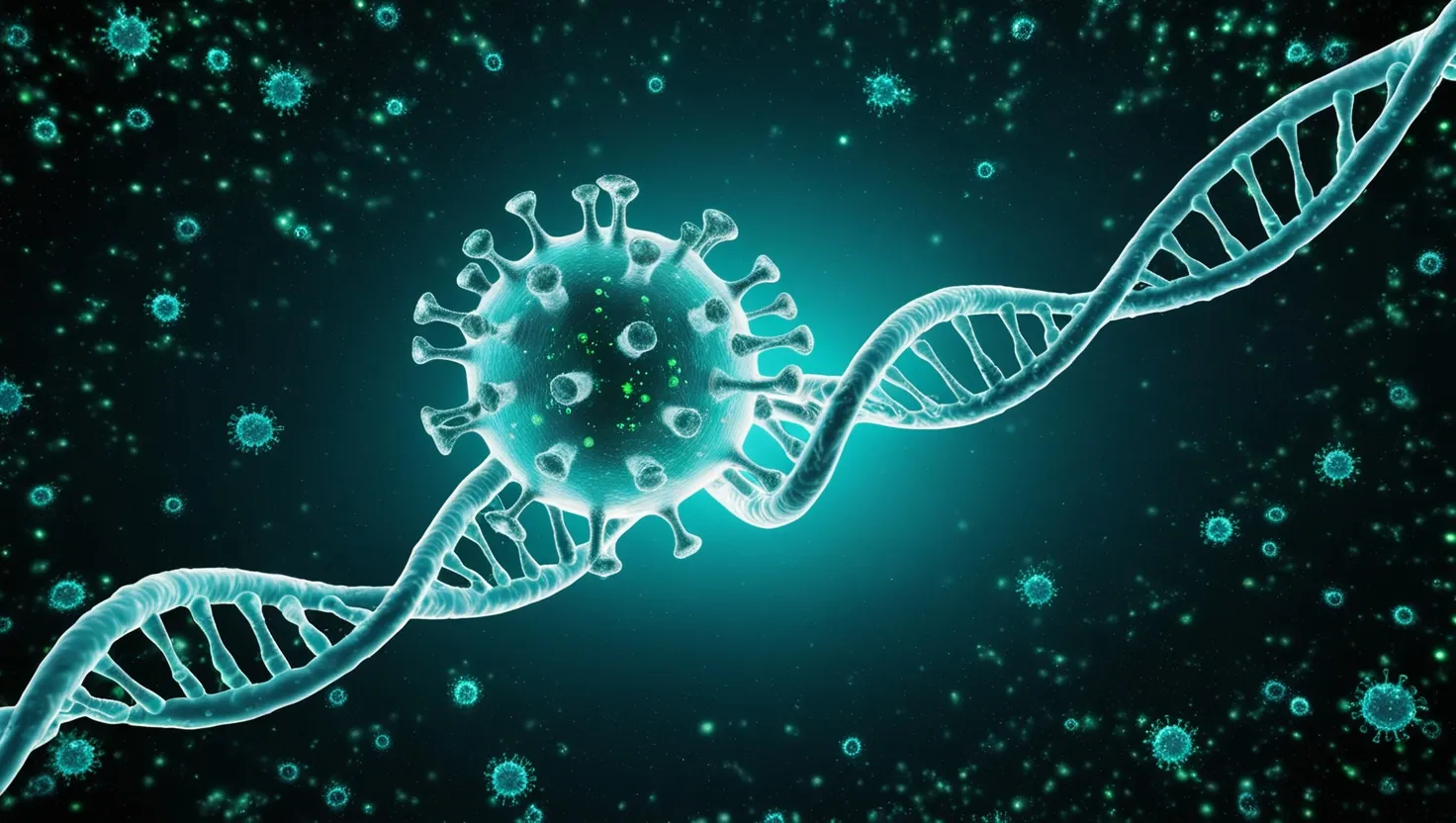
This one tends to surprise people the most. About eight percent of human DNA comes from viruses that infected our ancient ancestors millions of years ago. These are called endogenous retroviruses, and they got permanently stuck inside our genome.
Here is how that happens. Certain viruses, like HIV’s ancient relatives, insert their genetic code directly into the DNA of the cells they infect. If that infected cell happens to be a sperm or egg cell, the viral DNA gets passed down to every future generation. Over millions of years, these viral fragments pile up, mutate, and eventually become a permanent part of what we call “human” DNA.
Most of these ancient viral genes are broken and inactive now, just leftover fossils sitting quietly in our chromosomes. But some are not dead at all. One gene called syncytin, which came directly from an ancient virus, is now essential for forming the human placenta. Without this hijacked viral gene, pregnancy in mammals would not work the way it does.
Let that sink in for a moment. A virus helped make it possible for you to be born. Does that change how you feel about viruses?
Luis P. Villarreal, a virologist who has spent decades studying this topic, argued that viruses are “a major driving force in the evolution of life.” I think this single fact about the placenta proves his point better than any theory could.
Did Viruses Help Build The First Cells?
This next idea sounds almost like science fiction, but serious researchers take it seriously. Some scientists believe viruses may have played a role in the origin of DNA itself.
Here is the logic. Early life on Earth likely used RNA, not DNA, to store genetic information. RNA is less stable and more fragile. At some point, life transitioned to DNA, which is tougher and better at storing information long term. Nobody fully agrees on how that transition happened.
One theory suggests viruses invented DNA first, as a defense mechanism to protect their genetic material from the host cell’s enzymes, which were designed to destroy RNA invaders. If that is true, then DNA might have started as a viral innovation, something cells later adopted because it worked so well.
Patrick Forterre, a French microbiologist who pushed this idea forward, argued that viruses may have acted like genetic laboratories, creating new molecular tools long before cells existed in their modern form. If he is right, modern life might owe its entire genetic storage system to ancient viruses experimenting with survival strategies.
Does that change how you see the line between living and nonliving things?
What This Tells Us About Life Itself
After looking at all five mysteries, I keep coming back to one thought. Maybe the question “is a virus alive” is the wrong question entirely. Maybe life was never meant to fit into a single clean definition. Viruses blur every boundary we have tried to draw, between living and nonliving, between predator and parasite, between ancient and modern, between human and nonhuman.
The biologist Stephen Jay Gould once wrote that nature rarely cares about the categories humans invent to organize it. Viruses seem to prove exactly that. They do not follow our rules. They just exist, quietly shaping evolution, disease, ecosystems, and even our own bodies, without waiting for us to figure out what to call them.
So here is my final question for you. If eight percent of your DNA came from a virus, and that same viral trick made human pregnancy possible, are you really separate from the thing you call a virus? Or are you, in some strange biological sense, already part virus yourself?