Black Holes Are Breaking Physics: 5 Unsolved Mysteries That Could Rewrite Reality
Explore 5 unsolved black hole mysteries — from the information paradox to wormholes — and what they reveal about the true nature of reality. Read on.
What happens when you fall into a black hole? Do you die instantly? Does time freeze? Does the information that makes you you simply vanish from the universe forever? These aren’t just wild science fiction questions. They sit at the center of the biggest unsolved problems in all of physics — problems that have kept the smartest people alive up at night for decades.
Black holes are not just dark, scary space objects. They are places where the rules we use to describe everything — from atoms to galaxies — simply break down. And when physics breaks down, it means we’re missing something. Something big.
Let’s walk through five of the deepest puzzles black holes throw at us — puzzles that, if solved, could completely rewrite how we understand reality itself.
The Information Paradox: Can the Universe Forget?
Imagine you burn a book. The words are gone, right? Not exactly. In physics, the information contained in that book — every molecule, every arrangement of atoms — still exists in the smoke, the ash, the heat. In theory, if you had perfect knowledge of all those particles, you could reconstruct the original book. Physics says information is never truly destroyed. It transforms, but it never disappears.
Now throw that book into a black hole.
“God does not play dice with the universe.” — Albert Einstein
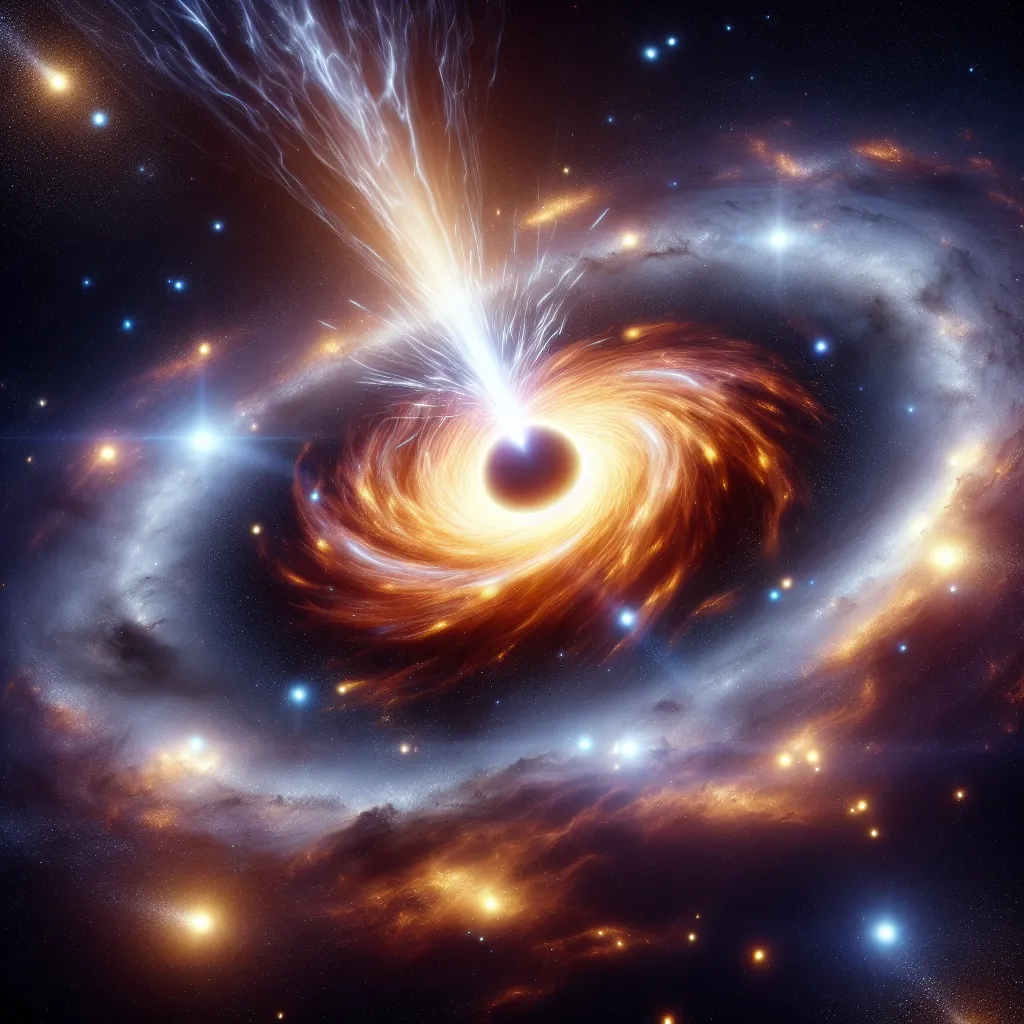
Stephen Hawking discovered in 1974 that black holes aren’t completely black. They slowly emit radiation — now called Hawking radiation. Over billions and billions of years, a black hole loses mass through this radiation and eventually evaporates completely. The problem? The radiation appears to be perfectly random. It carries no information about what fell in. So when the black hole is gone, the information about your book — and everything else that ever fell in — seems to be gone too.
This violates one of the most sacred rules of quantum mechanics: that information is always preserved. The universe, according to quantum theory, does not forget. Ever.
So either Hawking was wrong, or quantum mechanics is wrong. Both options are terrifying because both theories have been tested and proven accurate in every experiment we’ve ever run. They simply cannot both be right — and yet they both seem to be.
Does that mean there’s a third option? A deeper theory we haven’t discovered yet?
This is the information paradox, and it remains unsolved. Some physicists now believe the information does escape through subtle correlations in the Hawking radiation — correlations so tiny and complex that we can’t yet measure them. But no one has proven it. Not even close.
The Firewall Paradox: Would Crossing the Horizon Kill You?
Here’s what general relativity tells us: if you fall into a large black hole, you wouldn’t feel anything special at the moment you cross the event horizon. The event horizon is not a wall. It’s just a mathematical boundary — the point of no return. You’d cross it, and for a few moments, nothing would feel different. You’d just be falling.
But then a group of physicists called AMPS published a paper in 2012 that changed everything. They argued that if quantum mechanics is to be trusted — specifically, if information must be preserved — then the event horizon cannot be empty space. It must be a wall of fire. A literal firewall of incredibly high-energy particles that would incinerate anything crossing it.
“The most beautiful thing we can experience is the mysterious. It is the source of all true art and science.” — Albert Einstein
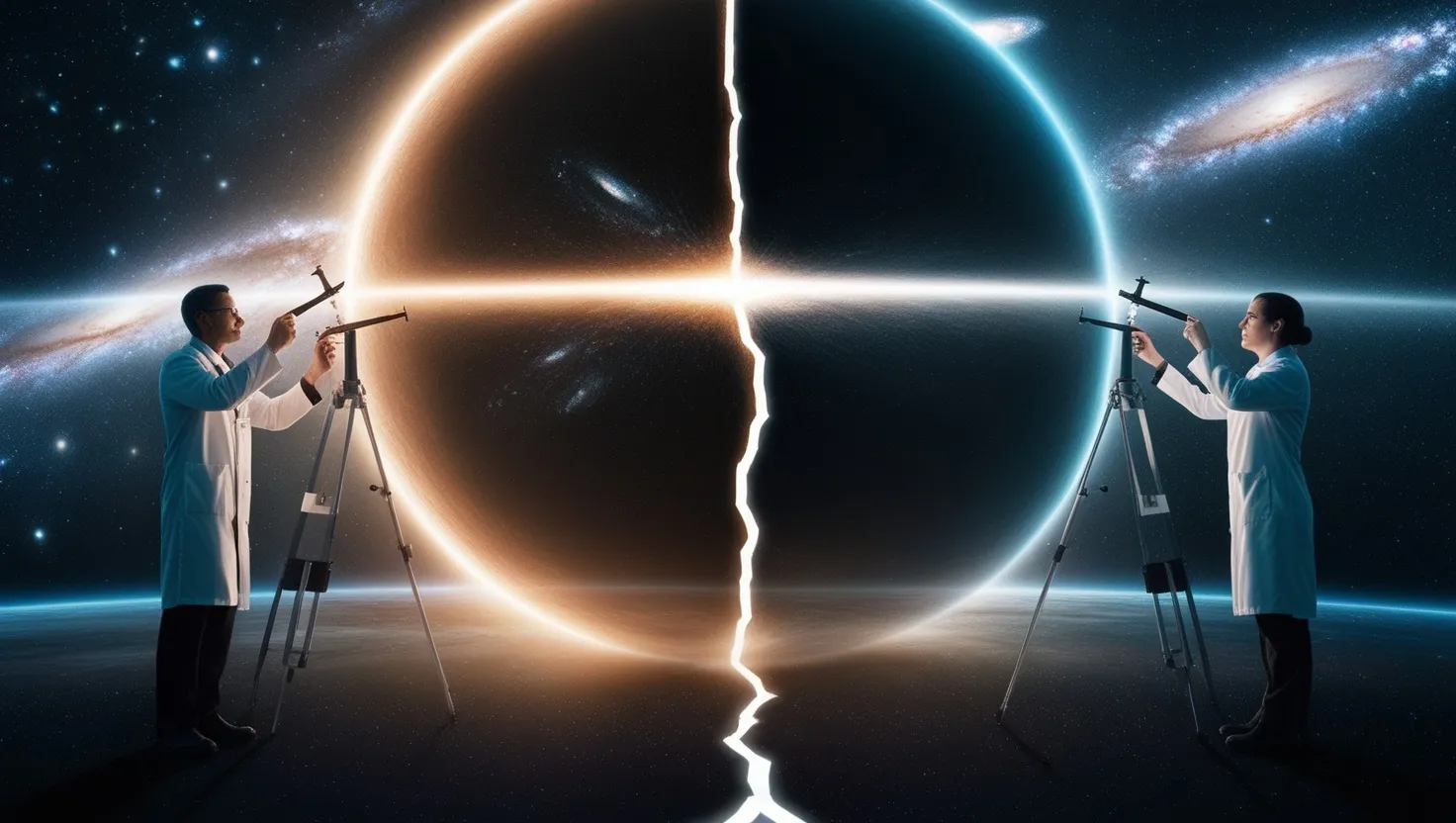
Think about what that means. Either you fall through the event horizon peacefully (as general relativity says), or you burn up instantly (as quantum mechanics might require). Both things can’t be true at the same time. And we have no experiment that can test which is correct because no information can escape from inside a black hole to tell us.
Ask yourself this: what does it feel like to be destroyed by a firewall you can’t see coming? More importantly — how can two of our most trusted theories produce completely opposite predictions for the same event?
The firewall paradox exposes a crack in the foundation of physics. Physicists have proposed wild solutions — including the idea that spacetime itself might be made of quantum entanglement — but none have been fully accepted. The debate is genuinely still open.
Singularities: Where Physics Goes to Die
At the center of a black hole, according to general relativity, lies a singularity. A point of infinite density. Infinite spacetime curvature. A place where mass is crushed into zero volume.
Here’s the honest truth about singularities: physicists don’t actually believe they’re real. They believe they’re a sign that our equations have failed. When your math produces infinity as an answer, it usually means the question was wrong, or the tool you’re using to answer it has reached its limits.
Think of it this way. Imagine using a ruler to measure the temperature of the sun. The ruler would melt. That doesn’t mean temperature is infinite — it means the ruler wasn’t the right tool.
General relativity is the ruler. Singularities are the melting point. What we need is a theory of quantum gravity — a framework that combines quantum mechanics and general relativity — to tell us what’s actually happening at the center of a black hole.
“Not only is the universe stranger than we think, it is stranger than we can think.” — Werner Heisenberg
We don’t have that theory yet. String theory, loop quantum gravity, and other approaches have tried. None have succeeded in giving us a complete, testable picture. The singularity sits there like a locked room, and we’re still looking for the key.
The Holographic Principle: Is Reality Just a Projection?
This one sounds like science fiction, but it’s completely serious physics.
The holographic principle, developed largely by physicist Juan Maldacena in the 1990s, suggests that everything happening inside a volume of space — including inside a black hole — can be completely described by information encoded on the surface surrounding that space. Like a 3D hologram generated from a 2D film.
What does that mean for you? It means the three-dimensional world you experience might be a kind of projection from a two-dimensional surface. The depth, the thickness, the volume of everything around you could be, in some sense, emergent — not fundamental.
Could the universe itself be a hologram? Not in the cheesy science fiction sense, but in a deep mathematical sense — yes, possibly. The mathematics behind this idea (called the AdS/CFT correspondence) is extremely well-studied and has proven incredibly useful in theoretical physics, even in areas far removed from black holes.
What’s fascinating here is what this says about black holes specifically. When something falls into a black hole, the information about it gets smeared across the event horizon — not lost inside, but encoded on the surface. Like writing the contents of a book onto its cover, except infinitely compressed.
Could this solve the information paradox? Maybe. The holographic principle suggests information is never actually inside the black hole in the first place — it lives on the boundary. But making this precise and proving it mathematically is still work in progress.
Wormholes and Time Travel: The Ideas We Can’t Quite Kill
Einstein’s equations of general relativity allow for wormholes — tunnels through spacetime connecting two distant points, or even two different times. He and physicist Nathan Rosen worked this out in 1935, which is why they’re sometimes called Einstein-Rosen bridges.
Here’s the catch: every wormhole that appears in the math seems to be unstable. It would collapse faster than anything — even light — could travel through it. So even if wormholes exist, they might be permanently useless as shortcuts.
“Time is an illusion. Lunchtime doubly so.” — Douglas Adams
But here’s where it gets interesting. Recent theoretical work has connected wormholes to quantum entanglement — the weird phenomenon where two particles, no matter how far apart, are instantly connected. Some physicists believe that entangled particles are actually connected by tiny, microscopic wormholes. If that’s true, then wormholes aren’t exotic rarities — they might be woven into the very fabric of space at the quantum level.
The connection between wormholes, entanglement, and the firewall paradox has led to one of the most exciting conjectures in recent physics: that spacetime itself is built from quantum entanglement. Geometry and quantum information might be the same thing, described in different languages.
Time travel, for the record, remains far more speculative. Even if traversable wormholes existed, using one to travel backward in time runs into logical paradoxes that most physicists believe nature finds some way to prevent. But we don’t know how nature prevents it. And that ignorance is itself a puzzle.
Black holes are not just objects in space. They are questions. Each one is a place where the universe holds up a sign that reads: your map ends here. The five puzzles above — information loss, firewalls, singularities, holography, and wormholes — are all connected, and solving any one of them would likely crack the others open too.
What unites all of them is the collision between two great theories — quantum mechanics and general relativity — that refuse to agree with each other. Until we find the deeper theory that contains both, black holes will keep winning every argument we pick with them.
And honestly? That’s what makes physics worth doing.