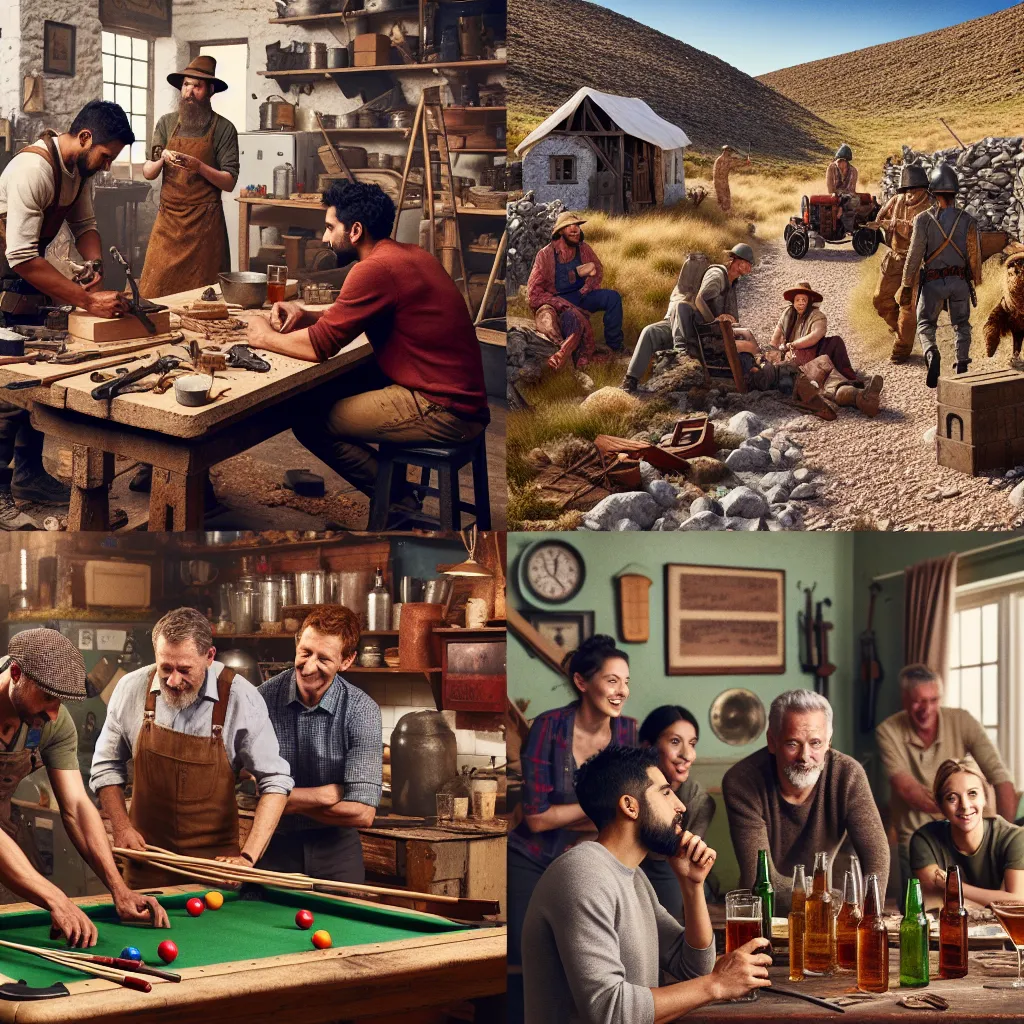
Welcome to the second season of Manlab, where we’re dedicated to helping modern men acquire the skills they need to navigate life’s challenges. Our workshop is fully equipped, the kitchen is open, the bar is stocked, and our sitting area is as cozy as it gets. Let’s dive right in and get productive!
Manlab is the ultimate training ground for honing skills and shunning shoddiness. It’s a beacon of enlightenment, guiding us from the chaos of confusion to the triumph of a job well done. In this episode, I’m handcuffed to Oz Clark, and an oddly dressed man from Zambia is out to get me, all because we’re pretending to read maps. At first, it’s a laugh, but soon it feels like a real game of cat and mouse, with nowhere to hide and the need to move faster.
We also practice the precise art of woodworking and venture deep underground in search of the perfect pool table. Lastly, we tackle an age-old problem: how to remember the names of girls you meet at parties—it’s torturous but necessary.
First up, we’ll chat about the undeniable marvel that is the in-car portable satellite navigation system. It’s as liberating as the desktop computer and the self-bleeding radiator valve. While tempting to think it has made the printed map obsolete, there are times when you need old-school navigation skills. For example, imagine you’ve just escaped from Dartmoor prison, a place built to be even more gruesome than Parisian sewers to house prisoners during the Napoleonic Wars. Few inmates ever escaped, and those who did often wandered aimlessly until they succumbed to the environment’s many dangers.
Against this rugged backdrop, TV’s Oz Clark and I stage our own prison break. We’re not actually breaking out of Dartmoor, but the simulation is serious. Armed with nothing but a map smuggled inside a cake and a wobbly sense of direction, we set out to find our bearings. Using a watch to determine the direction, we pinpoint South and plot our Southwest route.
On the run, we navigate using the compass and avoid being spotted. We plow through bogs, scramble over roads, and stealthily make our way to designated waypoints—all while being chased by expert trackers, led by Ian Maxwell, who’s adept at animal tracking since the age of eight.
Meanwhile, back in the workshop, we’ve figured out we don’t have a pool table. So, we decide to build one ourselves. Our choice of wood is as close to nature as possible, but the challenge lies in making non-uniform pieces fit together into a functional, flat, and level table.
Rory, our fearless slate prospector, heads to the Lake District to get the perfect slate for our table. Meanwhile, in the workshop, we’re chiseling and crafting joints, hoping everything comes together seamlessly. After precise fitting and assembly, our handcrafted table, complete with pockets and blue baize, is finally ready. We inaugurate it with a match, and it plays perfectly.
Back in the wilderness, Oz and I continue our desperate run. After many escapades, including camouflage and hiding from passersby, I injure my knee. Our escape plan is thwarted by the relentless terrain of Dartmoor, proving it’s as effective a natural prison as it was back in the day.
Shifting gears, we address another skill: remembering names at social events. Rory is dropped into an Army rugby league dinner with the daunting task of remembering everyone’s name using mnemonic techniques and clever tricks we’ve read about. Despite the pressure, he manages to remember a decent number of names, showing how critical and challenging this skill can be.
Lastly, we return to our escapade on Dartmoor. Despite meticulous planning, I’ve reached my limit physically, demonstrating how demanding and treacherous such terrain can be.
So there you have it: with just a map, a compass, a bit of ingenuity, and some grit, you can navigate anything life throws your way. Goodbye from Manlab, where we always know our coordinates.