Could Earth's Most Extreme Freeze Be the Reason You're Here?
Forged in Frost: How Catastrophic Snowball Earth Paved the Path for Life's Evolutionary Leap
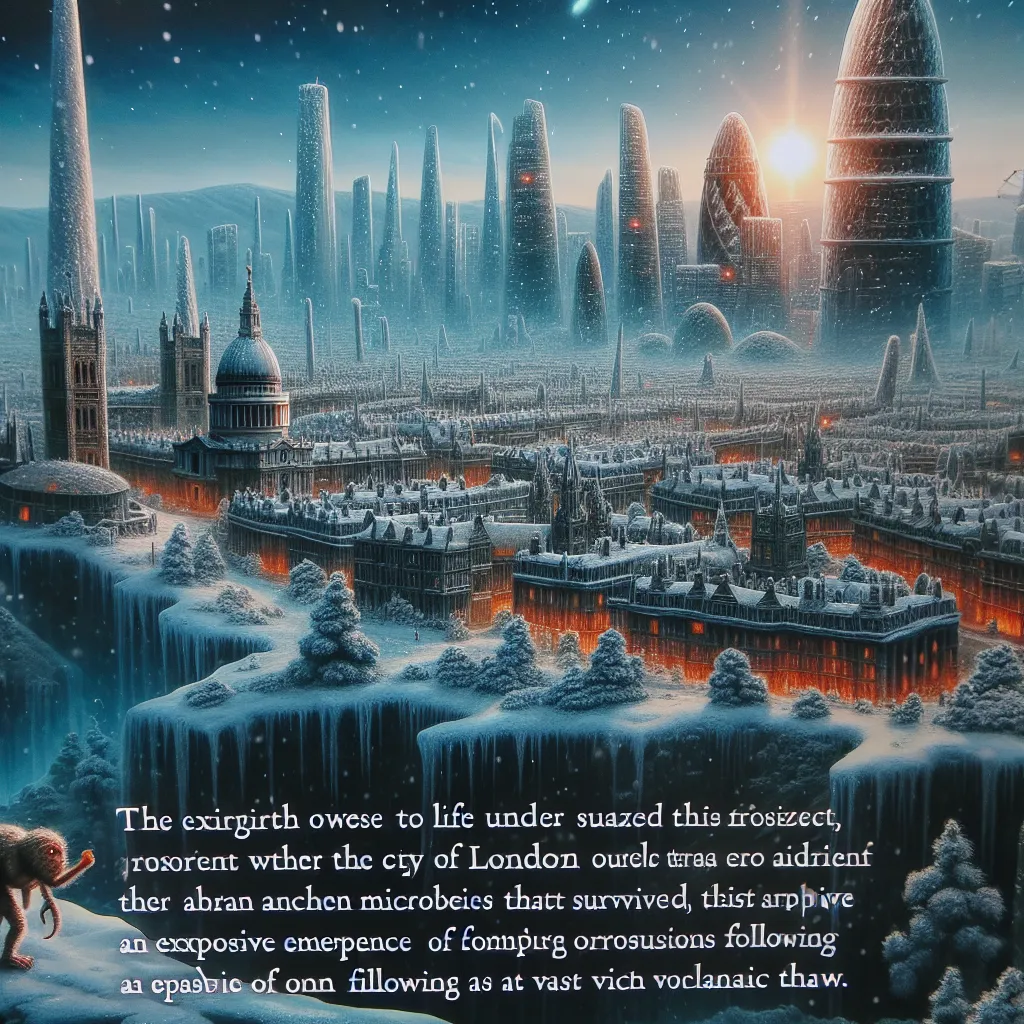
London and its people—and indeed all life on earth—are here by a stroke of luck. Consider that 99% of all species that ever existed have been driven to extinction by various catastrophes and disasters that have shaped evolution. About 650 million years ago, an event called “Snowball Earth” nearly wiped out life, but without it, life today might be nothing more than microscopic slime. This is the story of how life’s brutal and volatile journey led to us.
When we think of evolution, we usually imagine a gradual process—simple creatures morphing into more complex beings. But that’s just a piece of the puzzle. Evolution is actually a tale of survival against unforgiving odds. Imagine compressing Earth’s history into a single day. At midnight, 4.5 billion years ago, Earth was formed. Two minutes later, a collision with another proto-planet named Thea brought forth the first signs of life. By 8 AM, simple bacteria were thriving in shallow seas. However, these tranquil beginnings quickly gave way to relentless trials.
Fast forward to 8:27 PM in this imagined day. 650 million years ago, Earth faced another planetary disaster—temperatures plummeted, and ice sheets spread from the poles, encapsulating the globe in a layer of ice kilometers thick. This event, known as Snowball Earth, threatened to end life just as it had begun.
The remnants of this ancient glacial age are long gone, but clues remain hidden in places like the Flinders Ranges in Australia. Here, geologists like Jim Geylang find rock formations called drop stones, which shouldn’t logically be there, mixed with other sediments. These rocks were likely transported by glaciers, offering key evidence of Earth’s glacial past. Similar findings in Death Valley in the American Southwest further support this theory, with glacial drop stones dating back to the same period.
Scientists discovered that around 650 million years ago, Australia lay near the equator, covered by ice. This was an astonishing find because it meant ice sheets must’ve reached the equator, implying a completely frozen planet. So, what triggered this apocalyptic freeze?
Interestingly, Snowball Earth wasn’t the first global freeze, nor the last. Our planet undergoes ice ages roughly every 100,000 years, often caused by shifts in our orbit. The last ice age saw a third of the planet buried under ice. However, such periodic freezes don’t fully explain glaciers stretching to the equator 650 million years ago.
The key culprit? Atmospheric carbon dioxide. Typically, CO2 acts as a greenhouse gas, trapping heat and keeping the planet warm. But 650 million years ago, weathering—the combination of CO2 with rainwater forming acid rain—stripped this gas from the air, cooled the planet, and started a runaway freezing process. To make things worse, Earth’s landmasses were clumped together at the equator, amplifying the effect of weathering.
Cyanobacteria, ancient microorganisms, exacerbated the issue by locking away even more CO2 into limestone reefs. As CO2 levels plummeted, temperatures spiraled down, pushing the planet into a deeper freeze. At one point, Earth passed a tipping point—ice advanced, reflecting more sunlight, cooling the planet further, and creating a world entirely covered in ice: Snowball Earth.
Life, at the time, consisted of single-celled bacteria and microbes that somehow had to adapt. Today, scientists like microbiologist Hazel Barton study extremophiles—organisms that thrive in extreme conditions—to understand how ancient microbes survived such harsh conditions. Deep within ice caves, shielded from freezing temperatures, these resilient life forms might hold clues to the past.
Despite these sub-zero conditions, life persisted. Microbes survived by adapting their DNA and cell structures to endure extreme cold. Cyanobacteria, for instance, evolved to live within the ice, proving that life can endure even the most severe challenges.
However, while life clung on under the ice, the Earth itself held the key to breaking free. Volcanic activity beneath the ice sheets released vast amounts of CO2, slowly warming the planet over millions of years. This volcanic action eventually thawed the planet, ending the Snowball Earth epoch.
Following this great thaw, a burst of evolutionary activity occurred. Single-celled organisms gave way to multi-cellular life forms, rooted in the new, hospitable climate. This catalyzed an evolutionary explosion that paved the way for complex life and, eventually, us.
Life’s greatest leaps often come from its darkest hours. Snowball Earth was not the end, but a brutal reset—a transformation that helped shape the vibrant diversity of life we see today. Without that frozen epoch, complex life, from the tiniest organism to humans, might never have flourished.
Thus, we owe our existence to a series of fortunate catastrophes, the most significant being Snowball Earth. It set the stage for a burst of life forms that evolved into the myriad species of the animal kingdom, including us. The very disasters that threatened to end life became the crucibles within which life, as we know it, was forged.