Curious Case of Ice: Why Hot Water Might Freeze Faster
The Mpemba effect explores the counterintuitive phenomenon where hot water may freeze faster than cold, intriguing scientists and sparking ongoing debates and experiments.
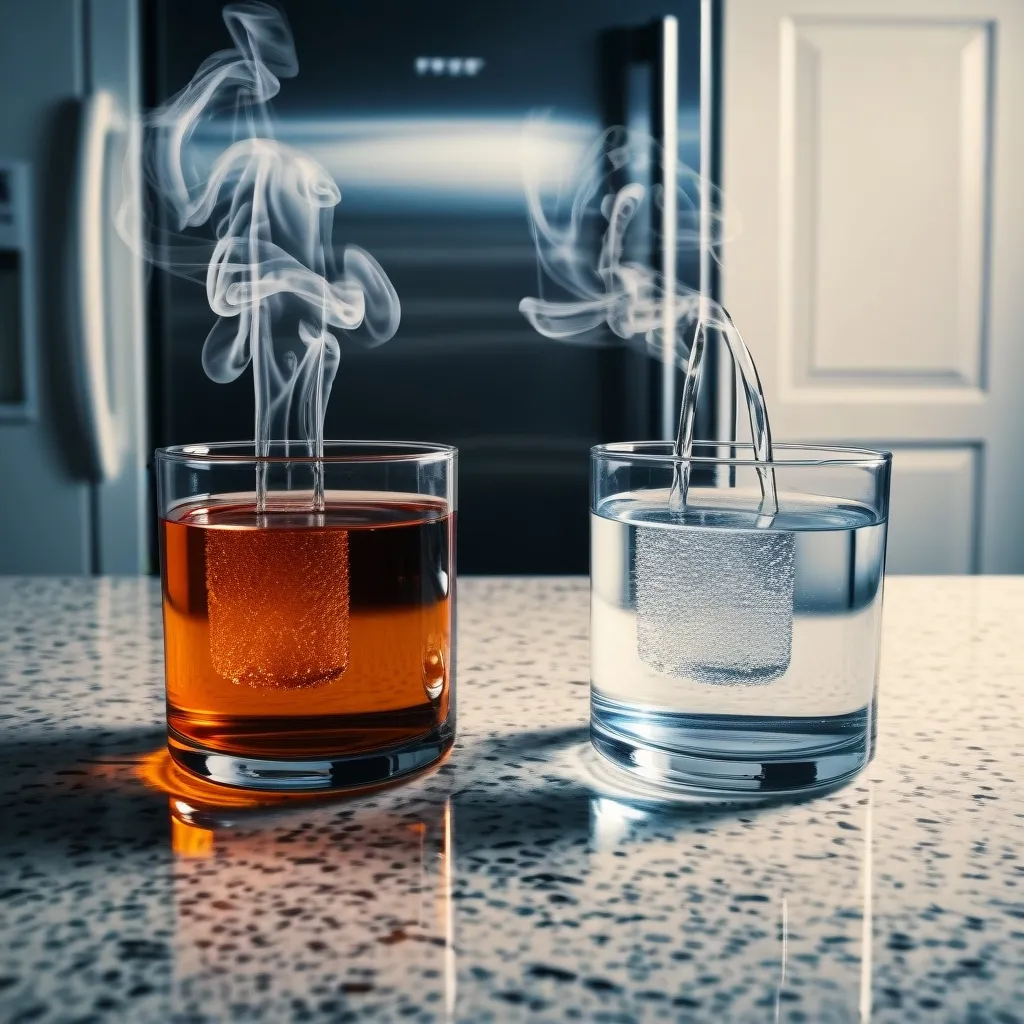
Picture this: you’re in your cozy kitchen, getting ready to make some plain old ice cubes. You’ve got two containers of water. One is steaming hot, fresh off the boil, and the other is refreshingly cold, straight from the fridge. As you pop them both into the freezer and sit back, you’d naturally assume the cold water will freeze faster, right? But surprise, surprise, this isn’t always the case, thanks to a quirky phenomenon called the Mpemba effect—a mystery that has been swirling around scientists and curious folks for ages.
Let’s rewind to where this tale begins. It’s the 1960s in Tanzania, and a high schooler named Erasto Mpemba is knee-deep in a science mishap that would turn into a worldwide ponder. While making ice cream with his classmates, Mpemba got a bit hasty—skipping the cooling step and tossing his boiling milk mix straight into the freezer. And guess what? It froze faster than his friends’ cooler mixtures. Naturally, when Mpemba tossed this conundrum at his physics teacher, he didn’t exactly get straight answers. Nonetheless, he had unknowingly set the stage for endless scientific curiosity and debate.
But Mpemba wasn’t the first to stumble upon this head-scratcher. Imagine minds like Aristotle, Descartes, and Sir Francis Bacon, also caught up in the puzzle of hot versus cold for centuries. So, does hot water actually freeze faster? And more intriguingly, why does it happen when it does?
To get a grip on this, let’s dive into the many experiments that have tried to nail down an answer. The basic setup is just like our kitchen scenario—two identical containers, one with hot water, the other with cold, cooling in a freezer. Yet the outcomes are as unpredictable as they are fascinating: sometimes the hot water indeed beats its colder counterpart to the icy finish line; other times, it doesn’t. This inconsistency is what keeps the debate spicy and unsolved.
A big headache for scientists trying to prove the Mpemba effect is the slew of uncontrollable variables at play. There’s evaporation, for starters. Hot water tends to evaporate more, reducing its volume and potentially speeding up the freezing process. Then there’s the insulation theory, where frost build-up on the cold container might slow down the freezing. However, these explanations don’t fit perfectly in every freezer scenario.
Various theories have been tossed in the ring to explain why hot water might edge out the cold. One popular one involves convection currents, those swirling, heat-moving dances of fluid that are more vigorous in hot water. Here’s the gist: when hot water cools, these currents help it shed heat faster than the more sluggish, temp-even cold water. It’s like having a head start in a race once the temperatures even out.
Others suggest it’s about the impurities. James Brownridge, deeply engrossed in studying the Mpemba effect, points to how little impurities in the water could act as cozy little homes for ice crystals to form—meaning hot water, with its unique impurity cocktail, could take the icy lead.
Yet, despite all these brainy theories, the Mpemba effect remains a bit like spotting a rare bird. Many experiments can’t consistently catch it in action, and a bunch of them end up declaring no substantial proof to show hot water beats cold under identical conditions. Still, there’s a chorus of voices in science that insist the effect is genuine but extremely finicky and condition-specific.
Interestingly, the Mpemba effect hasn’t just chilled curiosities about water. It pops up in other places—like with certain minerals and polymers—suggesting this quirk isn’t just a watery secret but might be a bigger piece of how materials behave out of their comfort zones.
So, why this relentless fascination with the Mpemba effect? Well, it’s not just about figuring out nature’s secrets; it’s the very human pull of curiosity. Mpemba’s story stands as a cheeky reminder of the strength in questioning the taken-for-granted, nudging scientists to dissect the ordinary in pursuit of wonder.
In the day-to-day, while the Mpemba effect might tuck itself away as a neat trivia tidbit, it quietly nudges into practical realms too, like in plumbing. There have been notes from plumbers noticing hot water pipes are more prone to bursting in the cold than cool ones. Maybe the Mpemba effect plays a stealthy role here, with hot pipes freezing and expanding just that little bit quicker.
The debate over the Mpemba effect swings on, with strong opinions packing the chatrooms of science. Some experts stand their ground that the effect is a tangible phenomenon with plausible roots in physics, while others remain staunch skeptics, convinced it’s a shadow of poorly controlled variables. Yet, regardless of where one stands, the Mpemba effect is more than a curious claim; it’s a hallmark of the tantalizing chase for knowledge in science.
In the grand scheme of things, the Mpemba effect is a humbling reminder that scientific paths aren’t always linear. Sometimes the seemingly silly questions unfold into a dance of scientific intrigue and unexpected answers. Whether a hot cup of water truly beats the cold to freeze might remain in the air, yet the quest to decode this peculiar puzzle has enriched our grasp of thermodynamics and the whimsical behavior of matter. Perhaps someday a final verdict will tie it all neatly, but until then, it’s a delightful enigma that continues to engage both the scientific and the daydreaming imaginations.
![Quantum Sensing: 10 Breakthrough Applications That Will Transform Modern Technology [2024 Guide]](/images/49872208-54ec-47e8-b6b5-4c8e47691183.webp)