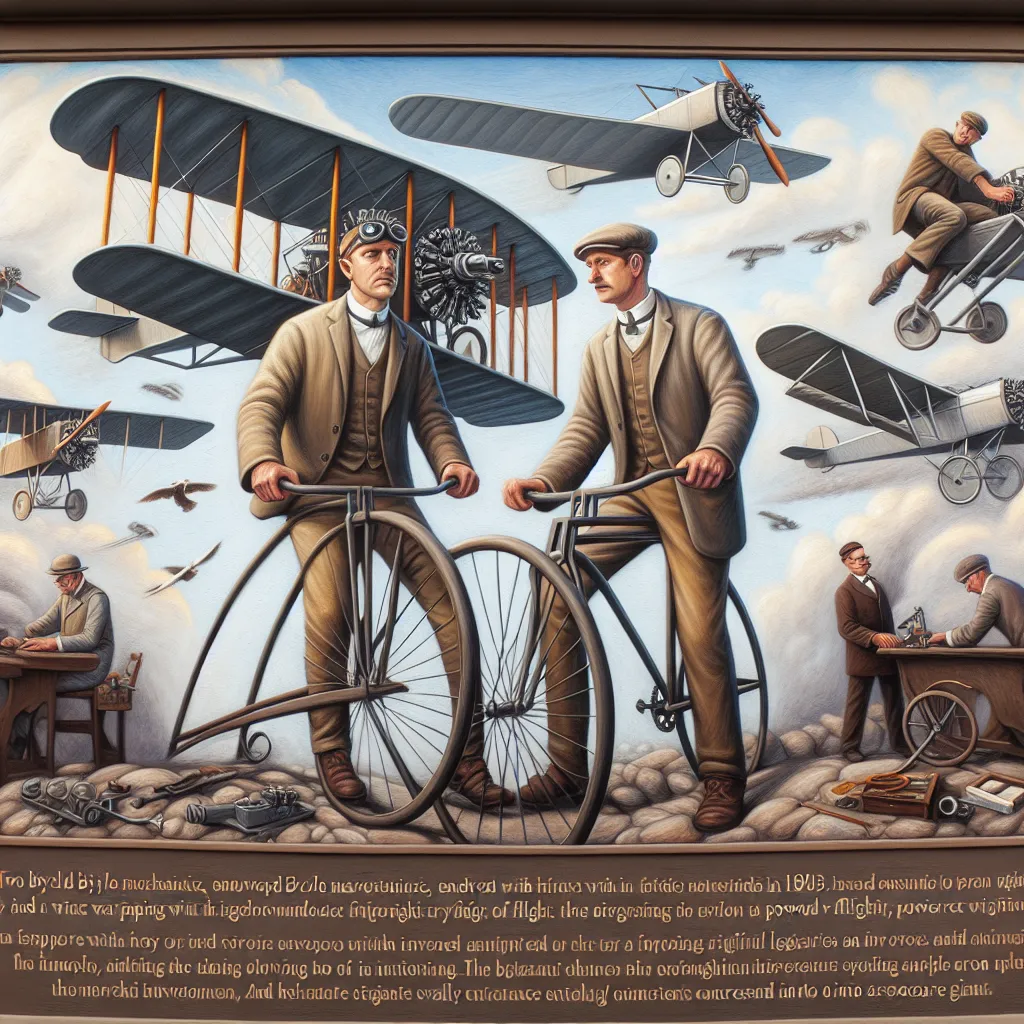
Wilbur and Orville Wright, two unassuming bicycle mechanics from Dayton, Ohio, harbored ambitions far beyond their humble beginnings. Wilbur, the older of the two, boasted a brilliant, inventive mind, while Orville had the technical prowess to turn those ideas into reality. They thrived as a team, balancing each other’s strengths perfectly.
The brothers, however, were not content with bicycles. Wilbur, especially, had his sights set on something far more audacious: conquering the skies. At a time when the idea of controlled flight was laughable to many, the Wright brothers saw potential where others saw impossibility. True visionaries, they believed in achieving the impossible.
Early aviation saw some successful attempts at lifting aircraft off the ground, but no one had yet mastered the art of control. Wilbur observed birds closely and noted how they adjusted their wingtips to maintain stability. He realized that an aircraft had to be inherently unstable to be controllable in the air. This insight led to the revolutionary concept of wing warping.
With this theory in mind, Wilbur and Orville began the arduous task of designing and building gliders, experimenting tirelessly to perfect their designs. They conducted their trials in windy locations with soft, sandy terrain to minimize the risk of fatal crashes. After countless trials, errors, and refinements, the Wright brothers finally saw their dream take flight.
On December 17, 1903, Wilbur and Orville achieved the first controlled, powered human flight with their Wright Flyer. Wilbur’s longest sustained flight lasted 59 seconds, but it was enough to secure their place in history. They didn’t just build an aircraft; they created a machine capable of maintaining control while airborne, a groundbreaking achievement.
Their success, however, attracted competitors, notably Glenn Curtiss, an innovative motorcycle designer. Curtiss, much like the Wright brothers, came from a background in mechanics and had a knack for powerful engines. He soon emerged as a formidable rival, pushing the boundaries of aviation further.
Against the backdrop of escalating competition, the Wright Brothers sought to protect their invention through patents. They secured a patent on their groundbreaking wing warping mechanism and could now legally prevent others from building similar aircraft. Yet, this defensive stance ignited fierce legal battles, particularly with Curtiss, who pursued alternative methods like ailerons for aircraft stabilization.
Curtiss, undeterred by setbacks, such as a dramatic crash before a major aviation contest, continued to innovate. His persevering spirit and talent helped him make significant strides in aviation, culminating in a successful public flight that garnered immense attention and challenged the Wright brothers’ dominance.
Orville and Wilbur, amid rising competition and legal disputes, focused on securing a lucrative military contract. This goal, however, ended in tragedy when a test flight led by Orville resulted in a fatal crash, killing Lieutenant Thomas Selfridge and injuring Orville severely.
The accident marked a turning point, intensifying the rivalry with Glenn Curtiss. While the Wright brothers fought to protect their patent rights, Curtiss capitalized on his innovative designs, substantially advancing aviation technology. With the onset of World War I, the U.S. government intervened, mandating shared patent rights to bolster the war effort, allowing Curtiss’s innovations to flourish.
Curtiss’s relentless drive saw him amass considerable success and wealth, ultimately establishing an aviation empire. Meanwhile, Orville Wright, disheartened by his brother’s death and overshadowed by legal battles, retired from active involvement in aviation.
The rivalry between the Wright brothers and Glenn Curtiss epitomized the pioneering spirit of early aviation, a testament to human ingenuity and tenacity. Ironically, long after the original players left the stage, their legacy merged into a single entity, Curtis-Wright, a robust aerospace manufacturer still in operation today. The journey from bicycles to powered flight, marked by competition and innovation, set the foundation for modern aviation as we know it.