Did Science Really Make Christianity Obsolete?
When Science Began Eclipsing the Divine Narrative
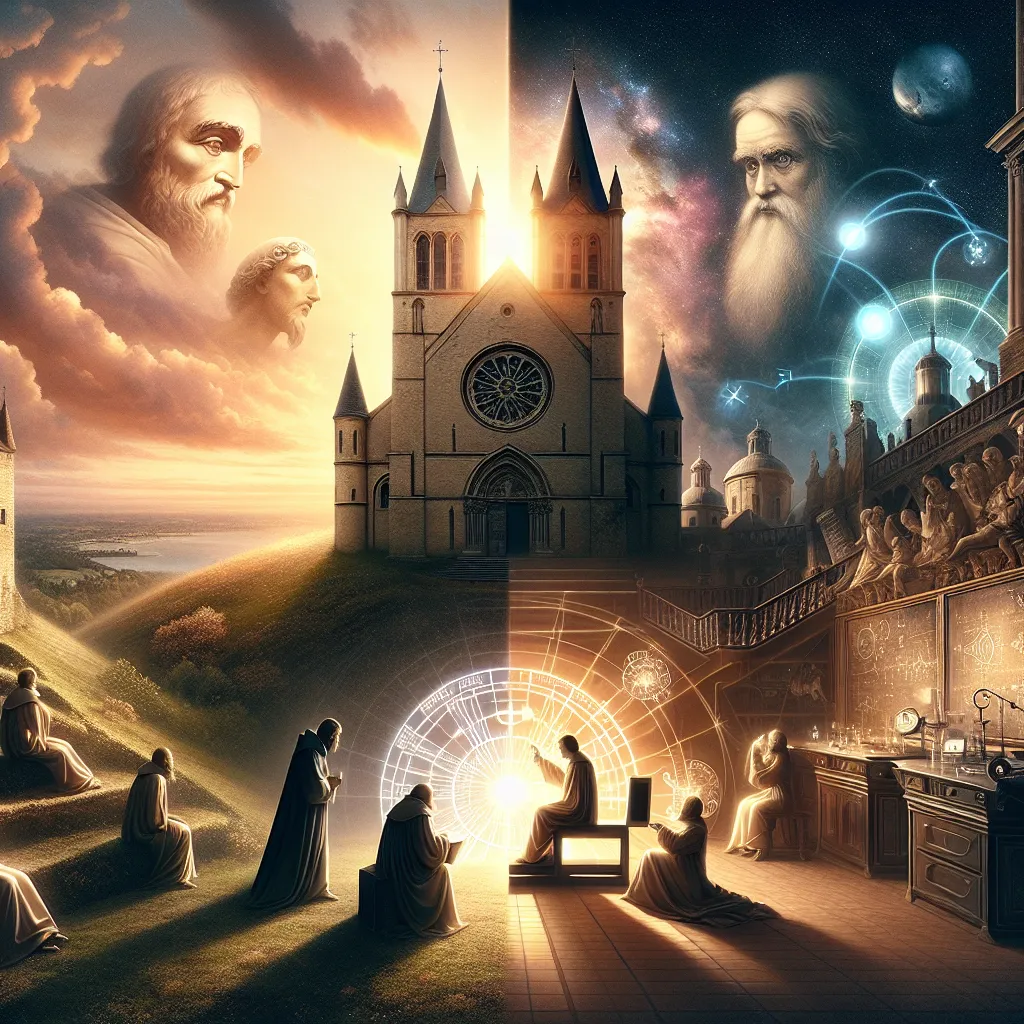
In the beginning, God created the heavens and the earth. With a command for light, the world began to take form. Waters gathered into seas, and man was crafted in His image. For many centuries, Christians held the Bible as the ultimate source of truth. But that changed in the 17th century with the birth of the Scientific Revolution—a new era that questioned and challenged the Christian perception of the world.
During the Renaissance, science grew stronger, clashing with the Catholic Church’s authority. Rebellious scientists faced severe consequences, including trials and even executions, for daring to question religious doctrines. By the 19th century, the Enlightenment had cultivated a new breed of scientists. Figures like Darwin further upended Christian beliefs, suggesting life evolved naturally rather than being created by God. This ongoing conflict led many to wonder if the Scientific Revolution would render Christianity obsolete.
Science emerged about four hundred years ago, thanks to European thinkers who sought to interpret the world through observation and reason. Science began prioritizing curiosity, inquiry, and experimentation over religious dogma. Some scientists retained their faith, but many believed that science was the only path to true knowledge, a thought that still makes some uneasy. Scientists like myself have faced backlash for our work, sometimes from extreme groups, challenging the orthodoxy often grounded in religious beliefs.
Oxford University has been a beacon of knowledge for over 900 years, nurtured initially by the Christian Church. Scholars like Copernicus planted seeds of tension between religious authority and scientific inquiry, setting the stage for future debates. The church’s resistance to new scientific ideas was evident when scientists like Galileo were condemned for their revolutionary findings.
In Protestant Britain, William Harvey and others began advancing science by focusing on observation and experimentation. This era paved the way for the scientific method, helping to challenge traditional beliefs held by the church. The Enlightenment furthered this shift, with thinkers like Newton and Franklin promoting reason and science over religious explanations. Franklin, in particular, became a symbol of this age, championing scientific rationality and helping to establish a secular state in the United States.
Darwin’s theory of evolution posed one of the biggest challenges to Christianity, suggesting that humans evolved through natural selection rather than divine creation. Mainstream churches have adapted, recognizing evolution as potentially part of God’s design, while fundamentalists in places like the United States continue to resist, sticking firmly to a literal interpretation of the Bible.
I met many scientists and thinkers who reconciled their faith with scientific evidence to varying degrees. Some, like David Patterson, even questioned the very existence of a personal God, finding spirituality in humanity and the natural world instead. Meanwhile, projects like the particle accelerator at CERN push the boundaries of our understanding, searching for particles like the Higgs boson to explain the universe’s origins without invoking divine intervention.
Over the centuries, Christianity has adapted to scientific discoveries, yet significant debates remain. I believe that science will continue to make religion less central to our explanations of the universe and even our own existence. The power of science to demystify the world is profound, and I foresee a future where it not only describes our physical reality but also provides insights into our spiritual and psychological needs—a future where reason gradually eclipses faith.