Did Violent Cosmic Chaos Secretly Create Earth and Its Alien Twins?
Dancing Amid Cosmic Chaos: The Miraculous Birth and Survival of Earth
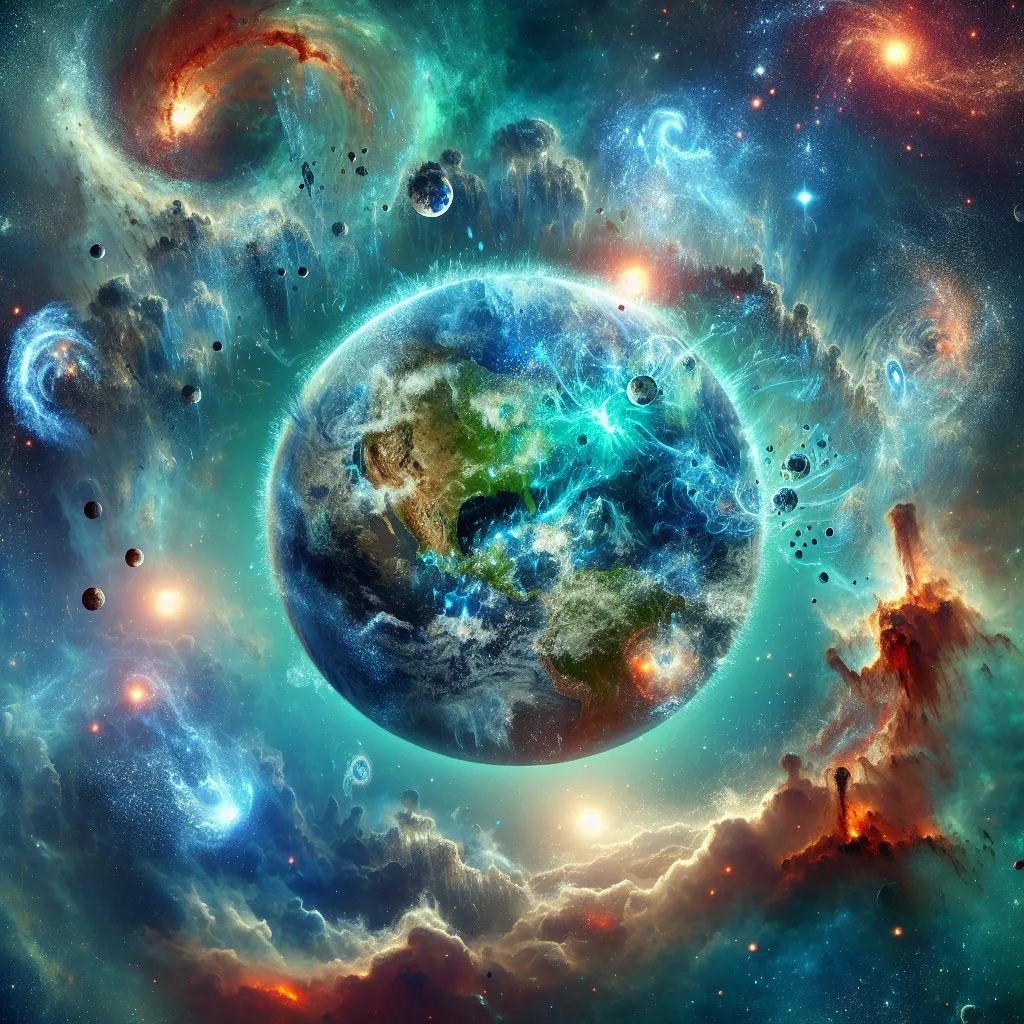
Our planet is the product of tremendous cosmic events that could have easily torn it apart. Earth’s formation was a series of chaotic and violent occurrences, such as planet-sized collisions, relentless cosmic bombardments, and even the powerful explosion of a supernova. Despite these cataclysms, Earth emerged, uniquely positioned to support life.
Life on Earth is astoundingly diverse and complex, thriving in a perfect balance of conditions. Something as simple as noticing Earth’s beauty from space can be an overwhelming experience, considering that all known life exists on this singular planet. Yet, a question intrigues us: Are there other Earth-like planets, possibly teeming with life, scattered across the universe?
To understand this, let’s roll back the clock 4.5 billion years. A speck of dust, amid many others in a stellar nursery—a giant cloud of gas and dust—began its remarkable journey to become Earth. Today, similar stellar nurseries, like the Eagle Nebula, continue the tradition of birthing new stars and planetary systems.
For this transformation, a powerful catalyst—a supernova—was essential. It caused shock waves that compressed gas and dust into dense clumps, forming stars and planets. This same process happened in our solar system: a supernova shockwave compressed a dusty cloud into a protoplanetary disk, eventually giving birth to our sun and its planets.
The early stages of Earth were marked by countless collisions with other space debris. These high-speed impacts generated heat, melting the young planet and causing heavy materials like molten iron to sink, forming a dense core, while lighter materials rose to the surface to cool and form the crust that we walk on today.
Earth’s survival and its evolution continued to be miraculous. It faced astronomical odds with everything from its size, distance from the sun, and the composition of its moon aligning just right. Even the moon—a product of a colossal collision with a Mars-sized body—proved critical. It stabilized Earth’s axis and helped ensure a climate conducive to life.
The early solar system was a chaotic, almost demolition derby-like environment, with bodies frequently colliding and sometimes merging, other times shattering. This tumultuous period led to the formation of our planets while leaving behind the asteroid belt.
Earth’s transformation from a molten magma ocean to a habitable world continued, with icy comet impacts and relentless asteroid strikes proving crucial. These cosmic deliveries brought critical elements, possibly even water, to Earth. Yet, this bombardment also posed continuous threats.
Understanding the importance of Earth’s formation helps us search for similar conditions elsewhere. The discovery of thousands of exoplanets by telescopes like Kepler offers hope that many of these worlds, even some just twice the size of Earth, might also be habitable.
Understanding other planetary systems further underlines our unique but not solitary journey. The universe’s sheer vastness means that even if Earth-like conditions are rare, the numbers still suggest millions of such planets might exist out there, potentially harboring life.
The story of Earth from dust to a life-supporting wonder is one of near-destructive cosmic events turning into the cradle of life. These same chaotic processes could potentially be creating other worlds nestled comfortably within habitable zones, awaiting discovery.
So, as we look up into the night sky, dotted with stars and distant galaxies, keep in mind the violent yet beautifully orchestrated cosmic ballet that brought us here. Life on other planets, thriving in conditions created by eons of celestial chaos, might just be out there, waiting to share the universe with us.