How Oxygen Almost Never Existed — And Why That Should Trouble You
Discover how the Great Oxidation Event reshaped Earth 2.4 billion years ago — triggering mass extinction, a global ice age, and the air you breathe. Read more.
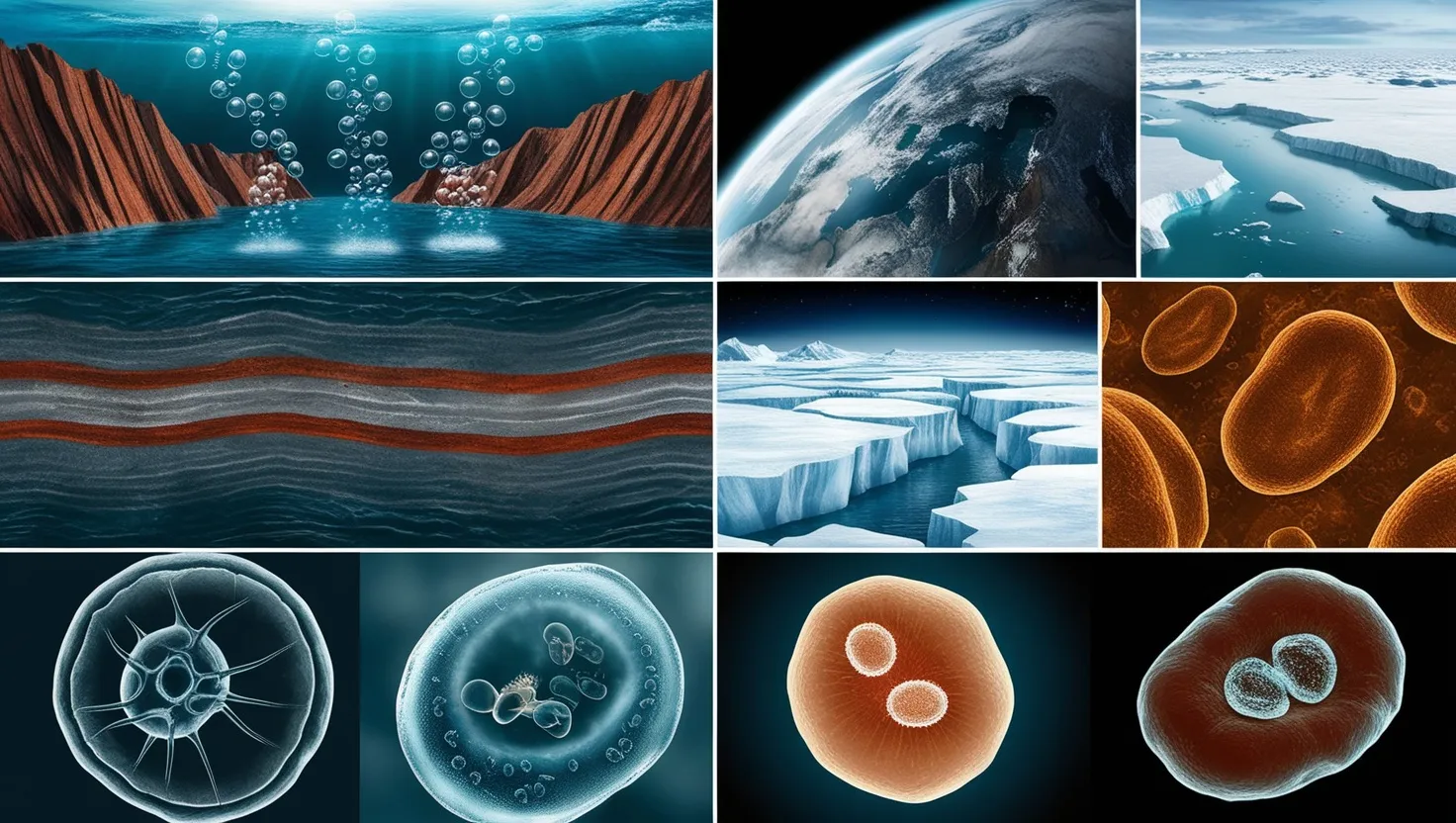
Picture this: you wake up one morning and the air outside is completely unbreathable. Not because of pollution, but because oxygen simply doesn’t exist yet. That was Earth, for the first two billion years of its life. No oxygen, no complex creatures, nothing you’d recognize as life. Then, roughly 2.4 billion years ago, something happened that changed everything — an event so dramatic that it reshaped the entire planet, killed off most living things at the time, and eventually made you possible. Scientists call it the Great Oxidation Event, and the strange truth is, we still don’t fully understand it.
Let’s start with the bacteria.
Long before the Great Oxidation Event, tiny microbes called cyanobacteria were already pumping oxygen into the oceans. They had been doing this for possibly 300 million years before oxygen actually built up in the atmosphere. Think about that. Three hundred million years of oxygen production, and the planet just… absorbed it all. Like a sponge. The oceans were filled with dissolved iron, and that iron grabbed every oxygen molecule before it could escape into the air. Volcanic gases did the same thing. The Earth was essentially running a giant clean-up crew, mopping up oxygen the moment it appeared.
So what changed?
“The history of life is a history of the interaction between living things and their physical environment.” — Richard Dawkins
That question — what actually triggered the Great Oxidation Event — is one of the most debated puzzles in all of Earth science. The obvious answer would be that cyanobacteria simply produced so much oxygen that Earth’s iron sponge got full. But it’s not that simple. Researchers suspect that a shift in volcanic activity may have played a role. Ancient volcanoes didn’t just belch lava — they also released gases that consumed oxygen. Some scientists think the composition of those volcanic gases gradually changed over hundreds of millions of years, producing fewer oxygen-eating compounds. When that happened, the balance tipped.
Here’s a question worth sitting with: If it took hundreds of millions of years for oxygen to accumulate despite constant production, what does that say about how easily life-sustaining conditions can be reversed?
Another angle involves Earth’s tectonic plates. Around 2.4 billion years ago, the continents were arranged differently, and geological evidence suggests that the rate of tectonic activity may have slowed. Fewer volcanoes meant less of those oxygen-consuming gases. The clean-up crew got smaller. Oxygen finally had room to breathe, so to speak.
But here’s where it gets weirder. The timing of the event doesn’t match when oxygenic photosynthesis evolved. The machinery for producing oxygen through sunlight appeared in cyanobacteria much earlier — possibly a billion years earlier, by some estimates. So why the delay? Why didn’t oxygen accumulate right away? The honest answer is that we don’t know. Something acted like a lock on the door, and we haven’t found the key. Some researchers think early ocean chemistry was so efficient at consuming oxygen that no amount of microbial production could overcome it. Others think biological innovations — like changes in how cyanobacteria worked, or new ecological relationships between species — may have finally pushed the balance.
“Life did not take over the globe by combat, but by networking.” — Lynn Margulis
Now let’s talk about the cold.
One of the most underappreciated consequences of oxygen rising in the atmosphere is that it likely caused the first global ice age. Here’s the chain of events: before the Great Oxidation Event, Earth’s atmosphere was rich in methane, produced by ancient microbes called methanogens. Methane is a powerful greenhouse gas — far more effective at trapping heat than carbon dioxide. When oxygen flooded the atmosphere, it reacted with methane and destroyed it. Earth lost its blanket. Temperatures plummeted. The planet may have frozen from pole to pole in what geologists call the Huronian glaciation, a deep freeze that lasted perhaps 300 million years.
Do you realize what that means? Oxygen — the thing that eventually made complex life possible — first triggered a mass extinction and a planetary ice age. The road to life as we know it ran directly through catastrophe.
The feedback between oxygen, methane, temperature, and geology during this period is still being pieced together. The sequence of exactly what caused what, and when, remains genuinely unresolved. Some researchers think the glaciation actually helped oxygen levels rise further by locking up organic carbon in ice. Others think the ice age temporarily slowed biological activity and reduced oxygen production. The planet’s chemistry during this period was wildly unstable, lurching between extremes before settling into something more familiar.
“Life is the sum of all your choices.” — Albert Camus
Here’s an angle that rarely gets discussed: the Great Oxidation Event was, by any measure, the largest mass extinction in Earth’s history. Anaerobic organisms — creatures that live without oxygen and are actually poisoned by it — had ruled the planet for billions of years. When oxygen flooded their world, most of them died. Not quickly, and not dramatically in the fossil record, but they were pushed into hiding. Today, their descendants survive in places where oxygen can’t reach: deep ocean sediments, waterlogged soils, the guts of animals, hot springs. Every time you hear about extremophiles living in strange, airless environments, you’re looking at survivors of the first great apocalypse.
What’s fascinating is that some anaerobic organisms didn’t just hide — they formed partnerships. Some researchers believe that the intimate relationship between ancient anaerobic cells and oxygen-producing bacteria eventually led to the mitochondria in your cells. The very thing that powers your body may be the result of a survival deal struck during the oxygen crisis. An ancient bacterium, instead of being killed by oxygen, got absorbed into another cell and became a permanent resident. You carry that ancient negotiation inside every cell of your body.
Think about that the next time you take a breath.
“We are the cosmos made conscious and life is the means by which the universe understands itself.” — Brian Cox
Now let’s talk about rust. Specifically, a type of rock called banded iron formations. These are striped layers of iron oxide — essentially rust — that appear in ancient rock records around the world. They formed when oxygen, produced by cyanobacteria, reacted with dissolved iron in the oceans. The iron sank to the ocean floor and became stone. These formations are our best physical record of when and how oxygen accumulated in ancient oceans.
The strange part is that banded iron formations stopped forming around 1.8 billion years ago. Geologists interpret this as the moment when all the dissolved iron in the oceans had been used up. The oceans had finally rusted out. But the precise chemistry behind how these layers were deposited — why they’re striped, what the alternating layers represent, and what stopped the process — remains an active area of research. Each stripe may represent a season, a volcanic event, or a biological bloom. Reading those stripes is like trying to decode a message written in a language you only partially understand.
Here’s a question that should genuinely trouble you: if the conditions that triggered the Great Oxidation Event were this specific, this dependent on the right volcanic gases, the right ocean chemistry, and the right biological evolution happening in the right sequence — how likely is it to happen on another planet?
The answer, honestly, is that we don’t know. And that uncertainty has real implications for how we search for life elsewhere in the universe. We tend to assume that oxygen-producing life will eventually oxygenate any planet it appears on. But Earth took at least a billion years after photosynthesis evolved before oxygen accumulated. And even then, it required a very specific set of geological conditions to cross the threshold. An Earth-like planet with photosynthetic life might sit in a low-oxygen state indefinitely.
“The most beautiful thing we can experience is the mysterious.” — Albert Einstein
What the Great Oxidation Event teaches us — if we’re paying attention — is that the conditions we take for granted are not inevitable. Oxygen in the atmosphere is not a default setting for a planet with life. It’s a hard-won, almost accidental outcome of billions of years of geological and biological luck. The breathable air around you right now is the product of ancient volcanic chemistry, microbial stubbornness, global catastrophe, and a series of still-unexplained switches being thrown at just the right time.
The fact that we still can’t fully explain why it happened, when it happened, and not earlier or later, should give us genuine pause. Earth’s chemistry was unstable and unpredictable for most of its history. It stabilized into something life-friendly, but it didn’t have to. And nothing guarantees it stays that way.
The mystery of the Great Oxidation Event isn’t just an academic puzzle for geologists. It’s a reminder that the world you live in is built on a foundation of ancient accidents, narrow escapes, and changes so enormous they reshaped every rock, every ocean, and every living thing on the planet. We are, in a very real sense, the children of a catastrophe that almost never happened.