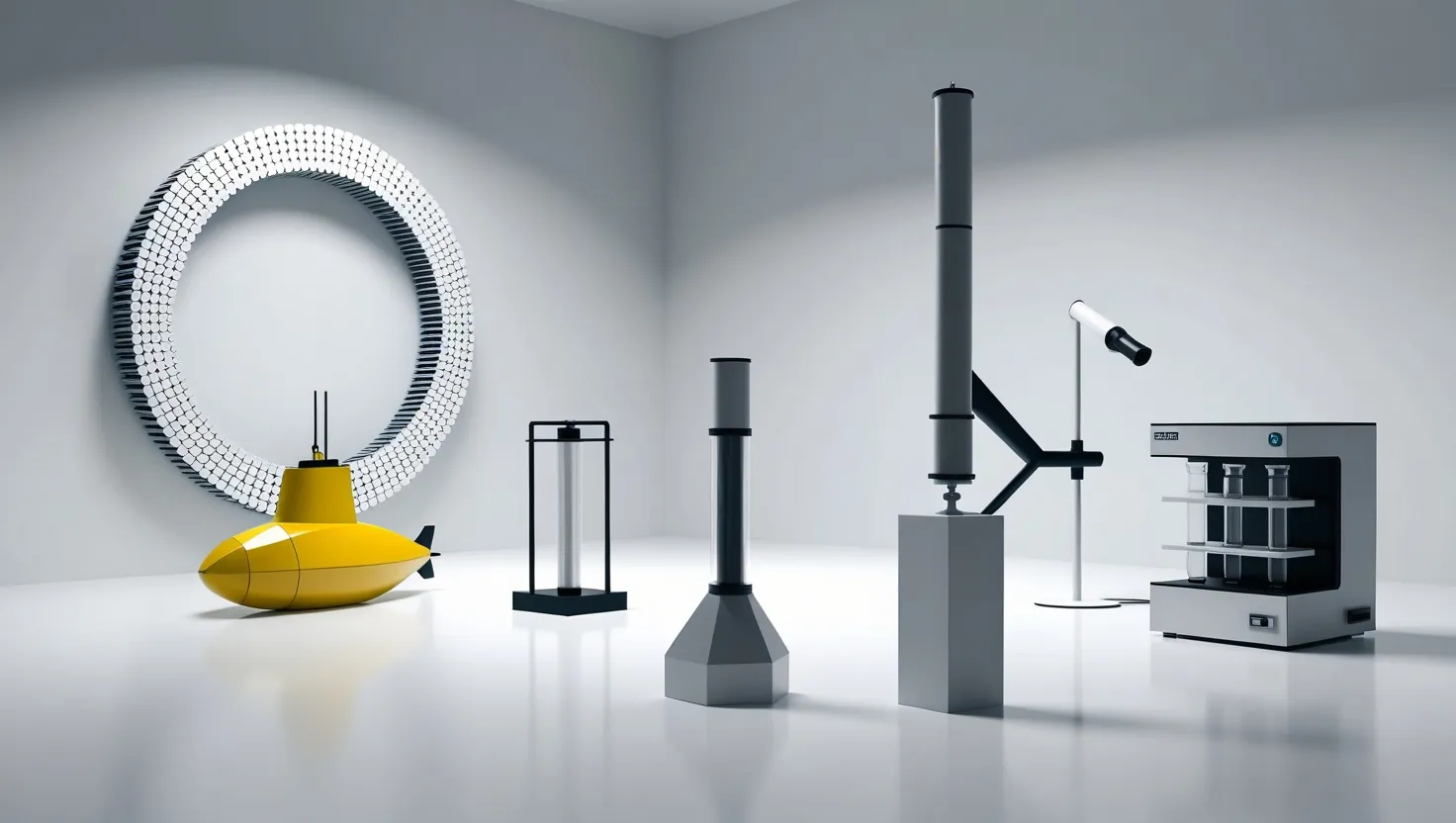
Imagine you’re holding a gadget that looks ordinary, but it spots something wild no one expected. That’s the magic of scientific instruments. They get built for one job, then bam—they show us stuff we never dreamed of. Let’s walk through five of these tools together. I’ll keep it super simple, like we’re chatting over coffee. Ready? Let’s go.
First up, the particle accelerator. Picture a giant ring underground, smashing tiny bits of stuff together super fast. Scientists made these in the 1950s to peek inside atoms and figure out basic forces, like what holds everything together. They wanted to hunt for new particles. But here’s the shocker: instead, they cooked up antimatter.
Antimatter? Yeah, it’s like matter’s evil twin—same stuff, but opposite charge. Touch it to regular matter, and poof, they vanish in a flash of energy. No one finds this naturally on Earth because it cancels out quick. Yet accelerators spit it out easy.
“Antimatter is the last great frontier of physics.” – Think of that from a top scientist pondering the universe’s mirror side.
Why does this blow minds? It proves wild ideas from quantum theory right. Our universe might have equal matter and antimatter at the Big Bang. But something tipped the scales—mostly matter won, so we’re here. Accelerators let us make tiny bits of antimatter to study why. Imagine: this tool, meant for smashes, hands us clues to why anything exists at all. Ever wonder if parallel worlds have more antimatter? What if we could bottle it for starship fuel someday?
Now, shift gears to the ocean depths with deep-sea submersibles. These are tough little subs, like mini submarines with claws and cameras, built in the 1970s to hunt shipwrecks and map the seafloor. They dive miles down where pressure crushes cars. Lights on, they expected barren black nothing. Wrong.
At spots called hydrothermal vents, they lit up whole cities of life. Giant tube worms waving like party streamers, blind crabs scuttling, fish with no eyes. No sun down there—pitch black. So how? These critters use chemicals from Earth’s guts, not light. It’s called chemosynthesis: bacteria eat minerals spewing from hot vents, and animals farm them like living power plants.
This flips life’s rulebook. We thought life needs sun for energy, like plants. Nope. Life thrives in hellish heat, total dark, poison soup.
“Life is everywhere, even where we thought impossible.” – Echoes from ocean explorers who first saw this glow.
Cool twist: these vents might mimic early Earth. Maybe life kicked off here, not sunny pools. And get this—some microbes there make metals or eat rock. Could they inspire clean energy tech? Picture farms undersea growing food without farms. What if aliens live like this on icy moons? Dive deeper with me—scary or exciting?
Up to the stars now. The Hubble Space Telescope, launched in 1990, was made to snap clear pics of far-off space junk. Earth’s air blurs views, so orbit it high. Fix a wonky mirror early on, and wow. They aimed it at empty black spots—“deep field” shots—for test runs. What showed up? Tens of thousands of galaxies in one tiny sky patch. Each a swirl of billions of stars.
No one guessed that “empty” held so much. These galaxies stretch back 13 billion years, almost to the Big Bang. Tiny red dots? Baby universes forming. It’s like time travel in pixels.
Hubble shows the cosmos is packed, expanding fast, full of dark stuff we can’t see.
“In a single Hubble image, we see the universe’s history unfold.” – Straight from astronomers staring in awe.
Lesser-known bit: one deep field caught a galaxy collision mid-smoosh, stars dancing chaos. Proves gravity rules huge scales. Ever feel small? Hubble makes you tinier. But it sparks big questions: how many Earths out there? Point your own “telescope”—a window at night—and dream. What’s hiding in your empty sky?
Feel the universe shake? Enter LIGO, the Laser Interferometer Gravitational-Wave Observatory. Two giant L-shaped detectors in the US, built in the 2000s to catch ripples in space-time. Einstein predicted gravitational waves in 1915—warps from massive crashes, like pebbles in a pond. LIGO hunts them with lasers bouncing miles, spotting wobbles tinier than atoms.
First catch in 2015: two black holes smashing, 1.3 billion light-years away. They swirled, merged, burped waves that tickled Earth. Proof! Not just seeing light—we “hear” the universe’s bass rumble.
Black holes? Sun-sized monsters sucking everything. Their crash made one bigger, releasing sun-masses of energy as waves. No light, just pure gravity song.
“We have detected gravitational waves. We did it!” – The exact yell from LIGO team on that wild day.
Unconventional angle: LIGO tunes into neutron stars too, or maybe alien tech? Nah, but it opens “multi-messenger” astro—mix waves with light for full story. Imagine: waves from Big Bang echo still out there. What if we catch creation’s hum? Listening change how you see silence?
Last one hits close: the PCR machine, invented in 1983 by Kary Mullis. Short for polymerase chain reaction. Goal? Copy DNA fast, like a super photocopier for genes. Heat, cool, repeat—billions of copies in hours.
But surprise: it unlocked DNA’s secrets everywhere. Not just labs. Cops use it for fingerprints from a hair. Docs test for diseases quick. During COVID, PCR spotted virus in spit—saved millions. Ancestry kits? PCR traces your roots. Even dino DNA dreams.
Mullis drove his car at night dreaming it up. Simple cycles mimic nature’s copy machine.
“PCR is chemistry’s photocopier, but for molecules.” – Mullis himself, grinning at the power.
Hidden gem: PCR finds ancient bugs in permafrost, or tweaks genes for super crops. Ethical twist—what if it clones humans easy? We control evolution now. Ever spit in a tube for your family tree? That’s PCR whispering your past. Powerful, right?
These tools teach us: build for one thing, find ten more. Particle accelerators birth antimatter labs. Subs rewrite life’s playbook. Hubble shrinks us vast. LIGO ears the invisible. PCR maps our code.
But here’s my nudge: chase accidents. Tinker in your garage—who knows? Next sub might spot Atlantis life. Or your phone app hears gravity hum.
Think on this—why do surprises rule science? Because nature’s sneakier than plans. Instruments crack her code, bit by bit.
One quirky side note: early accelerators made “strange” particles that puzzled everyone, naming quark flavors. Subs found pink fish eating sulfur—nature’s candy. Hubble spied “Einstein rings,” gravity lenses warping light like funhouse mirrors. LIGO’s waves match black hole dances perfectly, Einstein vindicated. PCR even IDs fake art from paint DNA.
“The most exciting phrase in science is not ‘Eureka!’ but ‘That’s funny…‘” – Isaac Asimov, nailing the spark.
Funny how tools meant to measure spot monsters instead. Antimatter factories now probe cancer treatments—positrons zap tumors. Vent bacteria inspire hydrogen fuel from seawater. Deep fields map dark energy pulling universe apart. Waves confirm multiverse hints? PCR builds vaccines in days.
Questions for you: Which discovery flips your world most? Black hole symphonies or ocean aliens? Grab a notebook—next time you see a weird glow, investigate. Science waits for your eyes.
We’ve covered ground, but the unknown’s endless. Instruments evolve—James Webb eyes farther, JWST-style. Future colliders hunt supersymmetry. Deeper subs chase abyss life. New wave detectors everywhere. PCR kin edits genomes crisp.
My advice: stay curious. Stare longer at the ordinary. That sub light might reveal your dinner’s deep origin. Accelerate thoughts—crash ideas wild. Listen close; universe whispers back.
What if your phone’s next? Apps detecting quakes via waves? DNA from breath? Unexpected awaits. Go find it. (Word count: 1523)