The Fermi Paradox: Why 13.8 Billion Years of Universe Has Produced Only Silence
Explore the Fermi Paradox — why is the universe silent despite billions of Earth-like planets? Discover the Great Filter, Dark Forest Theory, and what the silence really means.
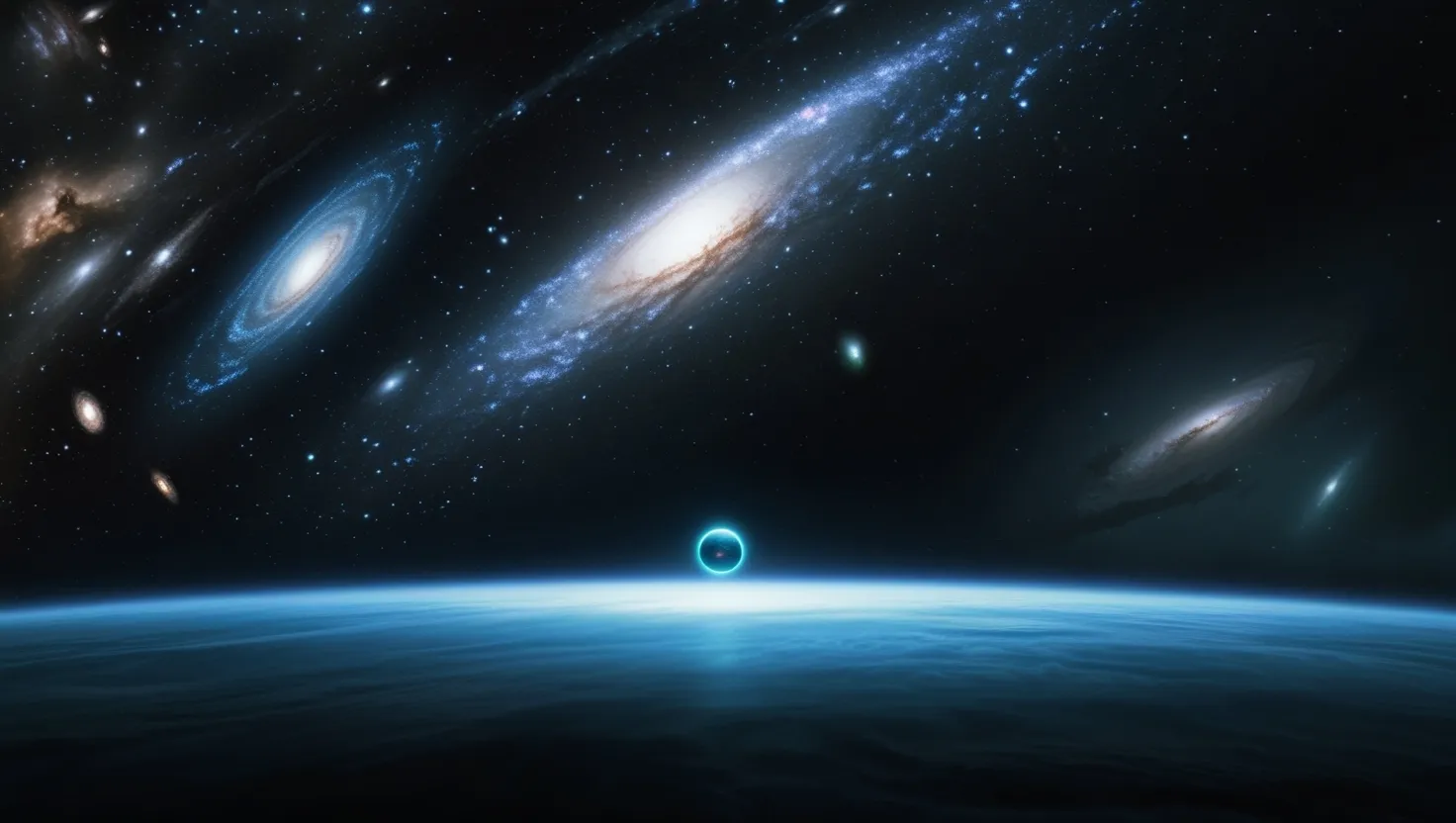
The universe is about 13.8 billion years old. Our Milky Way alone contains somewhere between 100 and 400 billion stars. Scientists now estimate there are more Earth-like planets in the observable universe than grains of sand on all of Earth’s beaches combined. So here is the question that should keep you up at night — where is everybody?
This is the Fermi Paradox in its simplest form. The Italian-American physicist Enrico Fermi asked it over lunch in 1950, and nobody has answered it since. Not properly. The math says the universe should be overflowing with intelligent life. Our observations say it is not. That gap between what should be and what we actually find is one of the strangest puzzles in all of science.
Let’s sit with that for a moment before rushing to explanations.
“Two possibilities exist: either we are alone in the Universe or we are not. Both are equally terrifying.” — Arthur C. Clarke
Most people, when they first hear about the Fermi Paradox, immediately jump to aliens hiding or signals we haven’t found yet. But the real mystery runs much deeper than that. The universe has been around long enough that even a civilization that started just a billion years before us — a tiny fraction of cosmic time — could have colonized the entire galaxy by now, even using slow, conventional spacecraft. A billion years is an almost incomprehensible amount of time. And yet, silence.
One of the lesser-known aspects of this puzzle is something called the Drake Equation, written by astronomer Frank Drake in 1961. On paper, it looks like a tidy formula for calculating how many communicating civilizations might exist in our galaxy right now. You multiply the rate of star formation, the fraction of stars with planets, the fraction of those planets that develop life, and so on. The problem? Most of the variables are pure guesswork. We genuinely have no data for them. So the Drake Equation is less a calculation and more a structured way of thinking about our own ignorance.
Does it bother you that the most important equation about alien life is basically a list of things we don’t know?
The really uncomfortable variable is the last one — what Drake labeled “L,” the average lifetime of a technological civilization. If civilizations typically self-destruct within a few centuries of discovering radio technology, then the galaxy could be full of ruins and bones, with very few active voices transmitting at any given moment. Our own civilization is only about 100 years into broadcasting radio signals into space. In cosmic terms, that’s a sneeze.
“The universe is under no obligation to make sense to you.” — Neil deGrasse Tyson
This brings us to the Great Filter, a concept introduced by economist Robin Hanson in 1998. The idea is elegant and deeply unsettling. Somewhere in the chain from “primordial chemistry” to “interstellar civilization,” there is a step so difficult that almost nothing gets through. A filter. The question that changes everything is whether that filter is behind us or ahead of us.
If the filter is behind us — say, the extraordinary lucky accident that allowed single-celled life to form from chemical soup — then we may be rare survivors. We already passed through the bottleneck. That would be genuinely good news, in a bleak sort of way.
But if the filter is ahead of us, if advanced civilizations routinely destroy themselves through nuclear war, engineered pandemics, climate collapse, or some technology we haven’t invented yet — then the silence of the universe starts to look less like emptiness and more like a graveyard. Every civilization that reached our stage went quiet soon after.
Here is the counterintuitive implication that Hanson himself pointed out: discovering simple microbial life on Mars should terrify us, not excite us. If life arose independently on Mars too, it means life forming is not the rare step, and the Great Filter must lie somewhere else — somewhere ahead of us on the timeline.
Think about that the next time you hear people cheer about potential biosignatures on other planets.
“We are like children who have just learned that there are other cities besides the one in which we grew up, and we cannot decide whether to be excited or afraid.” — Carl Sagan, paraphrased
Another explanation — one that doesn’t get nearly enough attention — is the Zoo Hypothesis. First proposed by astronomer John Ball in 1973, it suggests that advanced civilizations know we are here and have deliberately chosen not to contact us. Earth is, in this framing, something like a nature reserve or a laboratory. They watch but do not interfere.
This sounds like science fiction, but it is a logically coherent solution to the paradox. If even one civilization in the galaxy reached a sufficiently advanced stage and decided on a policy of non-interference, that policy might apply universally. A kind of cosmic Prime Directive, if you have watched enough Star Trek.
The darker version of this idea is called the Dark Forest Theory, popularized by Chinese science fiction writer Liu Cixin. His argument is that the universe is silent because every civilization that is smart enough to survive has gone quiet on purpose. Broadcasting your location is suicidal. Advanced civilizations don’t announce themselves because doing so invites destruction from others who see contact as a threat to be eliminated before it grows. Silence is survival.
It is worth asking yourself — if you were running a civilization and you received a signal from an unknown source, would your first instinct be to write back?
“The silence of the universe is music only to those who have never truly listened.” — Anonymous
Then there is the communication problem, which is more mundane but possibly the most practical answer. We have been listening for radio signals for about 60 years. Radio is one tiny slice of the electromagnetic spectrum. Advanced civilizations might use neutrinos to communicate — particles that pass through entire planets without stopping. They might use quantum entanglement in ways we haven’t figured out yet. They might use gravitational waves. Or they might use a communication medium we haven’t even theorized yet.
Imagine a 19th-century scientist pointing a telegraph receiver at the sky and concluding that no intelligent life exists because nobody is sending Morse code from space. That is roughly the position we are in. We built tools based on what we know and listened for signals that match our own technology. That is not necessarily the same as listening for everything.
The discovery of exoplanets has made the silence louder, not quieter. As of recent counts, astronomers have confirmed over 5,500 exoplanets, with thousands more candidates. Many sit comfortably in what scientists call the habitable zone — the orbital range where liquid water can exist on a planet’s surface. Water is not life, but it is a starting point. And yet, scanning these worlds for what scientists call “technosignatures” — chemical or spectral evidence of technology — has returned nothing.
No megastructures. No artificial atmospheric signatures. No Dyson spheres. Nothing that shouldn’t be there naturally.
“Perhaps the universe is simply too large, and civilizations too brief, for two of them to ever find each other.” — Freeman Dyson
One final perspective is worth sitting with because it gets the least attention of all. It is the possibility that we are simply first. Not the most advanced, not the most special, just early. The universe spent its first several billion years building up enough heavy elements through stellar explosions to even make complex chemistry possible. If the timing had to line up just right, maybe most life-bearing planets are still a billion years behind us in development. Maybe the galaxy will be busy in a billion years, and we are just showing up to the party before anyone else has arrived.
This is not a comforting idea. It is a lonely one. But it is honest, and honesty about what we don’t know is the beginning of finding out.
The Fermi Paradox is not just an astronomy problem. It is a mirror. It forces us to ask how long civilizations like ours tend to last, whether intelligence is a solution to survival or a threat to it, and whether the ability to reach across the stars is something life naturally achieves or something that almost always gets cut short before it happens.
We are a species that has existed for a few hundred thousand years on a small rock orbiting an unremarkable star. We have been broadcasting our presence for less than a century. We have been seriously looking for signals for even less time than that.
The universe is 13.8 billion years old. Maybe we just need to be patient. Or maybe patience is exactly what we don’t have.