Forest's Hidden Internet: Mycelium's Incredible Network Connects Trees and Shares Resources
Mycelium, the underground fungal network in forests, acts as a sophisticated communication system. This woodwide web connects trees and plants, enabling resource sharing and communication. Mycelium generates electrical signals, similar to nervous systems, allowing trees to send distress signals. This network demonstrates problem-solving abilities and may even function as a living computer. The mycelium's complex structure and communication methods challenge our understanding of intelligence and ecosystems.
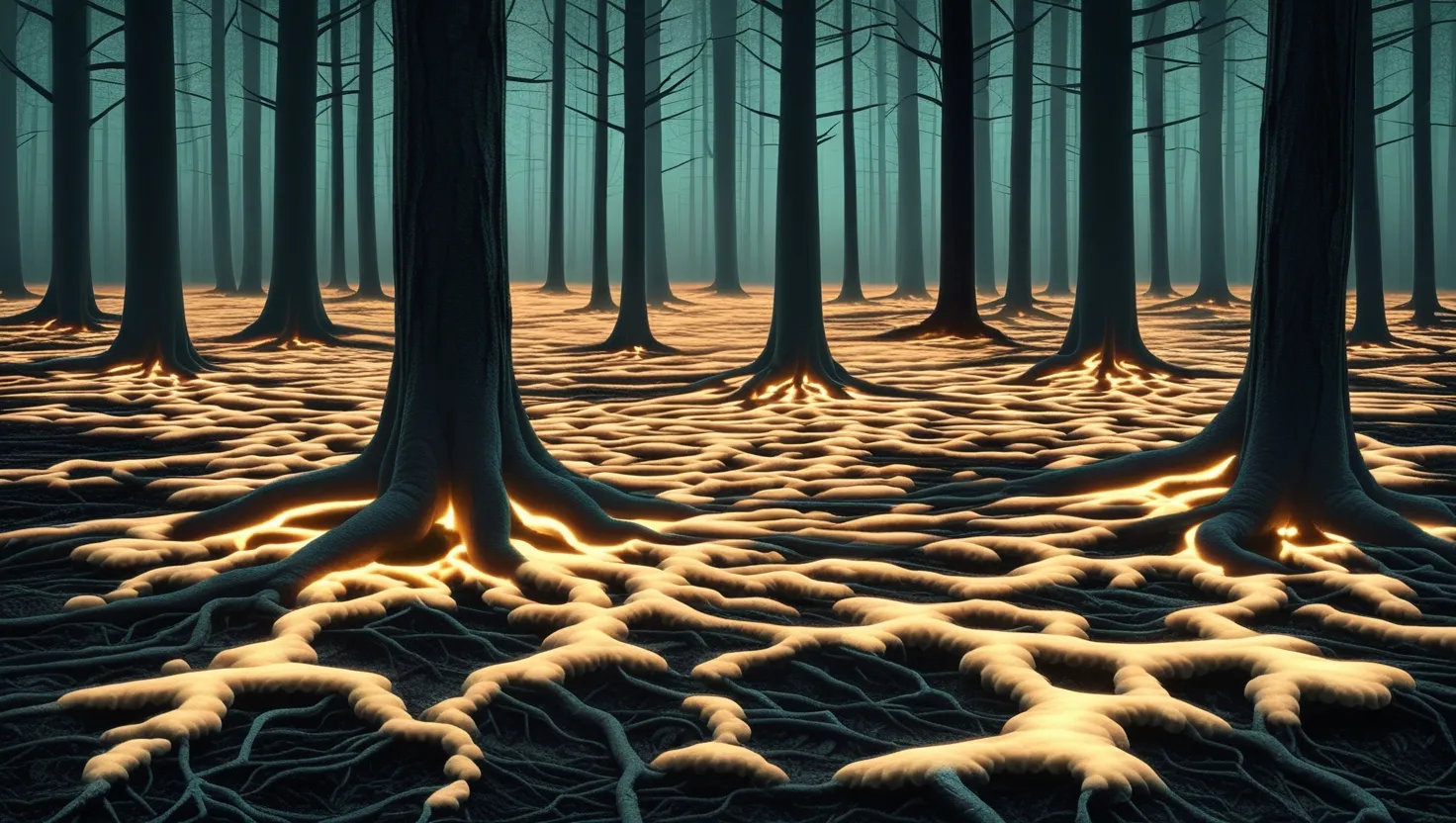
As you walk through a forest, the rustling of leaves and the chirping of birds might be the only sounds you notice, but beneath your feet, a silent and sophisticated communication system is at work. This is the realm of mycelium, the vast underground network of fungal threads that interweave the forest floor. Mycelium is more than just a decomposer of organic matter; it is a complex web that facilitates communication, resource sharing, and even what some scientists describe as a form of intelligence.
Imagine a network that spans acres, connecting trees, plants, and even different species in a symbiotic relationship. This is the “woodwide web,” a term coined by German forester Peter Wohlleben to describe the mycorrhizal network that links trees through fungal mycelium. In this network, trees can share water, nitrogen, carbon, and other essential minerals. For instance, in shady areas where saplings struggle to photosynthesize, they can rely on nutrients sent through the mycorrhizal network from older, taller trees. This mutual support is crucial for the survival and health of the forest ecosystem.
But how does this network communicate? The answer lies in the electrical activity within the mycelium. Recent studies have discovered that fungal mycelium generates electrical signals, including action-potential spikes and trains of spikes, similar to those found in animal and plant nervous systems. These signals are not just random; they are part of a complex internal communication system. For example, when a tree is under stress or attacked by insects, it can send distress signals through the mycelium, alerting neighboring trees to increase their defenses.
This communication is not limited to trees; it involves a wide range of organisms. Mycelium can form relationships with bacteria, insects, and even other fungi, creating a diverse and interconnected community. Paul Stamets, a renowned mycologist, describes mycelium as the “natural Internet” of the earth, highlighting its ability to transmit information using neurotransmitters similar to those in human brains. This network is so sophisticated that it can adapt to its environment, anticipate nutrient availability, and even solve complex problems.
One fascinating example of this problem-solving ability comes from a study involving a fungus-like organism called a slime mold. When placed in a maze with multiple exits, the slime mold initially explored all directions to find food. However, when reintroduced to the same maze, it navigated directly to the exits with rewards, demonstrating a form of cellular intelligence. This ability to learn and remember is not unique to slime molds; other fungi have shown similar capabilities. For instance, a study on wood-decaying mycelium found that the fungi could recognize and respond to different shapes, such as wood blocks arranged in circles or crosses, by adjusting their growth patterns accordingly.
The idea that fungi could be used as computing devices might sound like science fiction, but it is a reality being explored by researchers. Fungal mycelium, particularly from species like the pink oyster mushroom, can resolve computational geometry problems by changing their environmental conditions and using their electrical activity to create computing circuits. This means that the complex signals within the mycelium can be translated into messages, potentially allowing fungi to act as living, environmental sensors on a large scale.
The concept of using fungi as computers raises intriguing questions about the nature of intelligence and cognition. If fungi can solve problems, learn, and communicate, do they possess a form of intelligence? This question challenges our traditional definitions of intelligence, which are often based on human cognitive abilities. The intelligence of mycelium is different but no less remarkable; it is a distributed, networked intelligence that operates on a scale and in a manner entirely foreign to us.
But what if this fungal network is more than just a local communication system? Some scientists speculate that it could be part of a larger, cosmic network. The SERD (Space Element Reduction Duplication) network model, for example, suggests that the structure and information transfer mechanisms in mycelium networks have analogies with the cosmic web and the expanding universe. This model proposes that the emergent properties of mycelium networks could provide clues about the underlying structure of space-time itself.
While these ideas might seem far-fetched, they are grounded in the observation that natural networks often exhibit similar optimization principles, whether in the Internet or in fungal mycelium. The nodes of crossing in mycelium networks, which allow the fungus to regrow and adapt, follow the same mathematical optimization curves as those developed for computer networks. This similarity suggests that there may be universal principles governing network formation and communication, principles that could be applied across different scales and domains.
As we continue to explore the mysteries of mycelium, we are forced to reconsider our place in the natural world. We are not isolated entities; we are part of a vast, interconnected web of life. Every step we take in the forest is a step into this living, thinking supercomputer. The forest floor is not just a passive backdrop for our activities; it is an active participant in the ecosystem, communicating, adapting, and evolving in ways that are both familiar and alien.
The next time you walk through a forest, take a moment to appreciate the hidden world beneath your feet. The mycelium is not just decomposing organic matter; it is a vibrant, pulsing network that underpins the health and resilience of the ecosystem. It is a reminder that intelligence and communication are not exclusive to humans or even animals; they are fundamental aspects of life, manifesting in diverse and often unexpected ways.
In this sense, the forest is not just a collection of trees and plants; it is a complex, interconnected system that challenges our conventional views of intelligence, communication, and even the nature of reality itself. As we delve deeper into the mysteries of mycelium, we may uncover secrets that not only explain how forests “talk” to each other but also reveal new dimensions of the natural world and our place within it.