Is the Moon a Giant Space Station Built by an Ancient Civilization?
The Moon fascinates us with theories of alien origins. Despite scientific evidence of natural formation, it sparks imagination about extraterrestrial life and ancient civilizations. Its mystery continues to captivate humanity's curiosity about the cosmos.
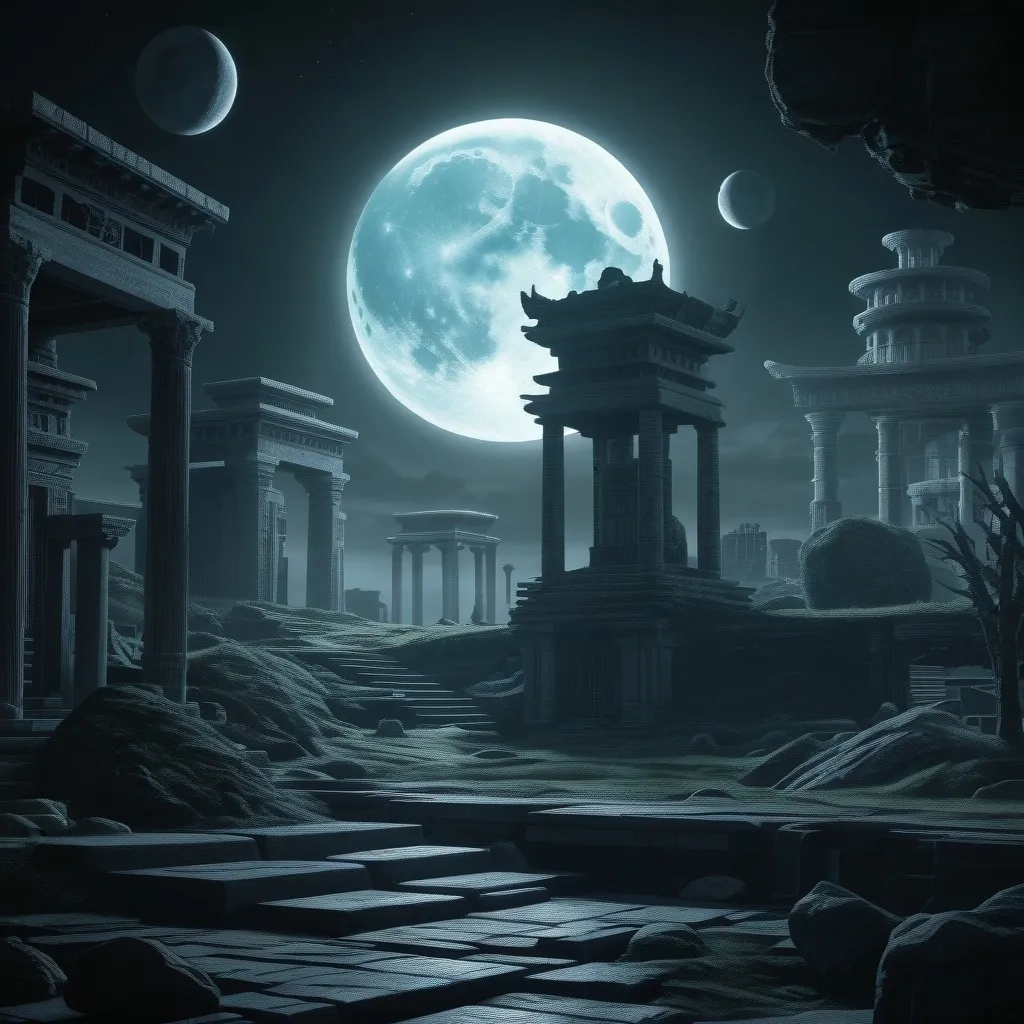
The Moon: A Cosmic Marvel or Ancient Alien Creation?
Have you ever gazed up at the Moon and wondered if there’s more to it than meets the eye? You’re not alone. For decades, people have been captivated by the idea that our celestial neighbor might be more than just a natural satellite. Some even believe it could be a massive space station built by an ancient alien civilization. Sounds crazy, right? Well, let’s dive into this wild theory and see what it’s all about.
Picture this: advanced extraterrestrials visiting Earth thousands of years ago, leaving behind mind-boggling structures like the pyramids of Giza and Stonehenge. It’s a pretty out-there concept, but it’s got people talking. The whole ancient astronaut theory gained serious traction thanks to Erich von Däniken’s book “Chariots of the Gods?” He basically suggested that aliens not only popped by for a visit but also gave our ancestors a helping hand with technology and culture.
Now, here’s where things get really interesting. In the 1970s, a couple of Soviet authors came up with this crazy idea called the “Spaceship Moon” hypothesis. They thought the Moon might be hollow or partially hollow, kind of like a giant artificial structure created by some super-advanced alien civilization. I know, it sounds like something straight out of a sci-fi movie, right?
But here’s the thing – the people who believe in this theory have some pretty interesting arguments. They point out that the Moon’s density is lower than expected, which could mean it’s hollow. They also talk about how the Moon’s composition seems too uniform and how its orbit is a bit odd for a natural satellite. It’s like they’re building a case for the Moon being some kind of cosmic Death Star.
Now, before you start packing your bags for an alien encounter, let’s pump the brakes a bit. As cool as this theory sounds, it’s got some pretty big holes in it (pun intended). Scientists have a much more down-to-earth explanation for how the Moon came to be. They reckon it formed about 4.5 billion years ago when a Mars-sized object called Theia crashed into Earth. The debris from this cosmic fender-bender eventually clumped together to form our Moon.
And you know what? There’s some solid evidence to back this up. When the Apollo astronauts brought back Moon rocks, scientists found that they were similar to Earth rocks in some ways but different in others. This fits with the idea that the Moon formed from a mix of Earth and Theia material.
But let’s play devil’s advocate for a moment. If the Moon really was built by aliens, how the heck did they pull it off? We’re talking about constructing something the size of, well, the Moon! The amount of energy and resources needed would be astronomical (another pun, sorry not sorry). And where did they get all the materials? It’s like trying to build a life-size replica of the Earth in your backyard – possible in theory, but the logistics are mind-boggling.
Plus, if there really were alien structures on or inside the Moon, don’t you think we would have spotted them by now? We’ve sent countless probes and even people to the Moon, and so far, no one’s found any alien construction sites or “Made by ET” labels.
But here’s the thing – even though the science doesn’t back up the “Moon as a space station” theory, it’s still pretty fascinating to think about. It taps into our curiosity about the unknown and our hope that we’re not alone in the universe. And let’s face it, the idea of ancient aliens zipping around the solar system is way cooler than a bunch of rocks smashing together.
In the end, the Moon remains what it’s always been – a natural satellite that’s been our constant companion for billions of years. It’s influenced our tides, our calendars, and even our imaginations. Whether you see it as a simple rock in space or dream of it as an alien megastructure, there’s no denying its impact on our lives and our culture.
So the next time you’re outside on a clear night, take a moment to look up at the Moon. Appreciate its beauty, its mystery, and the way it’s captured human imagination for thousands of years. And who knows? Maybe someday we’ll discover something up there that changes everything we thought we knew. Until then, we’ll keep exploring, keep wondering, and keep dreaming about what might be out there in the vast expanse of space.
After all, isn’t that what makes us human? Our ability to question, to imagine, and to seek out the unknown? Whether it’s ancient aliens or natural phenomena, the universe is full of mysteries waiting to be unraveled. And as long as we keep looking up at the night sky with wonder, we’ll never stop trying to understand our place in this vast cosmic dance.
So, what do you think? Is the Moon just a big rock circling our planet, or could it be something more? Whatever you believe, one thing’s for sure – the Moon will continue to fascinate us for generations to come. And who knows? Maybe one day we’ll build our own Moon-sized space station. Now that would be something to see!