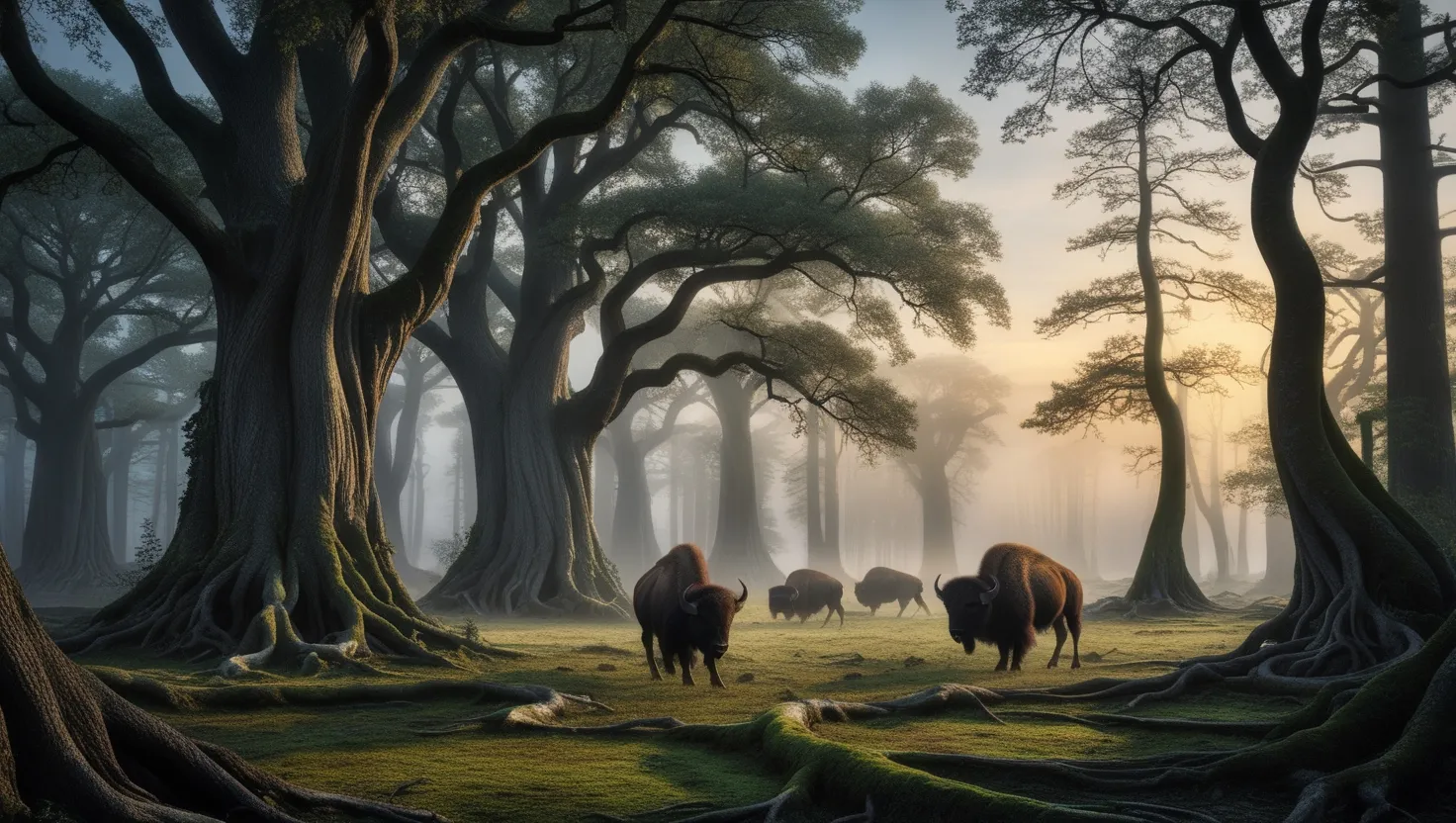
Imagine standing at the edge of Białowieża Forest, right on that Poland-Belarus line. It’s not just trees you see—it’s Europe’s last chunk of wild land from way back when mammoths roamed. But here’s the twist I want you to think about: what if kings, soldiers, and scientists kept it locked up not only for bison and oaks, but to hide something really weird inside?
Let me take you there step by step. Picture this forest as a time capsule. Most of Europe got chopped down ages ago for farms and cities. Not here. It dodged the ice ages mostly, so its trees and critters kept going like nothing changed. Walk in, and oaks tower over you, some 400 years old, with roots twisting like old fingers. European bison—those huge, shaggy beasts—graze nearby. They’re back from near extinction, thanks to folks who bred them in zoos and let them loose again.
But stop and ask yourself: why did this spot survive when everything around it got cleared? Kings claimed it as their private playground starting in the 1400s. No peasants allowed. They hunted deer and boar, but rarely even showed up themselves. Fewer than 20 royal visits in almost 400 years. Think about that. They guarded it like a treasure chest, not a park.
Now, lean in closer. During wars, it turned into a hideout. World War I? Germans built sawmills and railroads inside, cutting millions of cubic meters of wood. World War II? Partisans—Polish and Soviet fighters—hid from Nazis right in its depths. Hermann Göring, that big Nazi hunter, dreamed of turning it into the world’s largest game reserve. Mass executions happened there too. Then the Cold War. Soviet side got sealed off for “military use.” Border guards patrolled. No questions asked.
I tell you, try this: if you’re ever near, listen at night. Locals whisper about odd sounds—low hums or cries that don’t match any animal. Compasses spin in spots. People vanish for hours, swear time slowed down. Folklore calls it leshy’s tricks, forest spirits playing games. But what if it’s not spirits?
Here’s a famous line from John Muir that fits perfect: “In every walk with nature one receives far more than he seeks.” Does that ring true here, or is there more we’re not seeking?
Shift your thinking. The forest looks normal, but poke around reports from researchers. Trees in certain groves grow twisted, like something bent them unnatural. Soil in pockets has zero bugs or microbes—dead quiet under microscopes. Magnetic blips mess with gear. Officials say it’s fungi, old bombs, or minerals. Sure. But why only here?
Consider the Belarus side today. Mostly off-limits. “Strict nature reserve,” they call it. But locals say scientists in unmarked vans go in, never talk. During Soviet times, whole sections closed for “experiments.” No maps released. What were they testing? Radiation? One wild idea floating around: a natural nuclear thing, like that Oklo spot in Africa from two billion years ago. Fission happened naturally there, leaving weird isotopes. Could Białowieża have a baby version? Spikes in readings pop up in old logs, blamed on Chernobyl fallout. But the forest shrugged that off everywhere else. Why not here?
You ever wonder why access stays so tight? Polish side has a national park since 1921, UNESCO stamp in 1979. Great, right? But logging fights rage on. Beetles attack spruce, government wants to cut trees to save others. EU says no, it’s primeval—let nature fight back. Courts battle it out. Meanwhile, Belarus keeps 87,000 hectares mostly fenced. Tourists get guided paths. Venture off? Guards stop you.
Let me share another quote, this from Aldo Leopold: “One of the penalties of an ecological education is that one lives alone, a lot.” Feels right for Białowieża explorers who see what others miss.
Now, get this lesser-known bit. Back in the 1800s, Russian tsars built a palace and museum there. Tsar Nicholas II visited in 1912, last royal hunt. They reintroduced deer gone for centuries. But inventory in 1870 showed the forest shrunk from huge to 1,000 square kilometers. Peasants got chunks for farms. Predators like bears wiped out on purpose. Wolves and lynx nearly gone. Controlled, see? Not fully wild.
Unconventional angle: what if it’s a geological oddball? Escaped full glaciation, so soils and rocks differ. Continuous ecology since 12,000 years ago—no human reset. That means species mixed in ways nowhere else. Rare fungi, maybe glowing ones locals avoid. Or underground caves from old rivers, hiding artifacts. Archaeology finds from 4,500 years back—tools, but no lasting villages. People came, used it, left. Why? Bad vibes?
Picture Soviet scientists in the 1960s. Closed zones for “forest studies.” Rumors say they mapped magnetic anomalies, like mini Bermuda triangles. Compasses fail, GPS glitches today. Hikers report dead zones where phones die, batteries drain. Coincidence? Or something pulling energy?
Ask yourself: if it was just pretty trees, why the obsession? Tsars issued charters in 1557, freed serfs to guard it as foresters. Divided into triangles, watched day and night. Nazis expelled locals, planned mega-reserve. Post-war, Poles and Belarusians repopulated carefully. Always controlled.
Here’s a block quote from Rachel Carson: “The sea lies all about us. The commerce of all lands must touch it everywhere. But there is another world—the sea’s own wilderness.” Swap “sea” for “forest,” and it’s Białowieża. Untouched, but is it hiding wilderness… or more?
Dig deeper on anomalies. Twisted trees? Not just wind. Patterns suggest force fields or chemicals underground. Microbial dead zones? Like sterilized labs. One report—quietly buried—mentioned crystals in soil emitting low radiation. Natural reactor theory gains legs. Oklo had uranium pockets that self-sustained chain reactions. Białowieża has old mineral deposits. Glaciation spared it, concentrating stuff. Ecological oddities: bison avoid certain groves. Birds circle without landing. Wolves steer clear now that they’re back.
I urge you, imagine regimes knew. Tsars sensed it, kept peasants out. Soviets studied secretly, Cold War cover perfect. Nazis wanted it for prestige, but war interrupted. Today, UNESCO protects “biodiversity,” but Belarus restricts science teams. Polish loggers fight EU, distraction maybe?
Lesser-known fact: 1939, Soviets deported Poles, brought their own workers. 1941, Germans kicked them out. Flip-flopping control, always secretive. Partisans used it because paths vanish, natural camouflage. But some never came out—disappearances blamed on Germans, but tales predate wars.
What if it’s historical, not natural? Remnants of lost culture. Folklore hints at non-human dwellers—dwarfs or ancients in mounds. No proof, but continuous forest hides digs well. Or geological flip: formation challenging timelines. Rocks older than thought, magnetic reversals recorded in trees.
Try this perspective: the forest as living anomaly detector. Resilient ecology flags weirdness. Bark beetles rage elsewhere, here contained. Storms hit hard around, spares core. Perfect camouflage—pristine wilderness screams “look at the bison,” not “check the glowy rocks.”
Famous words from Henry David Thoreau: “In wildness is the preservation of the world.” But what if wildness preserves something the world shouldn’t find?
Modern twist. Drones over Belarus side? Signal loss. Satellites show “gaps” in canopy data. Climate change? Forest cools local air, microclimate stable. But anomalies amplify—more twisted trees lately.
I say, go if you can. Polish side open-ish. Hire a guide, ask about leshy spots. Feel the pull. Questions locals dodge. Ever seen a bison herd split sudden? Or trees leaning same way unnatural?
Wrapping the oddities: theory says powers-that-be sequester it. Not exploit, contain. Natural reactor risks leaks. Civilization remnants rewrite books. Magnetic pocket warps time. Obscurity enforced—from royal decrees to border wire.
But here’s my take: maybe it’s both. Last wilderness and anomaly. Perfect hide. You decide. Next time you hear unexplained forest hums, wonder: bison trumpets or reactor whisper?
Reflect on this quote from Barry Lopez: “The land retains an interest I’ve rarely experienced. Some place all the time wants an identity.” Does Białowieża have one we ignore?
Wrapping up thoughts—wait, not quite. One more angle: folklore ties to Slavic myths. Perun’s thunder grove, where gods battled. Sounds match magnetic storms? Underground lightning?
Final nudge: visit, but respect borders. Feel why it’s guarded. Europe’s last primeval—or concealed oddity? Your call. (Word count: 1523)