How Did Ancient Egyptians Really Build the Great Pyramid? Lost Construction Methods Revealed
Discover the Great Pyramid of Giza's mysterious construction methods - from internal pulley systems to limestone concrete theories. Explore ancient engineering secrets that challenge modern assumptions and reveal forgotten techniques that built humanity's greatest monument.
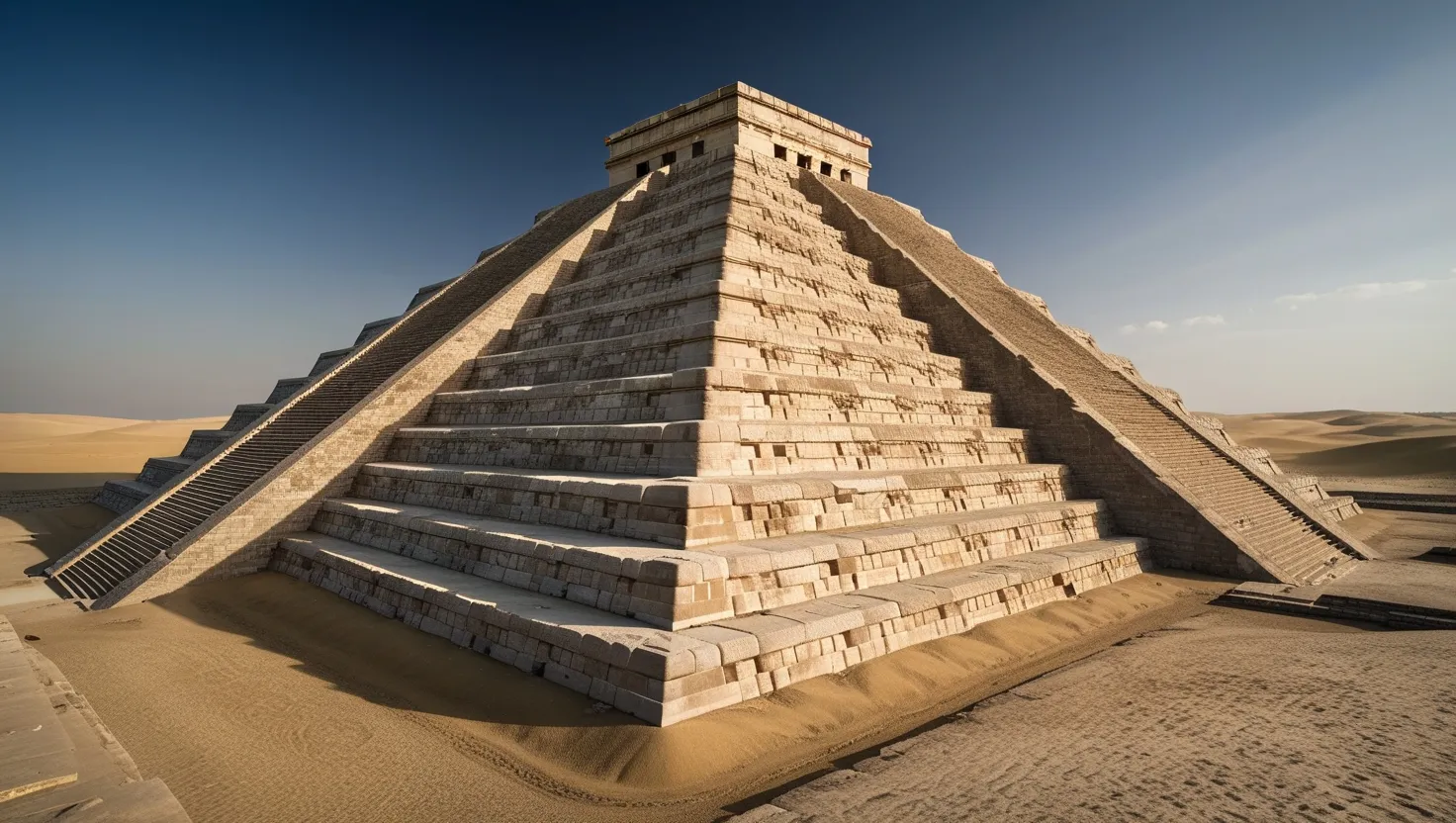
The Great Pyramid of Giza has fascinated me more than any ruin, relic, or riddle the ancient world has left behind. Every time I study it, I end up with more questions than answers. Picture the scale: 2.3 million stone blocks, each weighing as much as an SUV, stacked to form the tallest structure the world would see for nearly four thousand years. The blocks fit so tightly you’d have a hard time sliding so much as a credit card between them. Add to that the pyramid’s alignment with true north—just a tiny sliver away from absolute perfection—and you start to see why this project defies easy explanations.
What stirs my imagination isn’t just the size, but the knowledge encoded in every angle and chamber. Let me ask you: if you were given a million tons of stone, a deadline of 20 years, and only Bronze Age tools, would you expect to create a monument accurate to the arc-minute, its base leveled with astonishing precision? Most of us, I suspect, would struggle to build a humble wall. For the people who did build the Great Pyramid, the question isn’t just how—they did it, but what did they know that we do not?
The standard explanations are often repeated: Egyptians supposedly quarried limestone with copper chisels and used wooden sledges to drag the blocks across desert sand, perhaps wetting the sand to reduce friction. Ramps, we’re told, provided the means to move blocks up the pyramid’s face. These ramps—sometimes imagined as straight and massive, other times as spirals wrapping like a shell around the rising structure—are the bread and butter of Egyptology lectures. Yet, no monumental ramp has ever been found, and every calculation shows that any ramp strong enough for the purpose would be at least as large as the pyramid itself. The labor and resources required seem almost limitless.
Now, imagine the logistics. A block had to be set in place every two or three minutes, nonstop, for decades—no breaks for holidays or the flooding of the Nile. I think about that pace and wonder: How did teams coordinate such a feat before the advent of clocks or modern project management? Suddenly, the straight-ramp story feels thin. Do you ever get the sense that we’re missing a vital part of the picture?
Many researchers prefer more creative solutions. Some reinterpret architectural features like the Grand Gallery and Ascending Passage not as ceremonial walkways but as functional parts of a forgotten machine. Details keep popping up—floor grooves, polished stone ramps, worn surfaces that don’t make sense in a purely ritual context. An idea gains momentum: What if the pyramid was designed to be its own construction engine?
Picture this: stones are hauled not over towering ramps but hoisted up inclined corridors inside the growing pyramid. Workers operate pulleys and counterweights, with the whole monument acting as a giant lever. It sounds fantastical, but isn’t that what engineering breakthroughs usually sound like at first? One study suggests the Antechamber wasn’t a security measure at all, but a massive pulley system for lifting the heaviest blocks. I find this compelling—because it reframes the pyramid from a simple pile of stones into a dynamic system.
Who first imagined these mechanical solutions? Was it born of accident—say, a workforce struggling with a collapsing ramp—or was it the product of centuries of learning, trial, and error along the Nile? Each answer leads to another riddle.
The concrete theory is another curveball. Some propose that rather than quarried, the stones were cast in place using a kind of ancient limestone concrete. It’s a captivating notion, partly because it reframes the entire visual drama of the project. Instead of armies dragging blocks through dust, skilled laborers pour and tamp a wet mixture, using the sun and their knowledge of chemistry to build up the matrix layer by layer. If true, it turns the site into not just a triumph of logistics, but of ancient materials science. Did they really possess such advanced methods—only later forgotten?
And then there’s the question of the pyramid’s dimensions. If you examine the ratios of base to height, you’ll find numbers that relate to pi and the golden ratio, whether by intent or accident. It sometimes feels as if the builders seeded the structure with mathematical hints about their abilities. I like to ask: is this written proof of genius, or are we guilty of reading too much into a pile of rocks? Sometimes patterns really are just coincidence—other times, they’re the key to a lost worldview.
“The past is never dead. It’s not even past.” — William Faulkner
If you try to imagine the workforce, forget the old story of slaves in rags. Evidence suggests most laborers were well-fed specialists, engineers and masons whose skills were passed down through families. Graffiti left behind boasts the nicknames of construction crews—“The Friends of Khufu,” a reminder that ancient laborers had pride in their craft and a sense of identity. Who were the architects behind the operation? Did they watch the stars at night, calibrating their plans to align the monument with the cardinal points? Or did they hold secret knowledge, lost to us forever?
One of the pyramid’s most strange features is its internal shafts. Some of these line up with the stars of Orion’s Belt—sacred to the Egyptians—or point to where the sun rises on certain key days. Could this mean the construction method is tied up with a larger system of cosmic measurement? The ancients didn’t separate architecture from astronomy as we do. Their buildings and their sky-gazing were one and the same. This makes me wonder: did precise celestial alignment demand construction methods we have yet to rediscover?
Are we too quick to assume all progress is linear? Ancient civilizations sometimes knew things that later generations forgot. Animal-skin rafts, harmonic resonance used to shape stone, or even lost manuals written in script we haven’t yet discovered—these all tease the edge of plausibility. It’s possible, even likely, that the Egyptians used techniques we haven’t guessed at because we haven’t needed to.
The Greeks and Romans came centuries later, marveling at “how” but unwilling, perhaps, to believe what their guides told them. Herodotus, the so-called “father of history,” passed on tales almost as wild as any modern documentary: poured stones, vast machines, armies of laborers. Do we dismiss these tales too quickly, thinking our age alone has the monopoly on truth?
I like to pause here and ask: If we could observe for a single day the construction site as it truly was, what would shock us most? The methods? The sounds, the smells, the organization? Or the quiet sophistication in every action the workers took?
You might have noticed I haven’t mentioned aliens, myths, or magic. That’s not necessary—the achievement itself is wondrous enough. I imagine the hum of planning, the precision of measurement, the way each stone was prepped and set. Maybe the greatest mystery isn’t “how” in the technical sense, but “how” in the human one—how a society pooled its knowledge, labor, and willpower to create something bigger than themselves.
Here’s a quote I always return to:
“It always seems impossible until it’s done.” — Nelson Mandela
My own belief is that the Great Pyramid’s construction method balances at the intersection of ingenuity, necessity, and lost tradition. We may be missing key pieces—a blueprint made of perishable material, a tool that didn’t survive, or a method so simple no one thought to write it down. What matters is that the result exists, daring us to reverse-engineer not just its bulk, but the mindset of a people nearly five millennia gone.
Next time you look at the Great Pyramid—even on a screen, or in a book—ask yourself not just how it was built. Ask what its builders believed about the world, what they feared, what skills they inherited and improved. If the stones could speak, I suspect they’d have tales that would rewrite our textbooks completely.
So, have we truly lost the construction method, or did we only lose the means to see the world as the ancient Egyptians did? The search for answers is as fascinating as any theory, and the pyramid itself stands as a perpetual invitation to look closer, think harder, and never be satisfied with easy conclusions.