The Voynich Manuscript: The 600-Year-Old Coded Book No One Can Read
Explore the Voynich Manuscript — the 600-year-old coded book no one can read. Discover its strange history, failed decryptions, and the mystery that still baffles experts.
The Voynich Manuscript
Somewhere in a temperature-controlled vault at Yale University’s Beinecke Rare Book and Manuscript Library sits a book that has made some of the world’s smartest people feel completely stupid. It is small, unassuming, and falling apart at the edges. Its pages are stained with centuries of handling. And not a single person alive — or dead, for that matter — has been able to read it.
This is the Voynich Manuscript. And the more you learn about it, the stranger it gets.
Let me walk you through what we actually know, what we think we know, and what keeps researchers up at night.
What exactly is this thing?
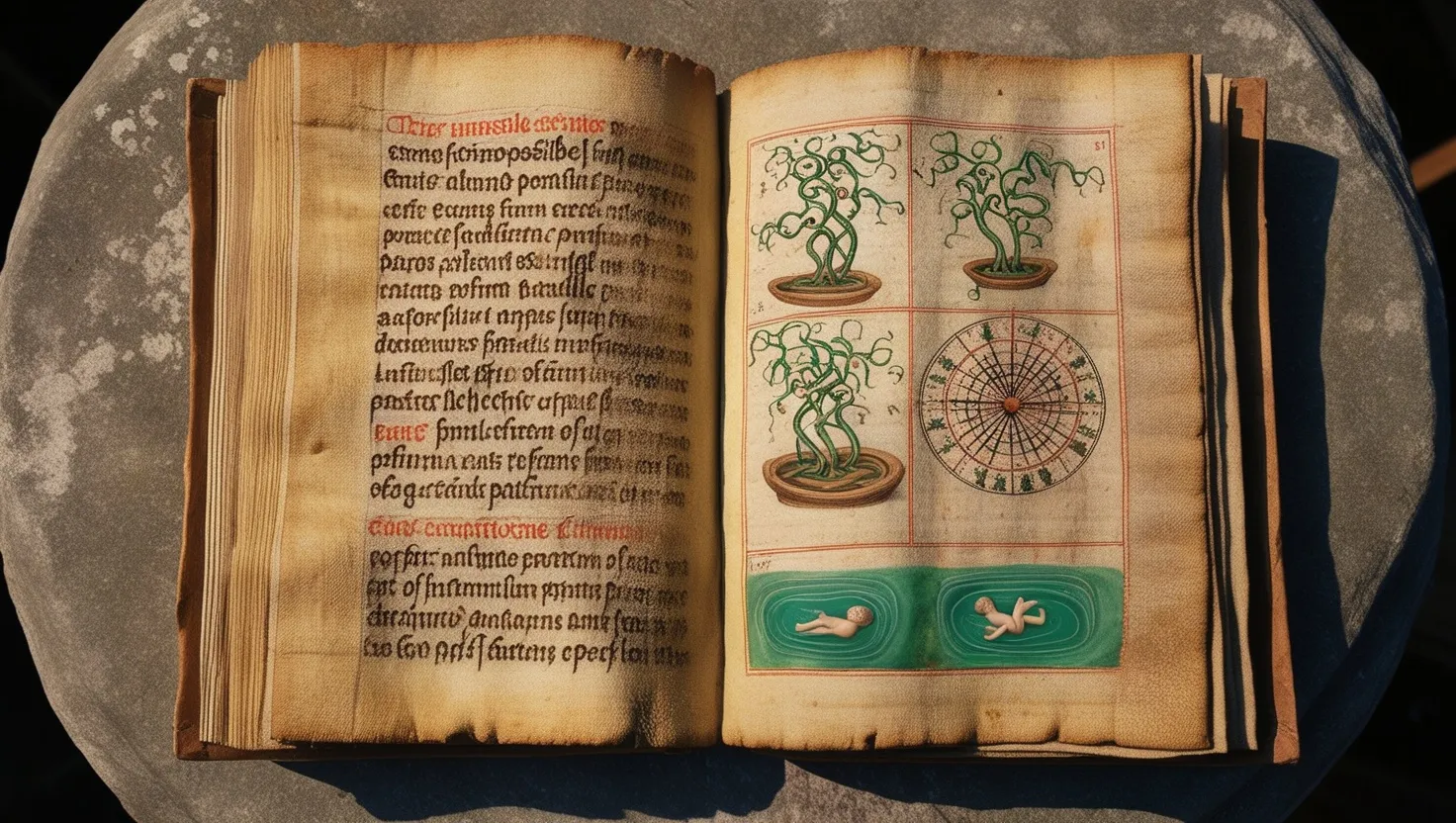
The manuscript is a handwritten book. It contains around 240 pages, though some pages appear to have been removed at some point in history. Every single page is covered in a script that nobody recognizes, arranged neatly in what looks like paragraphs, with margins and spacing that suggest organized thought. It looks like someone sat down and wrote a real book with real intention.
The illustrations are where things get truly strange. There are plants that do not exist anywhere in nature. There are astronomical diagrams with stars arranged in patterns that match no known constellation. There are sections showing dozens of naked women bathing in interconnected pools filled with green liquid. There are zodiac symbols, but they are slightly off — familiar yet wrong in ways that feel deliberate.
Carbon dating places the vellum — the animal skin the book is written on — somewhere between 1404 and 1438. This is not disputed. The materials are genuinely medieval. Whatever this book is, it is old.
“The most beautiful thing we can experience is the mysterious. It is the source of all true art and science.” — Albert Einstein
The book gets its name from Wilfrid Voynich, a Polish book dealer who bought it in 1912 from a Jesuit college in Italy called the Villa Mondragone. He immediately recognized that he had something unusual on his hands. He spent the rest of his life trying to figure out what it was. He failed.
Before Voynich acquired it, the manuscript had a paper trail stretching back to the court of Holy Roman Emperor Rudolf II in the late 1500s. Rudolf was famously obsessed with the occult, alchemy, and strange objects. According to letters found later, he apparently paid the equivalent of 600 gold ducats for the manuscript — a staggering sum that tells you people believed, even then, that this book was worth something.
Here is a question worth sitting with: why would anyone pay that kind of money for a book they could not read?
The cipher problem
Let us talk about the writing itself. Linguists call it “Voynichese.” It has around 25 to 30 distinct characters. They flow from left to right. Words appear with predictable frequency patterns. Certain words cluster in certain sections, which is exactly what you would expect from a real language writing about specific topics. For example, words near the plant illustrations are different from words near the astronomical diagrams.
This is the detail that makes cryptographers go pale. A purely random or made-up script does not behave this way. The internal statistical patterns of Voynichese match those found in real human languages. There is something called Zipf’s Law — a mathematical pattern that real languages follow — and Voynichese follows it perfectly.
So it is not random noise. But nobody can crack it.
During World War II, the US Army’s top codebreakers took a shot at it. These were people who had cracked Nazi military ciphers. They gave up. The NSA has reportedly studied it. Multiple professional cryptographers over multiple decades have announced breakthroughs, only to be disproved by their peers weeks later.
“In the middle of difficulty lies opportunity.” — Albert Einstein
One of the most interesting failed decryptions came from a computer scientist in the 1970s who used early computational analysis on the text. His conclusion was that the manuscript was written in an East Asian language transcribed phonetically into the Voynich alphabet. That theory collapsed upon closer examination. But the methodology he introduced — applying statistical analysis to the text — became the standard approach everyone uses now.
There is also a theory that the manuscript is written in a polyalphabetic cipher, meaning each Voynich character might represent different letters depending on its position in a word. This would have been unusually sophisticated for the 15th century, but not impossible. Leon Battista Alberti invented the polyalphabetic cipher around 1467, right at the edge of the manuscript’s possible creation period.
The hoax argument
Now here is the uncomfortable possibility that serious academics have been forced to consider: what if it is all fake?
The most compelling hoax theory centers on Edward Kelley, a 16th-century con artist and associate of the occult philosopher John Dee. Kelley was known for fabricating angelic alphabets and selling mystical knowledge to wealthy patrons. Rudolf II was exactly the type of buyer Kelley would have targeted. The theory suggests Kelley produced the manuscript, filled it with convincing-looking but meaningless text, and sold it to Rudolf as a book of alchemical secrets.
This theory has real merit. Kelley was demonstrably capable of creating sophisticated fake writing systems. The timing matches the manuscript’s first documented appearance in Rudolf’s court. And Rudolf was, by all historical accounts, exactly gullible enough to fall for it.
But here is what the hoax theory cannot fully explain: the statistical properties of the text. Creating a fake script that perfectly mimics the mathematical patterns of real human language — without modern computers — would have been nearly impossible for a 16th-century forger. Either Kelley was the most sophisticated linguistic fraudster in history, or the text is real.
“The truth is rarely pure and never simple.” — Oscar Wilde
The Vatican connection
This is where the story gets political.
The manuscript spent considerable time in Rome. Athanasius Kircher, a Jesuit scholar in the 17th century who was arguably the most famous intellectual in Europe at the time, corresponded extensively with people trying to get him to crack the code. He was sent the manuscript or a copy of its pages. He apparently studied it seriously and then went quiet on the subject.
Kircher was not a man who admitted defeat easily. He had “deciphered” Egyptian hieroglyphics — incorrectly, as it turned out, but confidently. His silence on the Voynich Manuscript is conspicuous.
The manuscript later ended up stored at the Jesuit college where Voynich bought it. Some researchers believe the Vatican has documents that could explain the manuscript’s origin or meaning, but those archives remain largely inaccessible to outside scholars. Whether this is institutional caution or deliberate concealment depends entirely on how suspicious you feel about large religious institutions and their libraries.
Do you think powerful institutions sit on inconvenient historical knowledge? The Voynich Manuscript might be the most documented case where that question actually matters.
What the plants might tell us
The botanical illustrations deserve far more attention than they usually get. Of the roughly 113 plant drawings in the manuscript, none match any known species exactly. But some of them are close — close enough that botanists have spent decades playing “spot the almost-match.”
One particularly interesting observation is that several of the plants resemble species native to Central America or the Caribbean. If accurate, this would place the manuscript’s origins after 1492, contradicting the carbon dating of the vellum. One possible explanation is that the vellum was old when the book was written — a recycled material — and the actual composition happened later than we assume.
This would also explain one of the other strange details: some of the nude female figures have features that some anthropologists describe as non-European. Subtle things — body proportions, hairstyles — that do not quite fit medieval European artistic conventions.
“All truths are easy to understand once they are discovered; the point is to discover them.” — Galileo Galilei
Where things stand right now
In 2019, a British academic announced he had cracked the code. He claimed the language was a form of proto-Romance language — an early ancestor of modern French or Italian. His translation produced a text about women’s health and herbal medicine, which would fit the illustrations. Within months, other linguists had pulled his methodology apart and the decipherment was rejected by the broader academic community.
The manuscript remains unread.
What makes the Voynich Manuscript genuinely different from other historical mysteries is the sheer volume of serious intellectual effort that has been applied to it without result. This is not a mystery that has been ignored. It has been examined with medieval scholarship, modern cryptography, computational linguistics, botanical analysis, art history, and carbon dating. Every tool we have has been thrown at it.
And it still just sits there, in its climate-controlled vault, keeping whatever it knows entirely to itself.
Maybe it is a hoax that worked better than anyone intended. Maybe it is a real text in a language that simply no longer exists. Maybe the answer is something nobody has thought of yet.
What I find most interesting is this: the Voynich Manuscript forces us to confront the limits of human knowledge. There is something genuinely uncomfortable about a book we cannot read. We live in an age where information is everywhere, where translation happens instantly, where nothing feels truly unknowable. And then there is this small, battered medieval book that looks at all of that confidence and says nothing at all.
That silence is the most eloquent thing about it.